
Giant clam
Tridacna gigas
A slow, still giant resting on the reef, its mantle glowing with colour. A giant clam stays where it is, and seeing one is never guaranteed.
Critically Endangered (IUCN, 2024) means it faces an extremely high risk of extinction in the wild. Large adults have been heavily harvested.


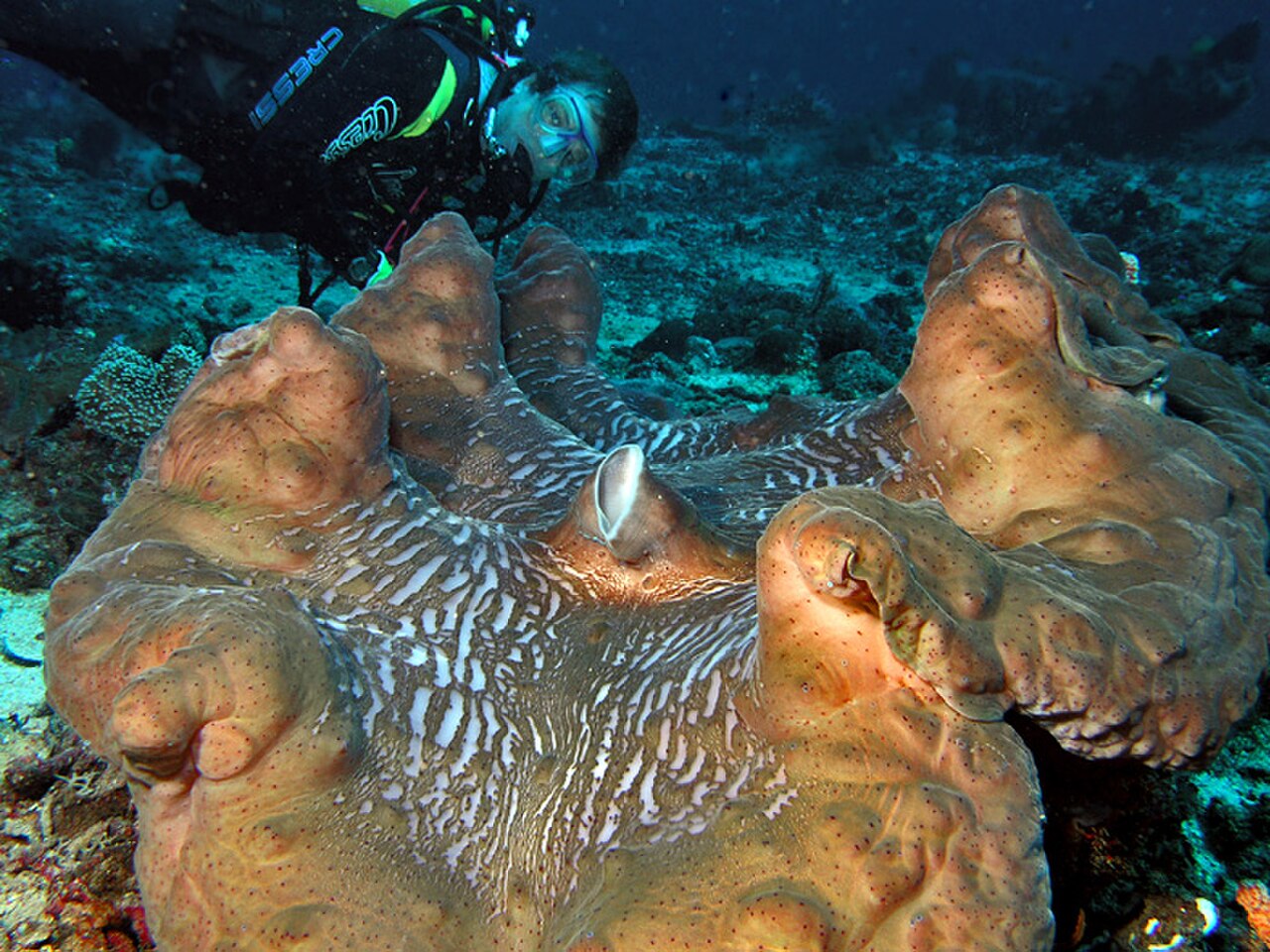

Photos show the species, not always the places on this page.
Length
Up to about 137 cm (4 ft 6 in) shell length for the largest known specimen; most are smaller
Weight
The largest verified specimen weighed about 230 kg (510 lb) dead, estimated at 250 kg (550 lb) alive. A 1956 find was reported at 333 kg (734 lb) dead. SeaLifeBase lists 500 kg (1,100 lb) as a published maximum, so sources differ
Next to a person
The longest are a little shorter than an adult is tall, and a big one can weigh as much as three or four adults
What it eats
Mostly sunlight. Algae living in its tissues supply roughly 65 to 70 percent of its food, and it also filters plankton from the water through a siphon. Young clams rely more on filter feeding than large ones do.
Around people
Calm, look only
How it lives
It settles on shallow tropical reef, reported at 0 to 35 m, and stays fixed in place for life. Each clam is both male and female. Adults spawn into the water, and one can release more than 500 million eggs at a time. Reported lifespan in the wild is more than 100 years.
Where it goes
Adult giant clams do not move. They attach to the reef as juveniles and stay there. Young clams drift as larvae in the plankton before they settle.
We only draw a journey on the map when scientists have tracked it or clearly documented it. For this animal we have not found one yet.
Populations
Found across the Indo-Pacific, from Myanmar east to Wallis and Futuna, north to Japan and south to western Australia. The IUCN lists it as Critically Endangered (assessed 2024). It is thought to have disappeared from some areas, for example peninsular Malaysia. Large adults are the ones most harvested. Older sources list it as Vulnerable. It is on CITES Appendix II. I did not find a population count for Tokelau, Samoa or Vanuatu.
Meet it respectfully
Float above and look, without touching. Never sit on, stand on or pry at a clam, and never take a shell. A clam cannot move away, so give it space and keep fins and hands clear of the shell edge and the mantle. Giant clams are overharvested for food, shells and the aquarium trade, so a quiet visit helps. Ask your guide about local rules for the site.
Fun fact
Tap the bulb to light it up.
It is the largest living mollusc, and the biggest shell on record is about 137 cm long.
Algae in its tissues make much of its food from sunlight, and the clam gives them shelter in return.
There is no verified record of a giant clam killing a person. The shell closes too slowly to trap a swimmer.
Giant clam in the Ocean Atlas
Places we have researched where this animal is recorded. It is never guaranteed, and some places are for watching from the boat only.
Travel with usComing soonTrusted referralExploringOn pause, story onlyEthics pass
Country colour: pink where we travel, blue where we are exploring or refer, grey for story only.
 Australia
 Fiji
Fiji Indonesia
 Marshall Islands
 New Caledonia
 Palau
Palau Papua New Guinea
 Philippines
 Samoa
Samoa Solomon Islands
 Tokelau
 Vanuatu
Sources for this page
- Wikipedia, Giant clam, 2026
- Wikipedia, Tridacna gigas, 2026
- SeaLifeBase, Tridacna gigas, 2026
- National Geographic, Giant clam
Facts checked 5 October 2026. Photos: Unsplash licence, or Creative Commons as shown on each photo.
Work in ocean travel?
We are always happy to hear from exceptional local operators, accommodation, conservation organisations and destination experts. If your work fits responsible, small-group ocean travel, we would love to learn more.
Partner with Ocean Calling