
Golden jellyfish
Mastigias papua etpisoni and other Mastigias
In Palau's Jellyfish Lake, golden jellies follow the sun across the surface. We snorkel gently, give them space and never touch.
Not Evaluated means IUCN has never assessed the golden jellyfish. In Palau, Jellyfish Lake is protected by local rules instead.
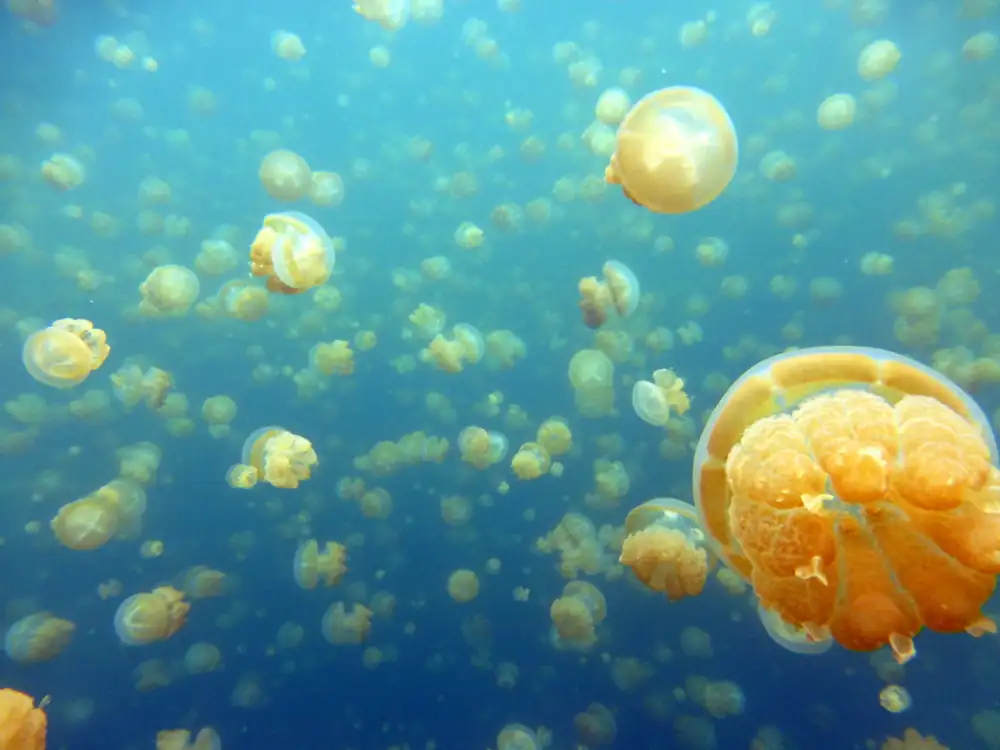
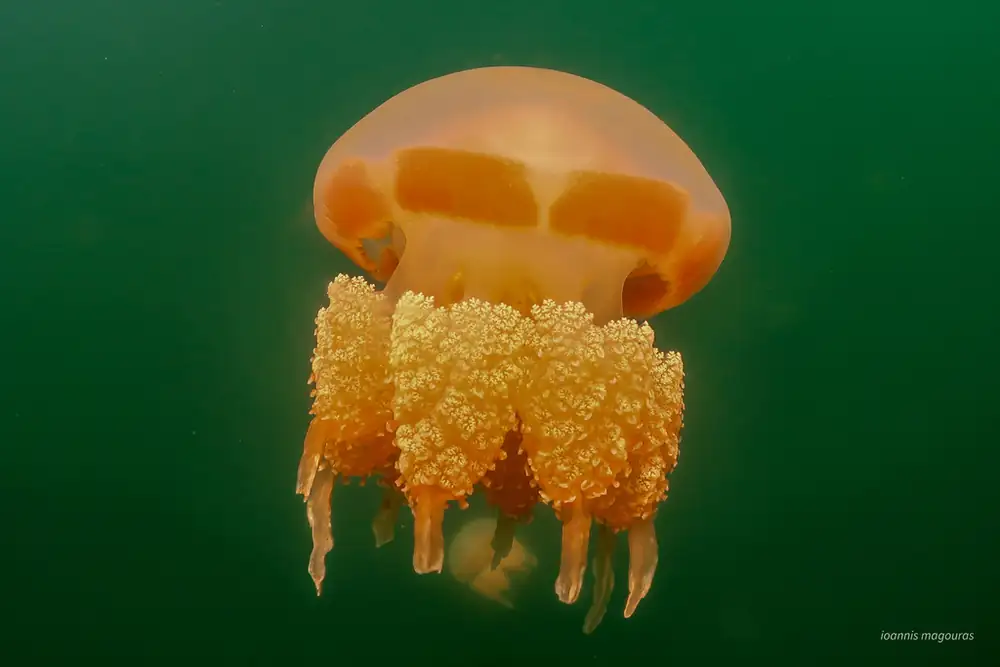
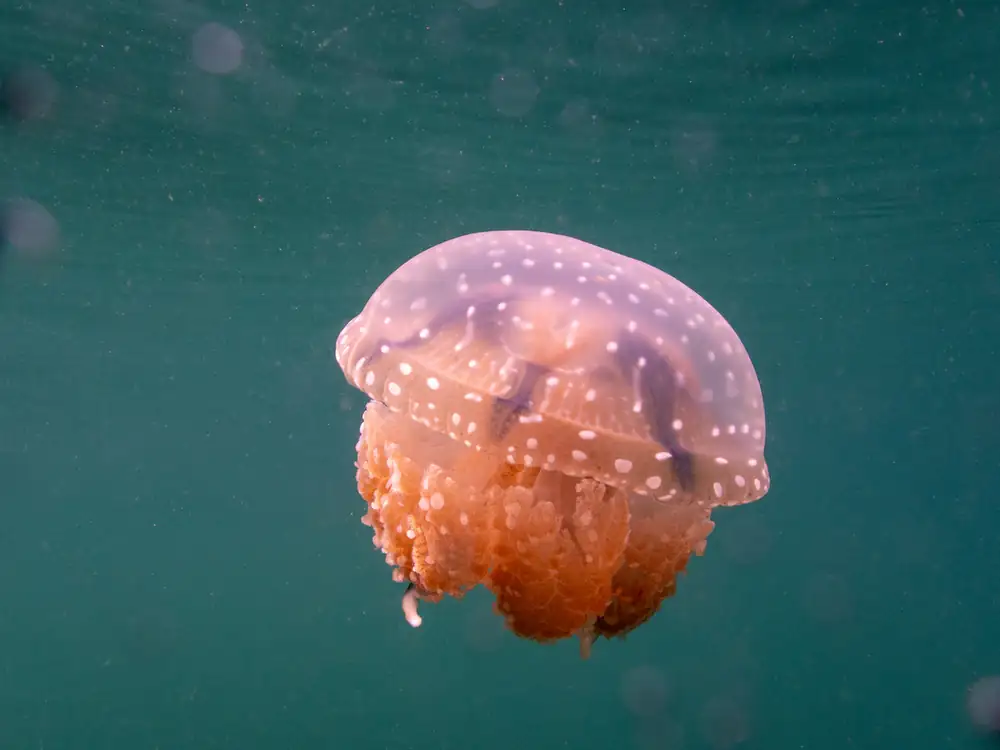
Photos show the species, not always the places on this page.
Length
In Jellyfish Lake, large adults usually have a bell about 18 to 20 cm (7 to 8 in) across; the largest recorded about 23 cm (9 in)
Weight
Not reliably measured
Next to a person
Bell about the size of a hand to a small dinner plate
What it eats
Tiny animal plankton caught with stinging cells, plus food made from sunlight by algae living in its body.
Around people
Calm, give space
How it lives
Golden jellyfish live in marine lakes, bodies of seawater surrounded by land. The golden jelly of Jellyfish Lake (Ongeim'l Tketau) in Palau, Mastigias papua etpisoni, is found only in that one lake, and algae in its tissue make food from sunlight, so the jellies swim toward the sun. They still have stinging cells; the sting is often too mild to feel, but it can tingle on sensitive skin. Golden jellies in Indonesian marine lakes, such as Kakaban Lake and lakes in Raja Ampat, belong to different lineages, and scientists are still working out how many species there are.
Where it goes
Not a migrant, but a daily traveller. On sunny mornings the jellies in Jellyfish Lake swim east toward the sun and stop at the shadow line of the trees, then turn west after midday. On cloudy days they spread out through the lake. Their route shifts toward the south edge from October to March and toward the north edge from May to August.
We only draw a journey on the map when scientists have tracked it or clearly documented it. For this animal we have not found one yet.
Populations
Jellyfish Lake usually holds millions of golden jellies, often about 5 million. When the lake gets too warm they stop reproducing, and after strong El Niño droughts they almost vanished in 1998 to 1999 and again in 2016, when the last one was seen in May 2016. Tiny polyps survived, and numbers came back to millions by 2019. In 2022 warm water brought them down to about 34,000, so numbers and lake access change from year to year.
Meet it respectfully
In Palau, visiting Jellyfish Lake needs a Koror State permit, and rules and fees can change, so check before you go. It is snorkel only, because the deep water holds poisonous hydrogen sulfide. Empty your pockets, bring nothing in or out of the lake, and use only allowed reef-safe sunscreen at least 30 minutes before you swim. Stay at the surface, move slowly without kicking, and never touch or lift the jellies; a mild sting does not make touching safe. The lake is sometimes closed or has few jellies.
Fun fact
Tap the bulb to light it up.
The five golden jelly subspecies of Palau's lakes were named after Palau's first five elected presidents.
Jellyfish Lake is the only one of Palau's jellyfish lakes open to visitors.
Palau banned reef-toxic sunscreens from 1 January 2020, after sunscreen chemicals were found in Jellyfish Lake.
It is a myth that the golden jellies of Jellyfish Lake cannot sting. They have stinging cells and use them to catch tiny plankton, but the sting is very mild.
Source: Coral Reef Research Foundation, Jellyfish Lake (updated Feb 2026)
A sea anemone that lives only in the lake, Entacmaea medusivora, eats golden jellies. Following the sun keeps the jellies away from the shady edges where it waits.
Source: Coral Reef Research Foundation, Jellyfish Lake (updated Feb 2026)
In 2005 a scientist described five golden jellyfish subspecies from five different marine lakes in Palau, each lake with its own.
Source: Dawson, 2005, Journal of the Marine Biological Association of the UK
Lake golden jellies did not come from one ancestor. Ocean jellies moved into marine lakes and changed in a similar way several separate times.
Source: Swift, Gómez Daglio & Dawson, 2016, Molecular Phylogenetics and Evolution
A 2017 study found chemical sunscreen ingredients in the water of Jellyfish Lake and in the golden jellies. On 1 January 2020 Palau became the first country to ban reef-toxic sunscreens.
Source: Pristine Paradise Palau (Palau Visitors Authority), Environmental initiatives
In Kakaban Lake, Indonesia, golden jellies have fewer and smaller stinging cells than their relatives in the sea outside the lake.
Source: Nurasmi et al., 2021, Journal of Tropical Life Science
Golden jellyfish in the Ocean Atlas
Places we have researched where this animal is recorded. It is never guaranteed, and some places are for watching from the boat only.
Travel with usComing soonTrusted referralExploringOn pause, story onlyEthics pass
Country colour: pink where we travel, blue where we are exploring or refer, grey for story only.
 Indonesia
 Japan
Japan Palau
Palau Philippines
Read more about the golden jellyfish
Sources for this page
- Coral Reef Research Foundation, Jellyfish Lake (updated Feb 2026)
- Coral Reef Research Foundation, Jellyfish Lake Conditions and Forecast (Sep 2026)
- Koror State Government via Pristine Paradise Palau, Current State of the Golden Jellyfish, 2022
- Pristine Paradise Palau, Visiting Jellyfish Lake in Palau, 2026
- Dawson, 2005, Journal of the Marine Biological Association of the UK
- Swift, Gómez Daglio & Dawson, 2016, Molecular Phylogenetics and Evolution
- Souza & Dawson, 2018, Zootaxa
- Republic of Palau, RPPL 10-30, Responsible Tourism Education Act, 2018
Facts checked 26 September 2026. Photos: Unsplash licence, or Creative Commons as shown on each photo.
Work in ocean travel?
We are always happy to hear from exceptional local operators, accommodation, conservation organisations and destination experts. If your work fits responsible, small-group ocean travel, we would love to learn more.
Partner with Ocean CallingNew: tiger sharks in Fuvahmulah, January or March 2027
from CHF 2,900