
Swinhoe's storm-petrel
Hydrobates monorhis
A small dark seabird skimming the waves far from land. Swinhoe's storm-petrels are hard to find, and no sighting is ever a promise.
Near Threatened (IUCN) means it is close to qualifying as threatened. It was moved up from Least Concern in 2012, because a moderate decline is expected, mainly from introduced species at its colonies.

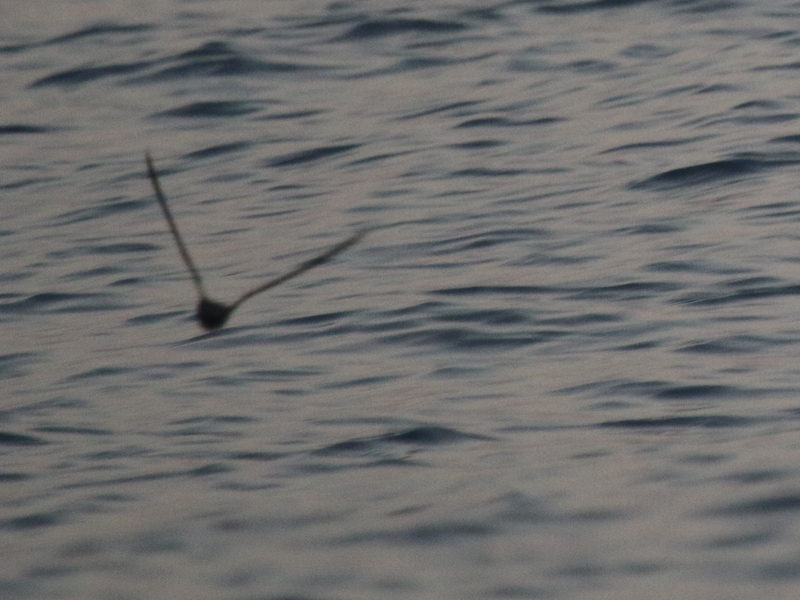
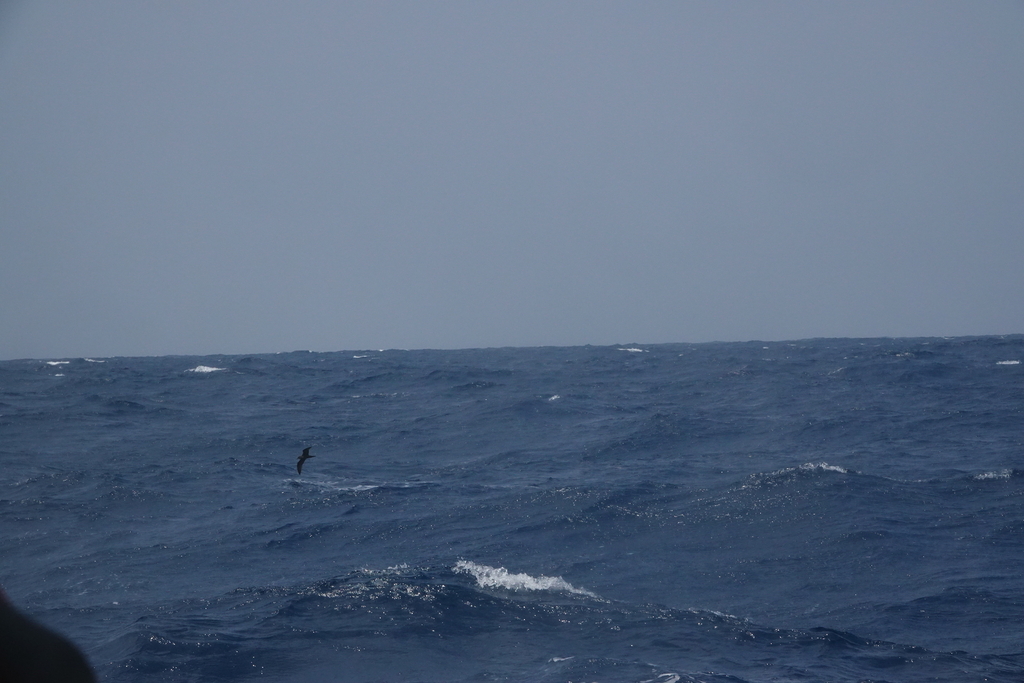
Photos show the species, not always the places on this page.
Length
About 18 to 21 cm (7.1 to 8.3 in) long, with a wingspan of about 45 to 48 cm (18 to 19 in)
Weight
About 38 to 43 g (1.3 to 1.5 oz), from one regional source. Other sources did not give a weight.
Next to a person
About as long as an adult's hand, and about as heavy as a golf ball.
What it eats
Plankton and other small prey picked from the surface while flying. One source lists shrimps and a type of anchovy. In Madeira one bird fed at a chum slick set out for other storm-petrels.
Around people
Distant, watch quietly
How it lives
It breeds in burrows on small islands in the Yellow Sea and South China Sea region. It is strictly nocturnal at the colonies, to avoid gulls and skuas, and it avoids landing on bright moonlit nights. Males give harsh chatter calls, while females give clear, bright ones, which is unusual among petrels. Outside the breeding season it lives at sea.
Where it goes
After breeding in the northwest Pacific, it is strictly a bird of the open sea and winters in the northern Indian Ocean, including the Arabian Sea. Four birds fitted with geolocators were tracked about 6,700 km between their breeding and wintering areas, and the whole seasonal journey was over 12,000 km. A small number turn up in the Atlantic and Mediterranean as rare visitors, so records in places such as Portugal or the UK are exceptions.
We only draw a journey on the map when scientists have tracked it or clearly documented it. For this animal we have not found one yet.
Populations
Near Threatened worldwide. The IUCN moved it up from Least Concern in 2012, because a moderate decline is expected, mainly from introduced species at colonies. A 2010 estimate (Sato et al.) gave at least 130,000 breeding pairs, and about 100,000 pairs may nest on one small islet in South Korea (Gugeul), which would be over 75% of the world population. Other colonies are far smaller: about 7,500 pairs on Verkhovsky Island (Russia), at least 1,000 pairs in Japan, and about 7,900 pairs on Chilbaldo (South Korea). There is anecdotal evidence that some colonies are declining. No breeding colony has been confirmed in the Atlantic.
Meet it respectfully
Most sightings are brief and distant, from a boat at sea. Keep the boat steady and at a distance, and never chase the birds. Do not use chum, bait or lights to draw them in. Never land on or enter a nesting island without a permitted guide, because introduced predators and disturbance are the main threats. I did not read local rules for this species, so follow your guide and local rules.
Fun fact
Tap the bulb to light it up.
About 100,000 pairs may nest on a single small islet, which is most of the world population.
Four tracked birds flew about 6,700 km from their breeding area to the Arabian Sea.
Females give clear chatter calls and males give harsh ones, the reverse of what is usual in petrels.
Swinhoe's storm-petrel in the Ocean Atlas
Places we have researched where this animal is recorded. It is never guaranteed, and some places are for watching from the boat only.
Travel with usComing soonTrusted referralExploringOn pause, story onlyEthics pass
Country colour: pink where we travel, blue where we are exploring or refer, grey for story only.
 Australia
 China
 India
 Indonesia
 Israel
 Japan
 Malaysia
 Mexico
 Oman
 Portugal
 Singapore
 South Korea
 Sri Lanka
 Taiwan
 United Arab Emirates
 United Kingdom
Sources for this page
- GBIF, IUCN category, 2026
- Wikipedia, Swinhoe's storm petrel, 2026
- Nakahara et al., 2025, Bird Conservation International
- Madeira Birds, 2026
- The Sound Approach, 2026
Facts checked 5 October 2026. Photos: Unsplash licence, or Creative Commons as shown on each photo.
Work in ocean travel?
We are always happy to hear from exceptional local operators, accommodation, conservation organisations and destination experts. If your work fits responsible, small-group ocean travel, we would love to learn more.
Partner with Ocean CallingSwim with humpback whales in Moʻorea, September 2027
from CHF 4,500