
Thornback ray
Raja clavata
A patient ray of sand and mud that is often half buried. No sighting is ever a promise.
Near Threatened (IUCN, assessed 2023) means the species is close to qualifying for a threatened category, mainly because fishing can deplete it and it recovers slowly.
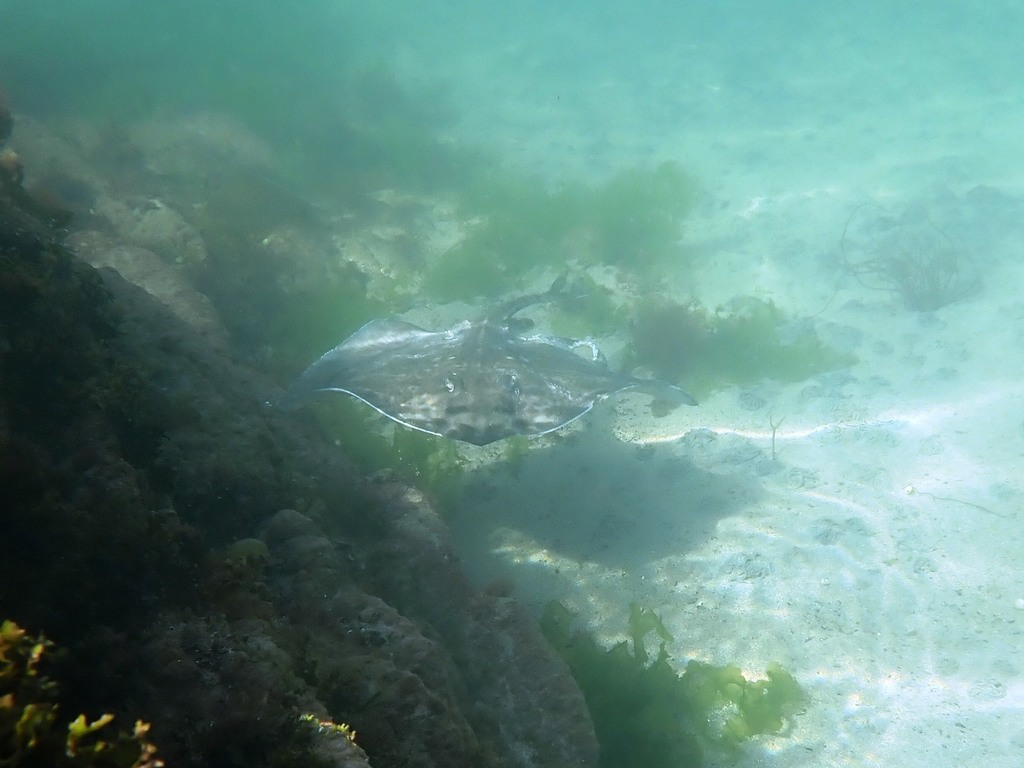
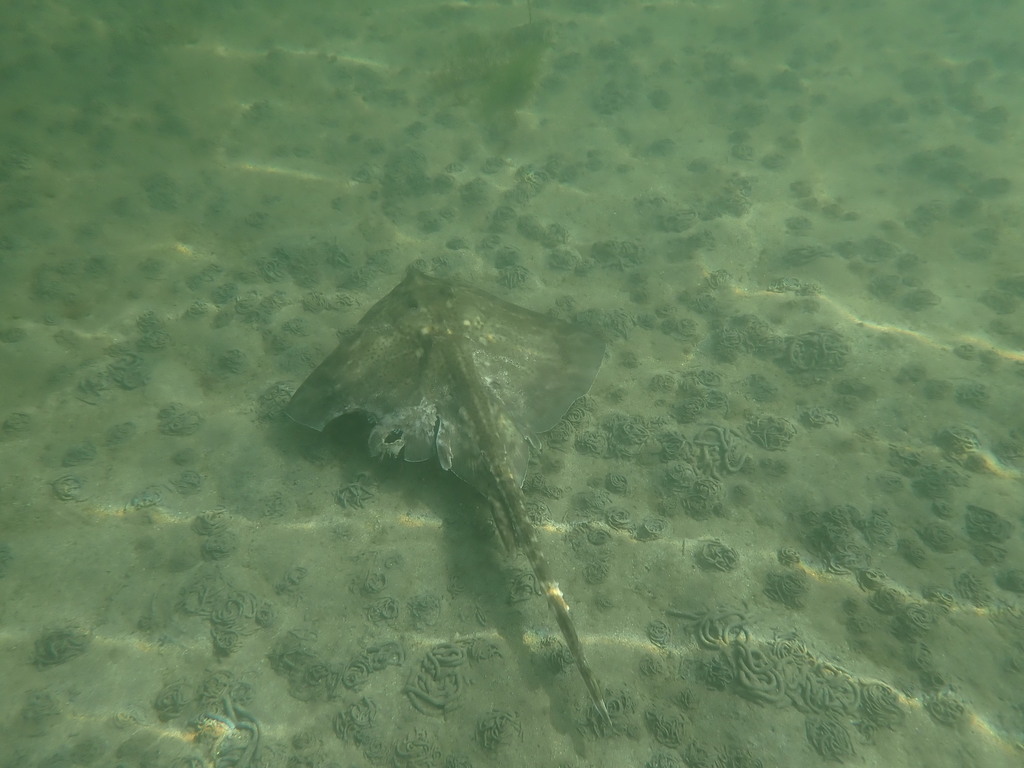
Photos show the species, not always the places on this page.
Length
Up to about 139 cm (4.6 ft) total length for females and 105 cm (41 in) for males. A common size is about 85 cm (33 in) (FishBase). Most are under 85 cm (Wikipedia)
Weight
Up to about 18 kg (40 lb) (FishBase). Typical adults are lighter, around 2 to 4 kg (4.4 to 8.8 lb) according to Wikipedia
Next to a person
A typical adult is about half the height of a person, and the largest females reach about four fifths of it
What it eats
Bottom-living crustaceans and fish. Young rays eat small crustaceans such as amphipods and shrimps, and adults take crabs, shrimps and small fish (Wikipedia). Its small, strong jaws crush shells (Wildlife Trusts). In the Azores, sand shrimps were the most frequent food.
Around people
Calm, give space
How it lives
Found on mud, sand and gravel from the shallows to about 1,020 m (3,350 ft), and most commonly at 10 to 60 m (33 to 197 ft) (FishBase). It buries itself in sediment by day and hunts at dusk (Wildlife Trusts). It lays eggs, usually about 60 to 140 egg cases a year and up to 170, with each capsule 5 to 9 cm long. Mating runs from February to September and peaks in June. Eggs hatch after about 4 to 5 months, and the pups are about 11 to 13 cm long. Maturity comes at about 6 to 8 years, and ages of at least 15 to 17 years have been recorded (FishBase, OSPAR).
Where it goes
It does not travel far. Of the thornbacks recaptured off Ireland, 79 percent were within 10 km of where they were tagged. In the Azores, 92 percent were recaptured within 40 km. Young rays stay inshore, and adults move seasonally to breed in spring and summer (Fisheries Ireland).
We only draw a journey on the map when scientists have tracked it or clearly documented it. For this animal we have not found one yet.
Populations
Worldwide: Near Threatened on the IUCN Red List (assessed in 2023, FishBase). OSPAR has listed it as threatened or declining since 2008, but its latest assessment finds biomass increasing in OSPAR regions II and III. It is stable to increasing in region IV and stable at a low level in region V. Recovery from depletion is slow. In Irish waters the population appears to be growing, and a study in the Azores called the stock relatively healthy (catch fell from 171 t in 2015 to 70 t in 2017). In the Solway Firth it has been heavily fished (Wikipedia).
Meet it respectfully
Watch from a distance and let the ray rest. The thorns on its back and tail make handling a bad idea for you and for it. Never chase, touch, lift, feed or bait it, and keep fins off the seabed around it. Follow your guide and local rules. No sighting is ever a promise.
Fun fact
Tap the bulb to light it up.
Thorns cover its back and tail, and older females also have them on the underside (Wikipedia).
By day it buries itself in sediment and comes out at dusk to hunt.
A single female can lay up to 170 egg cases in a year, with an average of about 48 to 74.
Thornback ray in the Ocean Atlas
Places we have researched where this animal is recorded. It is never guaranteed, and some places are for watching from the boat only.
Travel with usComing soonTrusted referralExploringOn pause, story onlyEthics pass
Country colour: pink where we travel, blue where we are exploring or refer, grey for story only.
 Belgium
 Croatia
 Denmark
 France
 Germany
 Ireland
 Israel
 Italy
Italy Malta
Malta Namibia
 Netherlands
 Norway
 Portugal
 Spain
Spain Sweden
 United Kingdom
Sources for this page
- FishBase, Raja clavata
- Wikipedia, Thornback ray
- The Wildlife Trusts, Thornback ray
- Fisheries Ireland, Thornback ray
- OSPAR, Thornback ray assessment
- PMC, Thornback ray biology in the Azores, 2021
- GBIF, IUCN category lookup, 2026
Facts checked 5 October 2026. Photos: Unsplash licence, or Creative Commons as shown on each photo.
Work in ocean travel?
We are always happy to hear from exceptional local operators, accommodation, conservation organisations and destination experts. If your work fits responsible, small-group ocean travel, we would love to learn more.
Partner with Ocean CallingSwim with humpback whales in Moʻorea, September 2027
from CHF 4,500