
Three-spot seahorse
Hippocampus trimaculatus
A slow, well camouflaged seahorse of sandy and muddy shallows. No sighting is ever a promise, and in Hong Kong it is very hard to find.
Endangered (IUCN, 2026) means it faces a very high risk of extinction in the wild. The 2012 assessment rated it Vulnerable.
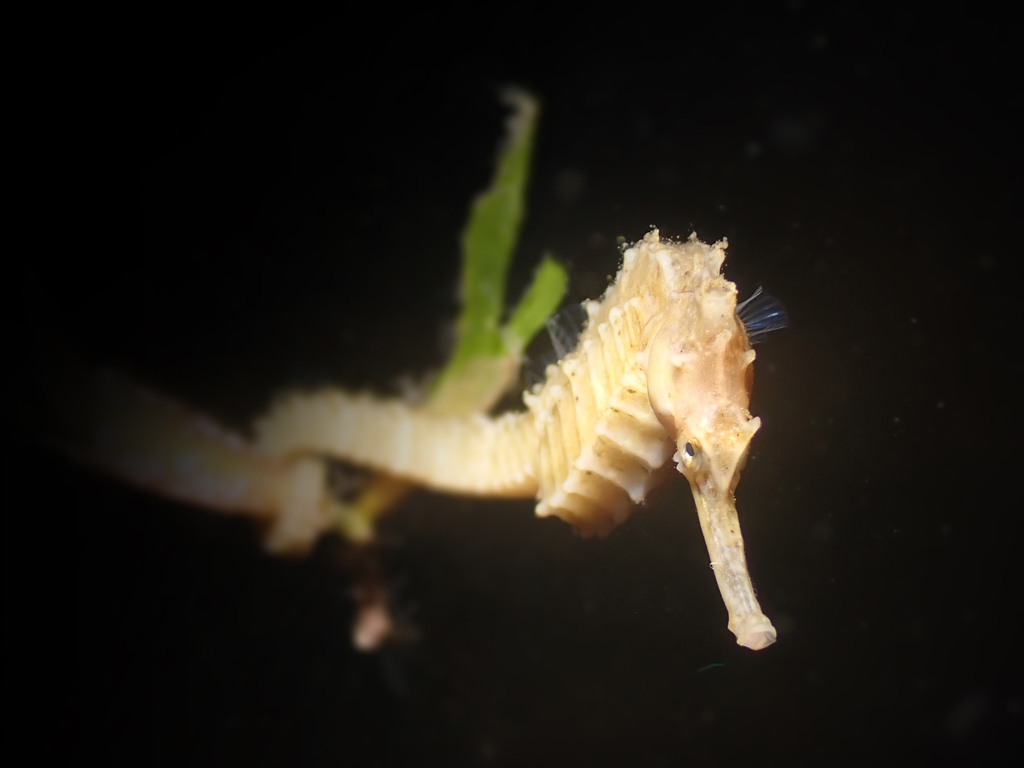
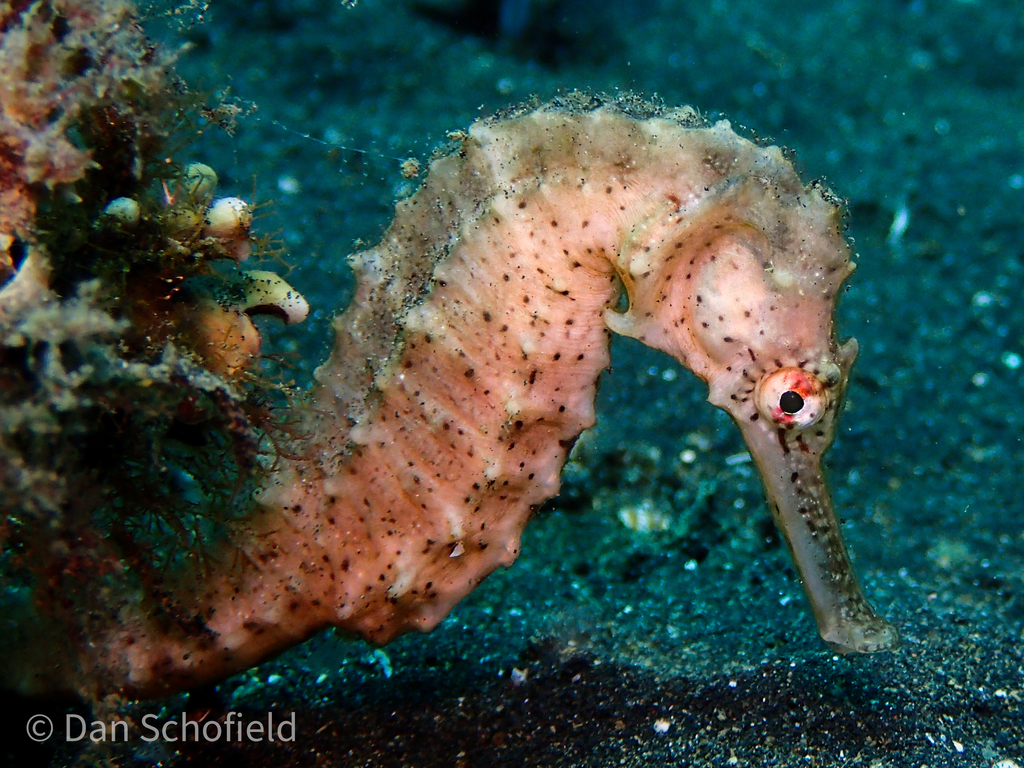
Photos show the species, not always the places on this page.
Length
Up to about 22 cm (8.7 in) total length (FishBase); one source says a seahorse of this species is mature at about 14 cm (5.5 in), another says before 10 cm (3.9 in), so sources differ
Weight
No weight is given in the sources checked; a seahorse of this size is very light
Next to a person
About the length of an adult hand, so far smaller than most fish people expect to see on a dive
What it eats
Plankton and small crustaceans, sucked in through the snout. It often anchors itself to seagrass while feeding. FishBase gives it a trophic level of 3.8, which fits a small-animal eater.
Around people
Calm, hands off
How it lives
It lives on gravel or sand bottoms around shallow reefs, in muddy estuaries and near mangroves, and it tolerates brackish water. FishBase gives a depth of 0 to 100 m, usually 0 to 20 m. It occurs singly or in pairs. As in all seahorses, the male carries the eggs in a brood pouch under the tail. Gestation is about 11 to 20 days, depending on water temperature, and breeding peaks around March to May in Chinese waters. Colour varies a lot, from golden orange or sandy to black, and some animals are striped.
Where it goes
Adults seem to stay in shallow coastal water, singly or in pairs, and no long migration is described in the sources checked. Young seahorses have been seen drifting just below the surface in open water in the Malacca Strait, which is one way the species can spread.
We only draw a journey on the map when scientists have tracked it or clearly documented it. For this animal we have not found one yet.
Populations
Endangered on the IUCN Red List in the 2026 assessment, up from Vulnerable in the 2012 assessment, and listed in CITES Appendix II. The range runs from India to Japan, the Philippines, Indonesia, Australia and French Polynesia. Threats named include habitat loss, bycatch in shrimp trawls on sandy and muddy bottoms, and a large trade for traditional medicine, souvenirs and pets. In Hong Kong, the Ocean Park Conservation Foundation lists it as one of three seahorse species recorded in local waters, but its 2011 to 2012 survey of 31 sites found only six seahorses, all of them yellow seahorses.
Meet it respectfully
Look, do not touch. A seahorse holds on with its tail and can be hurt by hands, gloves or a camera lens pushed close. Move slowly, stay above the bottom so you do not kick up silt, and never lift or move one to improve a photo. Do not chase it and do not use bait or food. If you do see one in Hong Kong, the Ocean Park Conservation Foundation asks divers to report sightings with a photo, location, depth and time.
Fun fact
Tap the bulb to light it up.
The male, not the female, carries the eggs in a pouch under his tail, and the young are born after about 11 to 20 days.
Colour is not a reliable clue. It can be golden orange, sandy or black, and some animals show brown and white zebra-like stripes.
Young seahorses of this species have been seen drifting just below the surface in open water in the Malacca Strait.
Three-spot seahorse in the Ocean Atlas
Places we have researched where this animal is recorded. It is never guaranteed, and some places are for watching from the boat only.
Travel with usComing soonTrusted referralExploringOn pause, story onlyEthics pass
Country colour: pink where we travel, blue where we are exploring or refer, grey for story only.
 Australia
 China
China Hong Kong
 India
India Indonesia
 Japan
Japan Malaysia
 Philippines
 Taiwan
 Thailand
 Vietnam
Sources for this page
- FishBase, 2026
- Wikipedia, Flat-faced seahorse, 2026
- IUCN Seahorse, Pipefish & Seadragon Specialist Group, 2026
- GBIF Backbone Taxonomy, 2026
- OPCFHK, Seahorse in Hong Kong, 2026
- OPCFHK, Seahorse survey results, 2013
- Project Seahorse, 2019
- Wong & Teh, Check List, 2017
Facts checked 5 October 2026. Photos: Unsplash licence, or Creative Commons as shown on each photo.
Work in ocean travel?
We are always happy to hear from exceptional local operators, accommodation, conservation organisations and destination experts. If your work fits responsible, small-group ocean travel, we would love to learn more.
Partner with Ocean Calling