
How to Snorkel Without Damaging Coral
You float face down, the reef is right there, and a fish you love slips under a ledge. You lean a little, your legs sink, and a fin brushes something hard. That is how most reef damage happens: not on purpose, just without noticing. So how do you snorkel without damaging coral? Read the water before you jump, float flat with your fins high, never stand or rest on the reef, and give it more space than you think you need.
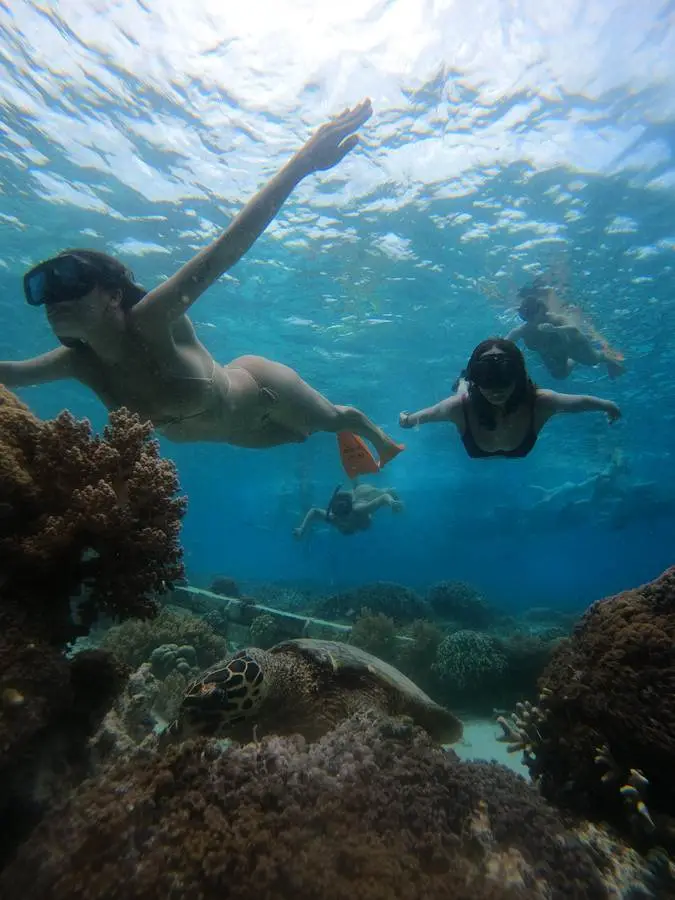
How to snorkel without damaging coral: the short answer
The honest answer is simple, and a little humbling. Most contact with coral is accidental. People do not kick the reef because they do not care. They kick it because a current moved them, because their legs dropped while they looked at something, or because they stood up for a second to fix a mask.
So the skill is less about good intentions and more about body awareness. Before you get in, you read the current and the depth. In the water, you stay horizontal, keep your fins up and away from the reef, and use your hands only for balance in open water, never on the bottom. When you need a pause, you roll onto your back or float upright in deep water, or you go back to the boat. NOAA's reef etiquette for the Florida Keys says the same: do not stand or rest on coral, and if you need to fix your equipment, lie on your back, float, or return to the boat.
Below, I explain why each of these small habits matters, and what a new study says about how badly we judge our own contact with the reef.
We touch the reef more than we think
In July 2026, researchers from the University of Sydney and Bangor University published a study in Conservation Letters. The team followed more than 700 recreational scuba divers at busy dive spots in the Philippines and Indonesia, including Bali. For 411 of them, they logged every contact with the reef: 4,981 contacts in total, about one every four minutes.
Around 41% of those contacts caused visible harm, like broken coral or sediment settling on living coral. More than 80% of the damaging contacts were accidental or not noticed by the diver. And the part that stayed with me: when the researchers compared the divers' own answers with what they had filmed, the divers underestimated how often they touched the reef by almost five times. The divers who touched the reef most were often the most confident that they had not.
Two more details are useful for snorkellers too. When one diver in a group touched the reef, the people around them became more likely to do the same. And cameras, gloves and pointer sticks were linked with more contact. This study was on scuba divers, not snorkellers, so I do not want to stretch the numbers. But the lesson travels well: our sense of control in the water is often better than our real control.
Read the current before you choose where to enter
Current decides where your body goes when you stop paying attention. Before you get in, look at the surface. Watch which way floating things, bubbles or other snorkellers are drifting. Then ask the crew or your guide what the water is doing today, not what it usually does at this site.
If the current runs toward a shallow coral head, enter so that it carries you along the reef, not onto it. Stay where the water is deep enough under you. NOAA's guidance asks snorkellers to keep a comfortable distance from the reef and to avoid shallow areas, which is exactly where a small push from the current turns into a fin on the coral.
If you feel yourself drifting toward the reef, the instinct is to kick harder. Often the better move is to stop kicking, lift your legs, and use a gentle sculling movement with your hands at your sides to steer away. Hard kicking close to the reef is how sand gets stirred up and how fins make contact.
Your eyes are not reliable underwater
A flat mask changes how you see. Because light bends when it passes from water into the air inside your mask, objects look larger and closer than they really are, commonly quoted as about a third larger and a quarter closer. The exact effect depends on the geometry, so take those numbers as approximate.
In practice this means two things. First, your sense of distance in the first minutes of a swim is not quite right, so give the reef extra space until you have adjusted. Second, a fish or a coral that looks almost within reach is a little further away than it seems, which is one more reason to keep your hands to yourself. Ask your guide about the depth of the site, so you do not need to guess.
Float flat, fins high, hands still
Good snorkelling posture is boring to describe and lovely to feel. Your body lies almost horizontal at the surface, your fins stay just under the surface, and you kick slowly from the hips with long, relaxed legs. When you look down at something interesting, the danger is that your hips drop and your legs swing down like a pendulum. Notice that moment, and lift your legs again before you lean in.
A well-fitting low-volume mask and snorkel helps here, simply because a mask that does not leak or fog means fewer stops and less fiddling over the reef. For new snorkellers, NOAA suggests a snorkel vest for extra flotation, and it specifically advises against pool noodles, because they can drift away and become marine debris.
A long-sleeved rash guard is also worth packing. It protects your skin from the sun for long floats, and it means you need less sunscreen on your back and arms in the first place.
Why touching coral matters, for the reef and for you
Coral looks like rock, but the living surface is a thin layer of animals. NOAA explains that even a small brush with hands or fins can damage these delicate coral animals, and that stray fins can stir up sand that smothers them. It works the other way too: some corals sting or cut, so contact can hurt you as well.
The same rule applies to the animals living on the reef. Do not touch, feed, chase or handle them. NOAA notes that this kind of interaction can stress animals and disrupt feeding and mating, and it can even provoke aggressive behaviour. A turtle that changes direction because of you has already paid a small price for your photo.
If you are on a boat trip, the reef can also be hurt before anyone gets wet, by an anchor dropped in the wrong place. We wrote about that in boat and anchor etiquette for snorkellers.
Does sunscreen, or a crowd, change what happens to the reef?
Sunscreen is part of this conversation, and the rules vary by place. Hawaii's Act 104, signed in 2018, made it illegal from 1 January 2021 to sell sunscreens containing oxybenzone or octinoxate in the state without a prescription. Other places have their own rules or none at all, so check the current rule before you travel. If you use sunscreen, a mineral sunscreen without those two filters is one option, applied well before you get in so less of it washes off straight away. Our reef-safe sunscreen guide looks at what the labels do and do not promise.
Crowds matter as well. The 2026 study found that contact spreads within groups, which is one reason small groups and calm briefings help. On our hosted retreats we keep groups to six guests at most, we work with vetted local operators, and anyone can skip an activity if the conditions or their energy are not right that day.
And one more honest thing: flying to a reef has an environmental cost that no careful fin kick can undo. That does not mean nobody should go. It means that when we go, we should go slowly, stay longer, and leave as little trace as we can in the water itself.
A simple checklist for your next reef day
Before you enter: listen to the briefing, ask about current and depth, check that your mask fits, and decide where you will enter so the current carries you along the reef. In the water: stay flat, keep your fins high, kick slowly, and look up every few minutes to see where you are. When you need a rest: roll onto your back in deep water or go back to the boat. Never stand on the reef, even for a second.
If you are just starting, our first-time snorkelling guide covers the basics before the reef. And if you would like calm, well-briefed reef days with a small group, you can look at our upcoming retreats.
Questions people ask
Is it ever OK to stand on coral?
No. NOAA's reef etiquette is clear: do not stand or rest on coral. If you need to adjust your equipment, lie on your back, float upright in deep water, or return to the boat.
Why do I touch the reef without noticing?
Most contact is accidental. A 2026 study of scuba divers in the Philippines and Indonesia found that more than 80% of damaging contacts were unintentional or unnoticed, and divers underestimated their contact by almost five times.
Does touching coral really harm it?
Yes. NOAA explains that even a minor brush with hands or fins can damage delicate coral animals, and stray fins can stir up sand that smothers them. Some corals can also sting or cut you.
Should beginners use a pool noodle?
NOAA suggests a snorkel vest for novice snorkellers and advises against pool noodles, because they can drift away and become marine debris.
Which sunscreens are banned in Hawaii?
Under Act 104 (2018), from 1 January 2021 it has been illegal to sell sunscreen containing oxybenzone or octinoxate in Hawaii without a prescription. Rules change, so check the current rule before you travel.
Do cameras make reef contact more likely?
In the 2026 study, cameras, gloves and pointer sticks were associated with more frequent reef contact. If you bring a camera, keep your body flat and your distance first, and the photo second.
Wildlife encounters are unpredictable and never forced. Ocean Calling works only with vetted, ethical local operators, and every animal is free to approach, or not, entirely on its own terms.
Sources & further reading
- NOAA Florida Keys National Marine Sanctuary. Reef etiquette.
- NOAA Coral Reef Conservation Program, 2015. Coral reef etiquette.
- State of Hawaii, 2018. Session Laws, Act 104 (sunscreens containing oxybenzone or octinoxate).
- Bangor University, 2026. Research reveals hidden damage caused to coral reefs by scuba divers.
- Roche, R. and Lin, B., Bangor University / The Conversation, 2026. Scuba divers underestimate how much damage they do to coral reefs.
- Earth.com, 2026. Divers damage coral reefs far more often than they realize.
- Wikipedia. Diving mask (optics of flat-window masks).
Further reading on Ocean Calling: More from the journal · Ethical dive operator guide · Gili Islands diving comparison · Wildlife & the law · See the retreats · Ocean Atlas
Find the retreat that fits you
Small groups of up to six guests, unhurried days and local experts. Tell us how you feel in the water and we will point you to the right trip.