
Gili Trawangan vs Meno vs Air: diving compared
From the boat, the three Gili Islands look like triplets. Underwater, they are three different characters. Here is how their currents, reefs and protection compare, and which island suits which kind of diver.
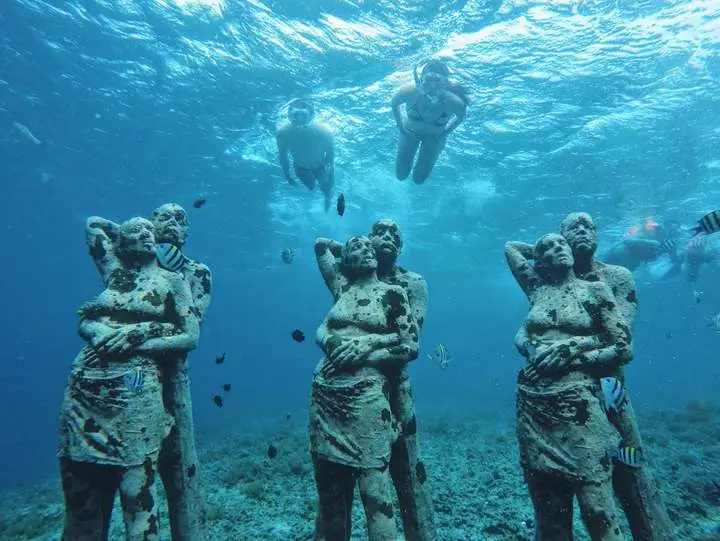
Sit on a boat between the three Gili Islands off Lombok, Indonesia, and they look almost the same: white sand, a low line of trees, turquoise shallows. Put your face in the water and the story changes. Only a short boat hop separates Gili Trawangan, Gili Meno and Gili Air, yet each one has its own current, its own reef and its own kind of dive day.
So, the quick answer. Choose Trawangan for livelier diving with more current. Choose Meno for calm, slow days. Choose Air for a balanced base, especially if your group has mixed levels.
One thing they share: all three sit inside the same protected area. That is worth understanding before you pick an island, because it shapes how you should dive anywhere here.
One protected area, three islands
The waters around the three islands were first named a recreation park in 1993, by a decree of Indonesia's Ministry of Forestry. A provincial conservation document gives the park as roughly 2,954 hectares: about 340 hectares for Gili Trawangan, 175 for Gili Air, 150 for Gili Meno, and around 2,289 hectares of sea. Today it is managed as a national marine protected area, known as Gili Matra, under decrees of Indonesia's Ministry of Marine Affairs and Fisheries from 2009 and 2022, with a zoning and management plan.
A protected area on paper is not the same as a healthy reef in the water. Zoning, patrols and the daily choices of dive centres and visitors all matter. Rules such as mooring and fees can change, so check the current rules with your dive centre before you travel.
Gili Trawangan: the liveliest diving, and the strongest current
Gili Trawangan, or "Gili T", is the largest and busiest of the three, and local dive operators describe its sites as the most current-exposed of the group. Current brings nutrients and moving water, which can mean more fish activity and, on some days, reef sharks or larger animals passing by. Those sightings are never guaranteed and depend completely on conditions.
The trade-off is the current itself. Several of the better-known sites suit divers who are comfortable drift diving, not someone on their first open-water dives. We wrote more about this in our guide to currents and marine life around Gili and Lombok.
Gili Trawangan is also where the Gili Eco Trust, a local conservation organisation, started its Biorock project in 2004. Biorock structures are steel frames carrying a very low electrical current. Minerals build up on the frame, and corals can be attached and grow there. Sources cite around 150 Biorock reefs around Gili Trawangan.
The trust and its partners report that corals on powered Biorock reefs bleached more slowly during the severe 2016 bleaching event and recovered faster than nearby natural reef. Some partner material goes further and says only the Biorock reefs survived. We want to be honest: these claims come mainly from the trust and the organisations that promote the technology. We did not find independent, peer-reviewed monitoring that confirms them, so we treat them as reported claims, not established findings.
Gili Meno: the quiet middle island, made for slow dives
Gili Meno sits between the other two and is the quietest. Many operators use its shallower, more sheltered sites for relaxed dives: sandy patches full of small life, seagrass close to shore where turtles may graze, and easier water for underwater photography. Its underwater statues, in the photo above, are one of the best-known snorkel spots in the Gilis. Our piece on the science and meaning of the Gili Meno statues goes deeper.
Gili Meno is also known for small turtle hatcheries, and here we are careful. Accounts describe young turtles kept in small pools for months before release, and visitors paying to release a turtle. A 2024 travel report, quoting a sea turtle protection worker, raised concerns about hatchlings in pools, visitors handling baby turtles, and explanations that did not match good conservation practice.
That is a secondhand account, not a formal assessment. It is still enough for us. We do not recommend handling hatchlings or paying for a release. Meeting a wild turtle on the reef, at a distance, on its own terms, is the better story.
Gili Air: the balanced option, and an easy base
Gili Air is the closest of the three to Lombok and sits in the middle in most ways: busier than Meno, calmer than Trawangan, with a mix of easy sites and some more current-exposed spots further out. Many dive centres there focus on beginner and intermediate training. For a group with mixed experience, or a trip that wants one base instead of island-hopping, it is often the most practical choice.
Because Gili Air is close to Lombok and busy with boats, it is also a good place to watch how a dive centre handles the basics: briefings, mooring, group size, and how guides react when a turtle is surrounded by people.
Why who you dive with matters as much as where
This is the conservation layer of the comparison. Tourism in the Gilis has grown fast, and Indonesian reporting on Gili Matra has described damaged coral and plastic waste piling up. Protection depends on people following the rules every single day: mooring instead of anchoring on coral, good buoyancy, no touching, no standing on reef, no feeding fish.
When you choose an operator, ask how they moor, how many divers they put with one guide, and what they do when a turtle is surrounded by snorkellers. Small, calm groups do less damage than big ones. A mineral reef-safe sunscreen for the boat, and a rash guard so you need less of it, are easy ways to bring less into the water. Our guide to snorkelling responsibly with Gili turtles has more practical detail.
Which Gili island fits your diving style?
The honest answer depends less on which island is "best" and more on what you want from your days in the water. Livelier, current-fed diving and you are happy in a drift? Gili Trawangan. Calm water, slow subjects and a quieter island? Gili Meno. A balanced, well-taught base for a mixed group? Gili Air. None of them is more "authentic" than the others, and they are close enough that a longer trip can include all three.
The wildlife mentioned here, turtles and reef sharks, is never guaranteed, and the local teams we work with never chase, touch or bait it. If this made you curious, you can look at our Gili Trawangan referral trip, where we match you with a vetted local team and you book with them directly.
Questions people ask
Which Gili island is best for beginner divers?
Gili Meno and Gili Air are usually the gentler choices for beginners, with more sheltered sites and many training-focused dive centres. Gili Trawangan's better-known sites have more current and suit divers who are comfortable drift diving.
Are the Gili Islands a marine protected area?
Yes. The waters were first named a recreation park in 1993 and are now managed as the Gili Matra national marine protected area, with zoning and a management plan. Check current rules and fees locally before you travel.
What is Biorock?
Steel frames with a low electrical current that help minerals and corals grow. The Gili Eco Trust started its Biorock project in 2004, and sources cite around 150 structures around Gili Trawangan.
Did Biorock reefs survive the 2016 bleaching better?
The trust and its partners report that they bleached more slowly and recovered faster. We did not find independent peer-reviewed monitoring confirming this, so treat it as a claim.
Should I visit a turtle hatchery on Gili Meno?
We do not recommend handling hatchlings or paying to release turtles. Reports describe young turtles kept in pools for months, and a 2024 account raised concerns about handling and practices. Watching wild turtles at a distance is kinder.
Wildlife encounters are never guaranteed and never forced. Ocean Calling works only with vetted, ethical local operators, and every animal is free to approach, or not, entirely on its own terms.
Sources & further reading
- Gili Matra Marine Natural Recreation Park (park description and area). West Nusa Tenggara conservation office, hosted by Global Coral Reef Alliance, n.d.
- Gili Matra Conservation Become the Focus of the 19th Islands of the World Conference Excursion. Universitas Mataram, 2024.
- Biorock. Gili Eco Trust, accessed 2026.
- Biorock reefs bounce back after coral bleaching, Gili Trawangan. Global Coral Reef Alliance, accessed 2026.
- Indonesia: Gili Trawangan Biorock projects. Biorock Indonesia, accessed 2026.
- Liputan Gili Matra: ancaman pariwisata massal terhadap lingkungan Gili Matra (bagian 1). Mongabay Indonesia, 2016.
- Gili Meno Guide: What to Do, Snorkeling Spots and Travel Tips (turtle sanctuary concerns). Backindo, 2024.
- Gili ostrovy: želví farma (turtle hatchery description). Cestujlevne.com, accessed 2026.
Further reading on Ocean Calling: More from the journal · Wildlife & the law · See the retreats · Ocean Atlas
Scuba diving certification on Gili Trawangan: turtles, calm days and no cars
Scuba certification · Gili Trawangan, Lombok, Indonesia
Turquoise water, no cars, no stress. This story is about the Gili Islands, where we run a trip.
Explore in the Ocean Atlas
Places in this article