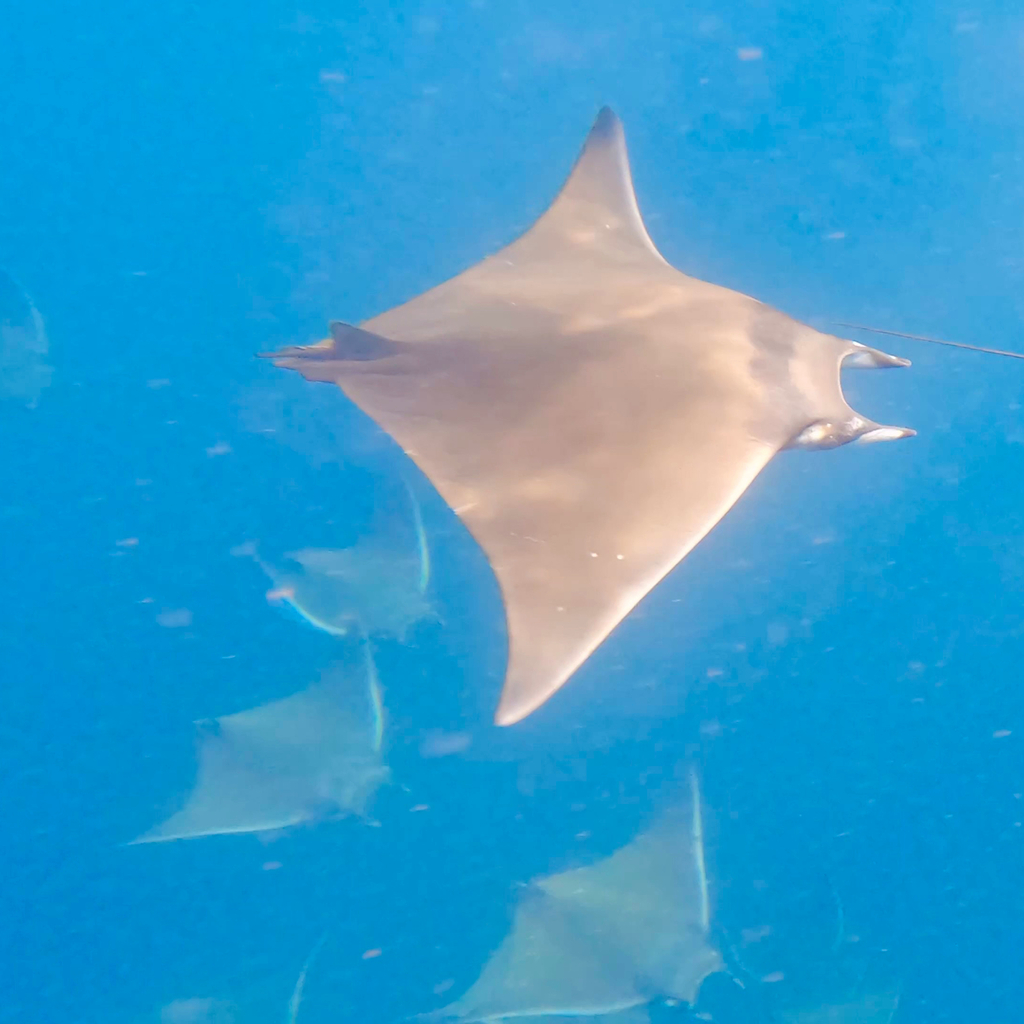
La Ventana Mobula Rays: Why May Is Their Month
A calm spring morning off La Ventana, in Baja California Sur. Somewhere across the channel, a small dark shape flies out of the water, flaps once, and falls back with a slap. Then another. Then another. The La Ventana mobula rays are not putting on a show for us. They are in the middle of one of the most private moments of their year.
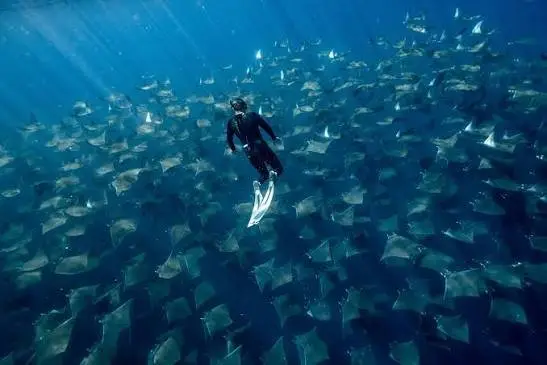
Why May? Because May is courtship month. In one study, almost 82% of all devil ray courtship and mating events recorded along this coast happened in May, and most of them happened right here, off La Ventana. To understand what you are seeing, it helps to know who these rays are, why one month matters so much, and where their babies go afterwards. It is a small story with a big timetable.
Who are the La Ventana mobula rays?
Most of the rays in this channel are Munk's devil rays, Mobula munkiana. They are the smallest members of the manta and devil ray family. They reach about 130 cm across and up to 25 kg. You can meet them properly on our Munk's devil ray page in the Ocean Atlas.
They live in the coastal waters of the Eastern Pacific, from the Sea of Cortez down to Peru. At some times of the year they gather in the Sea of Cortez in groups that can reach tens of thousands.
Why is May the best month for mobula rays at La Ventana?
Scientists working along the eastern coast of the Baja California peninsula recorded 221 courtship and mating events across three devil ray species. Munk's devil rays were part of 208 of them.
Courtship happened from March to August. But one month stood out very clearly: 81.9% of all the events were in May.
The place was just as clear. 209 of the 221 events were around La Ventana and Ensenada de Muertos. They happened between the surface and about 5 m deep, in water of 20 to 30 °C, and anywhere from 4 m to 6.3 km from the coast. So in May, this channel is not only a place to feed or a road to pass through. It is a courtship ground.
So why do they leap?
The leaping is what everyone remembers. The Manta Trust describes Munk's devil rays as breaching often, sometimes several metres out of the water. It is also honest that the reasons are still unknown, and may be linked to social life in the group.
Off La Ventana, researchers saw something more specific. They describe a "piggyback leap", which they read as a pre-mating position. And once, they watched 122 rays circling clockwise together for five hours, a "courtship vortex".
So some leaps are clearly about finding a partner. Many others are still a small mystery. I like that we do not have to explain everything.
A small ray with a slow life
A school of thousands can make it feel like there are rays everywhere. That feeling is a trap.
Munk's devil ray is listed as Vulnerable on the IUCN Red List. Each female gives birth to one single pup. Researchers estimate the pregnancy at 10 to 12 months, based on related species. Across the whole family, one pup every one to three years is typical. This slow rhythm is why their populations are so sensitive to fishing.
Two chapters of the same year
Adults court in the open channel, but newborns need somewhere calmer. That nursery was described at Ensenada Grande, a shallow bay in the Espíritu Santo archipelago, at the eastern edge of the Bay of La Paz. The team tagged 95 rays there, and 84% of them were newborns or juveniles.
The authors estimate that the pups are born from April to June. So the May gatherings off La Ventana and the young rays in the bay are two chapters of the same year, only a short distance apart. The wider Bay of La Paz is now recognised as an Important Shark and Ray Area, partly because Munk's devil rays use it for pupping, courtship and as a nursery.
Protected on paper, and in practice?
In Mexico, all manta and devil rays of the genus Mobula are federally protected. They may not be caught or sold at any time of year, under the fisheries standard NOM-029-PESC-2006. Internationally, the countries of CITES agreed at their twentieth meeting to move manta and devil rays to Appendix I, which means a full ban on international commercial trade.
But protection on paper and protection in practice are not always the same thing. The nursery study itself recommends managing fishing by place and by season, to reduce bycatch in small-scale fisheries, and clear rules for ecotourism.
How to watch them with respect
Mobula rays are fish, not marine mammals, so the question is not whether you may be in the water, but how. The Manta Trust code of conduct, written for manta rays, is a good reference. Enter the water quietly and no closer than 10 m. Never approach closer than 3 m. Let the animals come to you. Never chase, and never touch.
From the boat, a good operator slows down well before a school, cuts the engine where it is safe, and never drives through a group for a closer look. Leaping rays are just as beautiful from the surface as from below. Around nursery bays like Ensenada Grande, where the rays are very young and the water is very shallow, we simply leave them alone.
Wildlife encounters are unpredictable. Snorkelling near mobula rays should always follow local regulations and experienced professional guidance.
The desert sun is strong on these days, so I like a long-sleeve rash guard for sun and stings. I keep my phone in a small roll-top dry bag, so I am not tempted to film every splash.
If a quiet day like this is your kind of ocean, our Ocean Match can help you find the place and the pace that fit you.
And if you would like to be on the water here yourself, our La Ventana retreat in May 2027 is built around this season. To ask about a place, simply message me.
Questions people ask
When is the best month to see mobula rays at La Ventana?
Researchers recorded courtship from March to August, with 81.9% of events in May. Numbers change from year to year with the ocean, so a school is a gift, never a promise.
Are mobula rays the same as manta rays?
They are close relatives. Manta and devil rays all belong to the genus Mobula. Munk's devil ray is the smallest, at up to about 130 cm across, while oceanic mantas can be several metres wide.
Why do the rays jump out of the water?
Some leaps are part of courtship, like the "piggyback leaps" seen off La Ventana. For many others the reason is still unknown, and the Manta Trust suggests it may be linked to social life in the group.
Wildlife encounters are never guaranteed and never forced. Ocean Calling works only with vetted, ethical local operators, and every animal is free to approach, or not, entirely on its own terms.
Sources & further reading
- Palacios, M.D. et al., 2023. Reproductive behavior, seasonality, and distribution of three devil ray species (Mobula mobular, M. thurstoni, and M. munkiana) in the Southern Gulf of California, Mexico. Marine Biology.
- Palacios, M.D. et al., 2021. Description of first nursery area for a pygmy devil ray species (Mobula munkiana) in the Gulf of California, Mexico. Scientific Reports 11.
- Manta Trust. Munk’s pygmy devil ray (Mobula munkiana) species guide.
- IUCN SSC Shark Specialist Group. Bahía de La Paz Important Shark and Ray Area factsheet.
- Ossiander, I.C. et al., 2025. Composition and conservation status of rays sold in Baja California Sur, Mexico. Conservation Science and Practice 7: e70164.
- Wildlife Conservation Society, 2025. WCS celebrates historic and sweeping trade protections for sharks and rays adopted at CITES CoP20.
- Manta Trust. Manta ray tourism code of conduct.
Further reading on Ocean Calling: Mexico in the Ocean Atlas · The best regions and seasons to see manta rays responsibly · Underwater photography without the chase
La Ventana: a mobula ray retreat in the Sea of Cortez
Ray retreat · La Ventana, Baja California Sur, Mexico
Six quiet days by the Sea of Cortez, in the month the devil rays gather. This story is about Mexico, where we run our ray retreat in the Sea of Cortez.
Explore in the Ocean Atlas
Places in this article
Animals in this article