
Crystal Bay Mola: Why Sunfish Return to the Same Reef
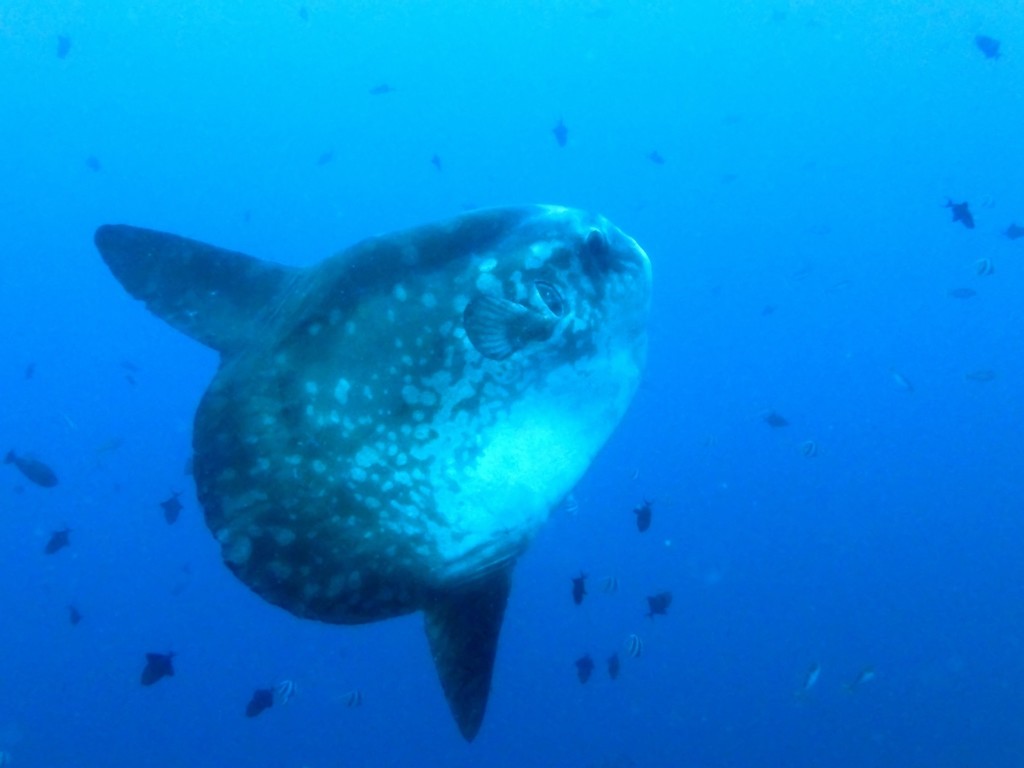
The water turns cold, your guide points into the blue, and a giant flat fish almost as tall as you hangs over the reef, letting small fish pick at its skin. Most divers think they have met a deep-sea stranger passing through. Some of these fish have been coming back to the same Bali reef for years.
In short
- The sunfish divers meet at Crystal Bay are almost always the giant or bump-head sunfish, Mola alexandrini, rising from deeper water to have parasites picked off by reef fish.
- Photo identification shows that at least some of these fish come back to the same Bali reefs within and between seasons, one of them after 7.2 years.
- A calm diver who keeps distance is not only being polite. A disturbed sunfish can change its skin pattern in seconds, leave its cleaners and swim away.
Which sunfish is this, exactly?
Do the mola at Crystal Bay just pass by? Not always. Science now shows that some of them return to the same reefs, season after season, and one was recognised again after more than seven years. This is for divers planning a mola season trip who want to understand what they are really looking at.
First, the name. Divers in Bali call it "mola mola", but the fish at Crystal Bay has a complicated naming history. In a detailed 2018 redescription, Japanese and Australian ichthyologists showed that the species long called Mola ramsayi should carry the older name Mola alexandrini, the bump-head or giant sunfish. The citizen science project Match My Mola has confirmed that the sunfish seen by scuba divers on Nusa Penida and Bali reefs are almost only M. alexandrini, while noting that not every scientist agrees on the naming. An Indonesian field study that worked from divers' photographs suggested a second species, Mola mola, may also appear. The honest answer: almost always the bump-head, sometimes debated.
Size has never been measured properly inside the Nusa Penida Marine Protected Area. The researchers behind Match My Mola estimate most fish at roughly 130 to 200 cm long, about the height of a diver. You can read more about the species on our ocean sunfish page.
Why a deep-water fish comes up to a shallow reef
Nusa Penida sits in the Lombok Strait, where strong currents of the Indonesian Throughflow carry Pacific water into the Indian Ocean. The Coral Triangle Center describes nutrient-rich upwelling that feeds the area's productivity, especially between July and October. The same season brings sunfish to the cleaning stations.
The first behaviour data for this species anywhere came from four satellite tags placed on sunfish around Nusa Penida and Nusa Lembongan, published in 2016. The fish used water from 10 to 27.5°C and spent 95% of their time in the upper 250 m, preferring the bottom of the warm surface layer. In other words, the reef is a short stop in a life lived mostly in open, cooler water.
So why stop at all? To get clean. Sunfish carry heavy loads of skin parasites, and at Nusa Lembongan scientists documented adult emperor angelfish cleaning giant sunfish as early as 2006. A survey run with local dive centres from July to December 2019 found that sunfish preferred calm, deeper, cooler water where cleaner fish were present, with the highest number of individuals recorded in September.
Crystal Bay mola: the fish that come back
This is where the idea of a passing visitor starts to fall apart. Every sunfish has its own pattern of spots and lines on its sides, a little like a fingerprint. Since 2013, Match My Mola has collected divers' photos and videos from the Bali area. In a 2023 study in Frontiers in Marine Science, researchers tested whether individuals could be recognised across 1,098 submissions.
Most matches were the same fish photographed by different divers on the same day. But nine individuals were photographed again after gaps of 1 to 2,652 days. The authors concluded that at least some individuals return to the same reefs both within and between seasons, and that the longest gap, 7.2 years, is the longest known example of site fidelity in any ocean sunfish. One fish, nicknamed "Concept", was photographed on three separate occasions at Crystal Bay itself.
The tags tell a similar story. One tag released on schedule after six months less than 10 km from where it was attached, while others surfaced 142 km, 162 km and 747 km away. So these fish travel, and yet some keep returning. Scientists still do not know whether they live here all year or visit with the cold upwelling. The fish occur in the area all year, from the surface to below 40 m, but divers mostly meet them between about July or August and November or December.
What a sunfish is telling you with its skin
Video in the same 2023 study showed that a giant sunfish can switch from pale to bold, high-contrast patterns within seconds. Fish being cleaned usually show soft, low-contrast patterns. One sequence from the Nusa Penida MPA shows a sunfish in cleaning position, head angled up and eyes covered. As the photographer moved closer, it turned upright, showed bold patterns and moved away.
The lead author links the bold display to disturbance during cleaning, based on her own observations, and is clear that numbers to prove it are still missing. It may be a warning signal that makes the fish look even larger. Either way, a sudden change of pattern is a good moment to stop moving closer.
Why returning fish change the ethics
If the fish at a cleaning station were always new arrivals, one bad dive would be a single bad moment. If some of them return for years, the same individuals meet the same crowds season after season. The tagging team already pointed to growing tourist pressure at Nusa Penida and to sunfish bycatch in eastern Indonesia, such as around Alor. How busy Crystal Bay has become is its own story, which we tell in Crystal Bay: what happens when a famous dive site gets too busy.
There is also a quieter point. So much about these fish is still unknown, including how many there are, that every disturbance happens to an animal we understand only a little. That is a good reason for humility on the reef, not for fear.
How to experience it respectfully
The Coral Triangle Center, the Indonesian government and the dive association Gahawisri developed a code of conduct for sunfish. It asks divers to keep at least 3 m (or 3 body lengths) from a sunfish at a cleaning station, and 10 m (or 5 body lengths) when the fish is unsettled. Wait until cleaning has started and the fish has been still for one minute. Stay close to the reef without surrounding the fish. Never swim behind or under it, or block its way out. Stay still if it comes towards you, and use no flash and no underwater scooters. Codes are updated from time to time, so check the current version with your operator before you dive.
In practice, a good operator dives in small groups, explains the code before the boat reaches the site, and chooses the site on the day by current and crowding, not by the photo. The same etiquette applies to mantas, which we explain in what a manta cleaning station is. If a station is crowded, the kindest choice is to wait further back, or to leave the fish to its cleaners.
A few practical things help you stay calm and still. The water on sunfish days can be surprisingly cold, so ask your operator which wetsuit they recommend. Some divers add a thin layer from a rash guard list like this one underneath. If you want to share photos with the research, a small housing or action camera, such as those on this underwater camera list, works best when you keep it simple, use no flash and shoot from the permitted distance.
Where this leaves a curious diver
The sunfish at Crystal Bay is not a stranger passing by, and it is not a performer waiting for us. It is a deep-water fish that comes up for a short, important service, and some individuals clearly know the way back. If the sunfish season is calling you, start with our Indonesia Ocean Atlas to understand the area first. If you would like to dive in Bali with a small local team we trust, you can read about our Bali scuba trip in Amed, a referral where you book the local team directly.
Questions people ask
When is sunfish season at Crystal Bay?
Divers most often meet sunfish between about July or August and November or December, and the Coral Triangle Center links the season to upwelling that is strongest from July to October. In one 2019 survey the highest count came in September. Sightings are never guaranteed, even in season.
Is the Crystal Bay sunfish a Mola mola?
Almost always it is the bump-head or giant sunfish, Mola alexandrini, formerly called Mola ramsayi. One Indonesian study suggested Mola mola may sometimes appear too, and the naming is still discussed among scientists.
Can I see a sunfish while snorkelling?
Sunfish occur from the surface to below 40 m, but encounters at the cleaning stations mostly happen to scuba divers, and the fish prefer the deeper, cooler water. Snorkellers are sometimes lucky. Plan for it as a diving experience.
How close can I get to a sunfish?
The local code of conduct asks for at least 3 m (or 3 body lengths) at a cleaning station and 10 m (or 5 body lengths) when the fish is unsettled, with no flash and no scooters. Check the current code with your operator before you dive.
Why is the water so cold on a sunfish dive?
The same upwelling that brings sunfish towards the reef brings cooler, nutrient-rich water up from depth. Satellite-tagged sunfish here used water as cold as 10°C. Ask your operator which wetsuit they recommend for the day.
Can my photos help the research?
Yes. The Bali Ocean Sunfish Research Project asks divers to submit clear, side-on images to Match My Mola, because each fish is recognised by the skin pattern on its side. Take the photo from the permitted distance. The science needs honest images, not close ones.
Wildlife encounters are never guaranteed and never forced. Ocean Calling works only with vetted, ethical local operators, and every animal is free to approach, or not, entirely on its own terms.
Sources & further reading
- Coral Triangle Center, Government of Indonesia and Gahawisri. Mola and manta code of conduct, as published by Bali.com.
- Nyegaard, M. et al., 2023. Rapid physiological colouration change is a challenge, but not a hindrance, to successful photo identification of giant sunfish (Mola alexandrini, Molidae). Frontiers in Marine Science.
- Thys, T. et al., 2016. Tracking a marine ecotourism star: movements of the short ocean sunfish Mola ramsayi in Nusa Penida, Bali, Indonesia. Journal of Marine Biology.
- Dewi et al., 2021. Sunfish (Mola spp.) habitat characteristics on their appearance at dive tourism depths in Nusa Penida waters, Bali. Jurnal Biologi Tropis 21(1).
- Konow, N., Fitzpatrick, R. and Barnett, A., 2006. Adult emperor angelfish (Pomacanthus imperator) clean giant sunfishes (Mola mola) at Nusa Lembongan, Indonesia. Coral Reefs 25.
- Sawai, E. et al., 2018. Redescription of the bump-head sunfish Mola alexandrini, senior synonym of Mola ramsayi. Ichthyological Research 65.
- Coral Triangle Center. Nusa Penida Marine Protected Area.
- ZuBlu. The Bali Ocean Sunfish Research Project.
Further reading on Ocean Calling: Crystal Bay: when a dive site gets too busy · Responsible manta diving in Nusa Penida · More from the Journal · Ocean Atlas
Freediving certification in Bali: Amed, USAT Liberty wreck and Ubud
Freediving certification · Amed & Ubud, Bali, Indonesia
Ocean breath first, sacred water after. This story is about Indonesia, where we run our Bali trips.
Explore in the Ocean Atlas
Places in this article
Animals in this article