
Ethical Komodo Diving: Why We Match You With Local Teams
Picture Komodo National Park: golden hills above, fast blue water below, and reef manta rays turning slowly over a cleaning station. People often ask if Ocean Calling runs its own Komodo diving retreat. The honest answer is no. Komodo is not one of our trips today, hosted or matched. But I can share how we would choose a local team there, and why we think that matters.

It may sound strange for a retreat company to say “we will not bring our own boat”. But to understand it, you first need to understand the water.
A park that is mostly sea
Many people imagine Komodo as dry islands and dragons. The dragons are real, but the park is above all a marine place. Komodo National Park joined the UNESCO World Heritage List in 1991. Of its 219,322 hectares, 130,177 are sea.
UNESCO describes the coral reefs as diverse and luxuriant, thanks to clear water, intense sunlight and a rapid exchange of nutrient-rich water from deeper parts of the archipelago. Strong currents bring sea turtles, dolphins and whales, and five species of sea turtle have been recorded in the park.
This is the gift of Komodo. It is also the reason for care, because the same water that feeds the reef moves fast through narrow channels.
One park, many kinds of dive
Komodo is not one single dive. Some sites are gentle and sheltered, others are serious and exposed. Even at the famous central manta sites, researchers write that “strong tidal currents affect both these central sites”.
So we never give Komodo one difficulty level. It can suit experienced, current-comfortable divers very well. It can also be a place where newer divers enjoy calmer sites while they build confidence. What matters is a team that reads the water on the day and chooses the site for you, by tide and by your experience, not by a fixed programme.
Why we do not run our own Komodo trip
Ocean Calling groups are small, six guests at most. We could plan our own Komodo week. But Komodo is already busy, and the park now manages visitor numbers through a daily quota. We do not want to be one more boat at a manta site in high season. And we do not believe a visiting team knows these tides better than the people who dive them every day.
In other places we do something different, and it is called matching. You tell us your level, your dates and what you hope for. We research, compare and suggest a local team we believe is a good match for you. We are not the operator. You book with the local team directly, and they are responsible for your diving. Today this covers Coron, Bali Amed, Gili Trawangan and Moalboal. Komodo is not on that list.
We do not name these teams publicly, and we keep learning about them over time. Your money stays mostly with local people who know the water, and you get a trip that fits you, not our calendar. That is what our Ocean Match is for, from CHF 19. For Komodo, the questions below are the same ones we would ask, so you can use them yourself.
Two safety questions, told simply
Malaria. The UK travel health service fitfortravel, from NHS Scotland, lists all islands of East Nusa Tenggara, including Komodo, as low risk. Tablets are not usually advised for most travellers there, but may be considered for people at higher risk, and avoiding mosquito bites is important everywhere in Indonesia. Health services in other countries may describe the risk differently, so please speak with a travel health clinic well before you go.
Boats. Most days on the water in Komodo go well. Still, in late December 2025 a traditional tourist boat with 11 people on board sank in the Padar Strait after engine failure, in waves higher than two metres, and four visitors went missing. Afterwards, the director of Indonesia’s National Maritime Institute said that “many tourist boats do not meet safety standards”. We share this with respect for the families involved, and because good questions before booking really matter.
The questions that tell you the most
If you are choosing a Komodo team on your own, a few questions help a lot.
Ask about the water. How do they decide that a site is not suitable today, because of the tide or the current? Which sites do they use for newer divers, and which only for experienced ones? Do they split groups by experience, and how many divers does each guide lead?
Ask about the boat. Does every diver carry a surface marker buoy, and what is the lost-diver procedure? Is there oxygen, first aid and a working radio on board, and life jackets for everyone? Does the captain check the weather before crossings, and will they cancel if it is not safe?
And ask about the mantas. What do they do when a manta site is too crowded? Do their guides stop divers who chase, touch or block the rays?
A team that answers calmly and clearly, and is happy to change the plan, is often a good sign. Membership of Green Fins, the reef-conservation initiative of The Reef-World Foundation supported by the UN Environment Programme, is a helpful starting point, but it is not a guarantee.
Being a quiet guest at a manta’s home
Every manta site is a home, not a stage. The Manta Trust code of conduct asks divers to stay at the side of a cleaning station and not swim onto the main cleaning area. Keep low and hover close to the seabed without touching the reef. Never approach closer than 3 metres, and never chase, touch or block a manta’s path as it swims overhead. Wildlife encounters are unpredictable. Diving with manta rays should always follow local regulations and experienced professional guidance.
The same calm applies to the turtles and reef sharks you may meet. Keep your fins quiet and your buoyancy good, especially in current, and never hold on to the reef. If your guide knows a manta photo-ID project, share your pictures. Citizen photos helped build the Komodo study above.
Between dives, I keep my phone and a dry layer in a small roll-top dry bag, so the deck stays tidy and I can listen to the next briefing.
The dragons, on foot
Many divers add a walk on Komodo or Rinca. Here too, the place shapes the animal. Researchers found that the largest dragons on the big islands of Komodo and Rinca were significantly longer and heavier than the largest on the small islands of Gili Motang and Nusa Kode, and that maximum size followed the density of deer, their main large prey.
Komodo dragons are wild predators, and serious bites are recorded. Visits are ranger-guided only. Stay on the trail, stay several metres away, and follow every instruction from your ranger.
If this made you curious about experiencing the ocean this way, you can explore our upcoming retreats.
Questions people ask
Does Ocean Calling run Komodo diving retreats?
Not at the moment, and Komodo is not part of our Ocean Match list either. Use the questions in this article to choose a local team, book with them directly, and let them run your diving.
Is Komodo good for beginner divers?
It depends on the site and the day. Some sites are sheltered and gentle, others have strong currents that suit experienced divers. A good local team chooses the site by tide and by your experience.
Will I see manta rays in Komodo?
Komodo is known for reef manta rays, and research shows they return to the same sites. Still, every encounter is a gift, never a promise.
Do I need malaria tablets for Komodo?
fitfortravel (NHS Scotland) lists Komodo as low risk, with tablets not usually advised for most travellers. Advice can differ, so please ask a travel health clinic before you go.
Wildlife encounters are never guaranteed and never forced. Ocean Calling works only with vetted, ethical local operators, and every animal is free to approach, or not, entirely on its own terms.
Sources & further reading
- UNESCO World Heritage Centre. Komodo National Park (World Heritage List 609).
- Germanov, E.S. et al., 2022. Residency, movement patterns, behavior and demographics of reef manta rays in Komodo National Park. PeerJ 10: e13302.
- Jessop, T.S. et al., 2006. Maximum body size among insular Komodo dragon populations covaries with large prey density. Oikos.
- fitfortravel (NHS Scotland). Indonesia travel health advice.
- ANTARA, 2025. Search underway for four Spanish tourists after Labuan Bajo boat sinks.
- Asia News Network, 2026. Indonesia’s poor maritime safety in spotlight following Labuan Bajo boat accident.
- The Reef-World Foundation. Green Fins.
- Manta Trust. Manta ray tourism code of conduct.
Further reading on Ocean Calling: Indonesia in the Ocean Atlas · Beginner diving in Indonesia · Questions to ask a dive operator before you book · What Komodo’s rays are doing at each site · Reef manta ray in the Ocean Atlas · Komodo dragon in the Ocean Atlas · The iron-coated edges of their teeth · Nests and virgin births · Why their last islands matter in a warming climate
Freediving certification in Bali: Amed, USAT Liberty wreck and Ubud
Freediving certification · Amed & Ubud, Bali, Indonesia
Ocean breath first, sacred water after. This story is about Indonesia, where we run our Bali trips.
Explore in the Ocean Atlas
Places in this article
Animals in this article
 Reef manta rayMobula alfredi
 Komodo dragonVaranus komodoensis
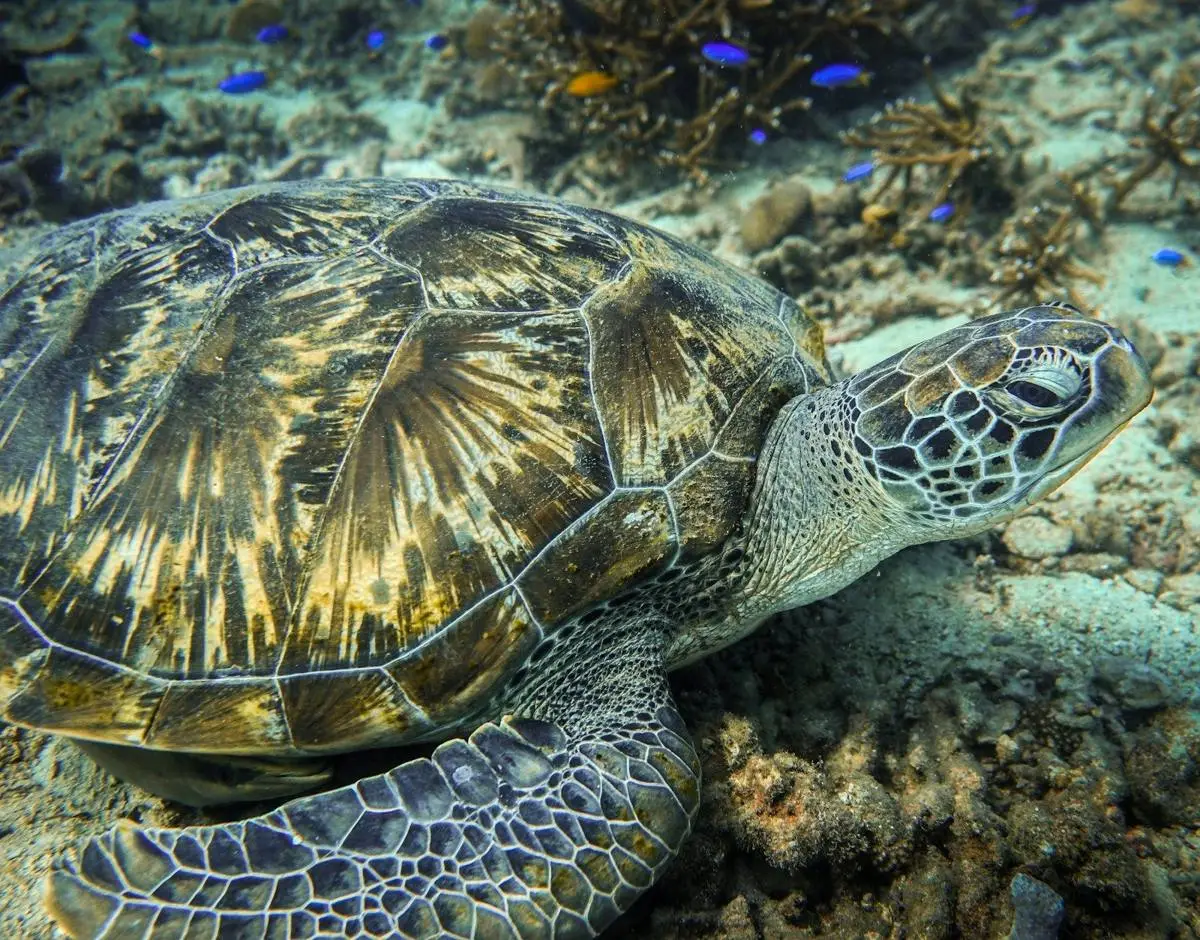 Green turtleChelonia mydas
 Hawksbill turtleEretmochelys imbricata