
Blainville's beaked whale
Mesoplodon densirostris
Blainville's beaked whales spend most of their lives out of sight, diving deep for squid and surfacing quietly in small groups.
Least Concern (IUCN, 2020) means it is not at high risk of extinction worldwide today.
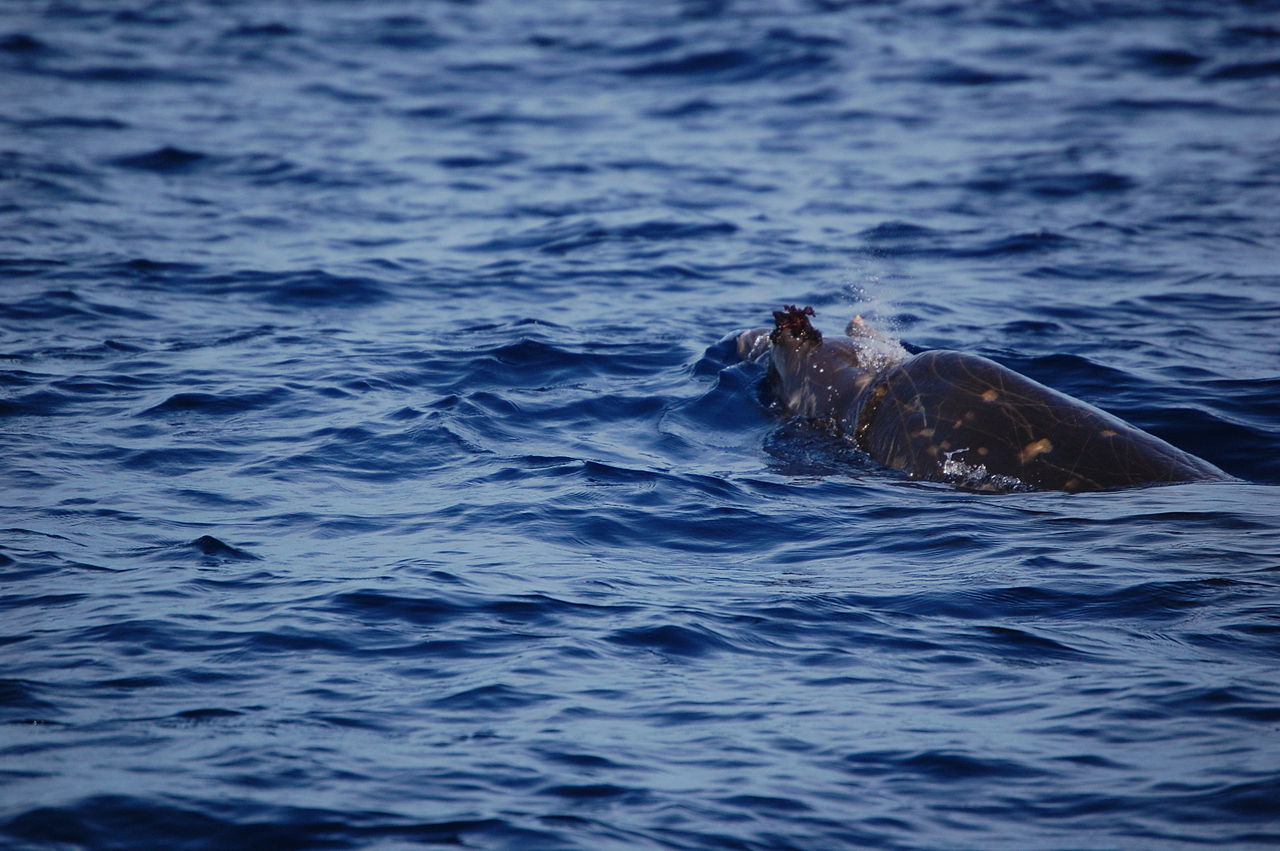


Photos show the species, not always the places on this page.
Length
About 4.6 to 6.0 m (15 to 20 ft)
Weight
About 820 to 1,040 kg (1,800 to 2,300 lb)
What it eats
Deep-water squid and fish. Its full diet is still not well known.
Around people
Calm, give space
How it lives
Blainville's beaked whales live in small groups over deep ocean slopes and canyons. They hunt at great depth using echolocation clicks, and they often go silent as they swim back up to the surface. Adult males have a strongly arched lower jaw with two tusk-like teeth.
Where it goes
Little is known about how far they travel. They are usually found over deep slopes and canyons in tropical and warm seas.
We only draw a journey on the map when scientists have tracked it or clearly documented it. For this animal we have not found one yet.
Populations
Found in tropical and warm-temperate oceans around the world. Around the Society Islands it is one of 16 whale and dolphin species documented in the Society Archipelago Important Marine Mammal Area, and a 2011 survey recorded it there. Sightings are rare, so we never count on meeting one.
Meet it respectfully
Beaked whales are shy and very sensitive to disturbance, including noise. We avoid close approaches and repeated boat passes, never swim towards a group, and keep any encounter brief, quiet and led by the whales.
Fun fact
Tap the bulb to light it up.
Adult males grow two tusk-like teeth on a high, arched lower jaw, and the teeth often carry barnacles.
They are among the deepest-diving toothed whales studied.
They often stay silent on the way back up from a dive, which may help them avoid killer whales.
Blainville's beaked whale in the Ocean Atlas
Places we have researched where this animal is recorded. It is never guaranteed, and some places are for watching from the boat only.
Travel with usComing soonTrusted referralExploringOn pause, story onlyEthics pass
Country colour: pink where we travel, blue where we are exploring or refer, grey for story only.
 Australia
 The Bahamas
 France
 French Polynesia
 Japan
Japan Mayotte
 New Caledonia
 Philippines
 Portugal
 Réunion
 South Africa
 Spain
Spain Taiwan
 United States
Sources for this page
- NOAA Fisheries, 2026
- CMS Pacific Islands Cetaceans, Mesoplodon densirostris
- IUCN Marine Mammal Protected Areas Task Force, Society Archipelago IMMA
- Oregon State University Marine Mammal Institute, 2011
Facts checked 26 September 2026. Photos: Unsplash licence, or Creative Commons as shown on each photo.
Work in ocean travel?
We are always happy to hear from exceptional local operators, accommodation, conservation organisations and destination experts. If your work fits responsible, small-group ocean travel, we would love to learn more.
Partner with Ocean Calling5-day freediving course in Bali
CHF 1,180