
Broadnose sevengill shark
Notorynchus cepedianus
A broad, unhurried shape in green kelp water. Sevengills may or may not be around, and no sighting is ever a promise.
Vulnerable (IUCN, 2020 according to FishBase and Wikipedia) means it faces a high risk of extinction in the wild, mainly because of fishing pressure.
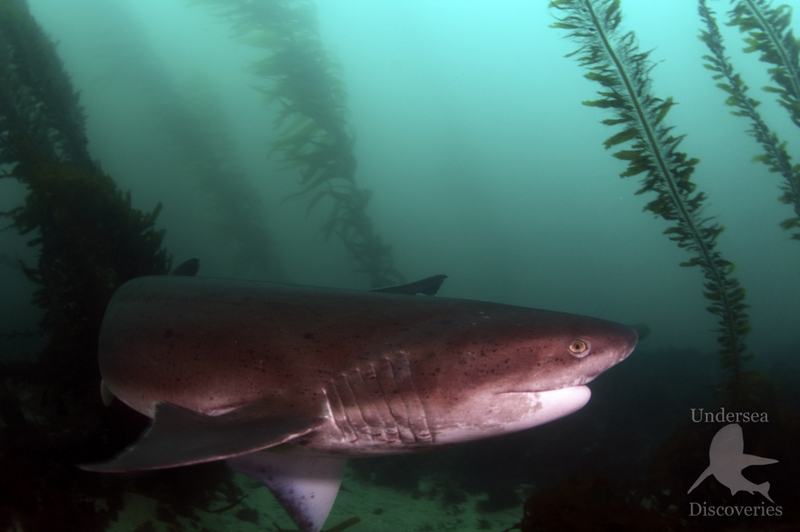


Photos show the species, not always the places on this page.
Length
Newborns are 40 to 45 cm; mature males are about 1.5 m and females about 2.2 m. The maximum recorded is about 3.0 m (9 ft 10 in) (Wikipedia, FishBase)
Weight
FishBase lists a maximum published weight of 107 kg (236 lb), while Wikipedia gives up to 182 kg (401 lb)
Next to a person
Adult females are about 1.3 times as long as an adult is tall, and the largest are close to twice as long
What it eats
Opportunistic. Other sharks, rays, chimaeras, bony fish, seals, dolphin and porpoise meat, and carrion. Wikipedia says one study found mammals made up about 30 percent of the diet, and that sevengills sometimes hunt in packs to take larger prey.
Around people
Calm, give space
How it lives
Sevengills live to about 30 years, with up to 49 recorded. Pups are born live after about 12 months, in litters of 82 to 95 and 40 to 53 cm long. Females mature at 11 to 21 years and males at 4 to 5 years (Wikipedia). It mostly cruises slowly near the bottom but can burst forward when hunting. It is found from the surface to about 570 m (FishBase), often in bays and estuaries, and typically shallower than about 80 m. It has seven gill slits and a single dorsal fin (Oregon Sea Grant).
Where it goes
Monterey Bay Aquarium says it may undertake significant migrations along coastal waters. At La Jolla, California, divers began reporting sevengills around 2007, and a photo-ID project started in 2010. A NOAA biologist quoted by Phys.org suggested possible reasons: more sharks after the 1994 gillnet moratorium, more divers, better cameras and social media. The project had no published results at that time, so the reason is still an open question.
We only draw a journey on the map when scientists have tracked it or clearly documented it. For this animal we have not found one yet.
Populations
IUCN rates it Vulnerable (2020 according to FishBase and Wikipedia), noting that it likely suffers great ongoing pressure from fisheries. It lives in temperate and subtropical waters worldwide except the North Atlantic and Mediterranean, including the Pacific coast from British Columbia to Chile. San Francisco Bay populations were depleted in the 1930s and 1940s for liver oil. Sport fishers in Australia and the United States still target it, and it is used for leather and liver oil. Monterey Bay Aquarium says limited fishery data elsewhere make wider assessments difficult. I found no global population count.
Meet it respectfully
Stay calm, keep your distance and let the shark leave on its own terms. Never chase, touch, feed or bait a sevengill, and do not block its path. Bites on people are very rare, with seven recorded since the 16th century and none fatal (Wikipedia), but this is a large predator and deserves space. Follow local rules and your guide.
Fun fact
Tap the bulb to light it up.
It has seven gill slits and a single dorsal fin.
The lower teeth are comb-shaped for holding prey, and the upper teeth are jagged for cutting.
After a big meal it digests slowly, and it can cruise for weeks without eating again.
Broadnose sevengill shark in the Ocean Atlas
Places we have researched where this animal is recorded. It is never guaranteed, and some places are for watching from the boat only.
Travel with usComing soonTrusted referralExploringOn pause, story onlyEthics pass
Country colour: pink where we travel, blue where we are exploring or refer, grey for story only.
 Argentina
 Australia
 Brazil
 Chile
 Mexico
 New Zealand
 South Africa
 United States
Sources for this page
- Wikipedia, 2026
- FishBase, 2026
- Monterey Bay Aquarium, 2026
- Oregon Sea Grant, 2026
- Phys.org, 2015
- GBIF, IUCN Red List category, 2026
Facts checked 5 October 2026. Photos: Unsplash licence, or Creative Commons as shown on each photo.
Work in ocean travel?
We are always happy to hear from exceptional local operators, accommodation, conservation organisations and destination experts. If your work fits responsible, small-group ocean travel, we would love to learn more.
Partner with Ocean CallingNew: tiger sharks in Fuvahmulah, January or March 2027
from CHF 2,900