
Brown ray
Raja miraletus
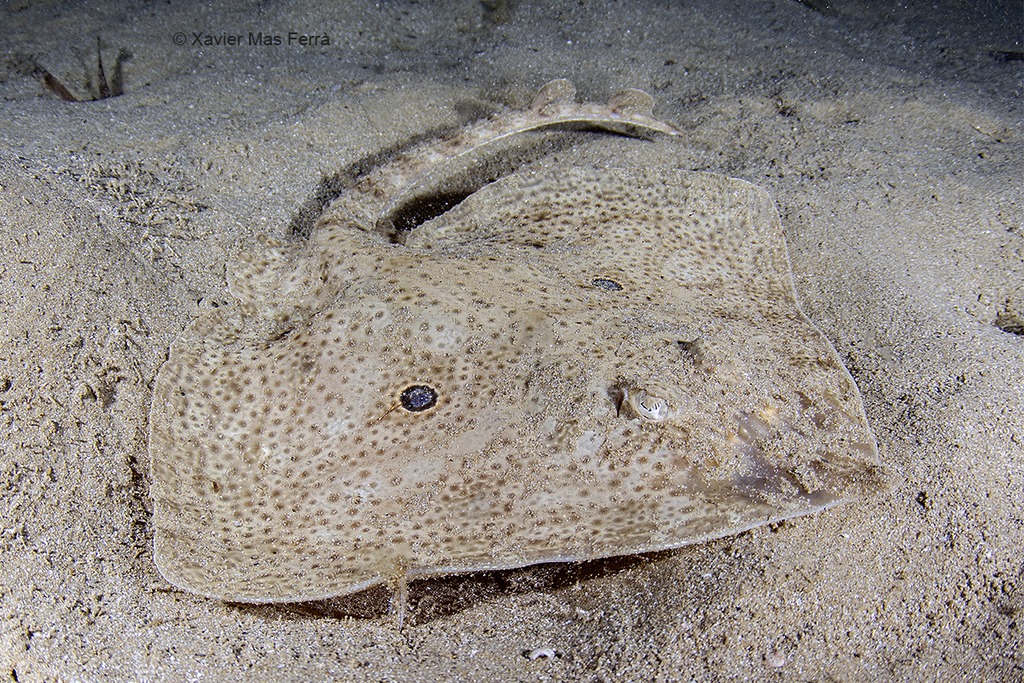
A flat shape resting on the sand, with two dark eyespots that watch for nothing in particular. No sighting is ever a promise.
Least Concern (IUCN, assessed 2019) means the species is not currently at high risk of extinction in the wild.
Photos show the species, not always the places on this page.
Length
Up to about 63 cm (25 in) total length; females up to about 59.7 cm (23.5 in). A common size is about 35 cm (14 in) (FishBase)
Weight
No weight figure was given in the sources I read
Next to a person
Usually about as long as an adult forearm and hand; the largest are roughly a third of an adult's height
What it eats
Bottom-living animals and fish offal (FishBase). Wikipedia lists decapod crustaceans, mysids, bony fish, cephalopods, amphipods and polychaete worms.
Around people
Calm, give space
How it lives
A small ray of soft seabeds on the shelf and upper slope, usually at about 50 to 150 m (164 to 492 ft) deep, with records from 17 to 462 m (FishBase). It lays eggs in oblong capsules, about 40 to 72 eggs a year, mostly from spring to summer. Maturity is reached at about 44 cm (17 in) or more. The generation time is estimated at about 6.5 years.
Where it goes
The sources I read do not describe any seasonal movements or migration routes for this ray.
We only draw a journey on the map when scientists have tracked it or clearly documented it. For this animal we have not found one yet.
Populations
IUCN lists it as Least Concern, assessed in January 2019 (FishBase). It is not the target of a dedicated fishery but is caught as bycatch, and the meat is eaten (Wikipedia). A regional assessment for the Mediterranean in 2016 also rated it Low Concern. Population size and trend were not stated in the sources I read.
Meet it respectfully
Rays rest on the seabed and often bury themselves, so look before you kneel or fin. Watch from a distance and let it lie. Never chase, touch, lift, feed or bait it, and keep your fins off the sand near it. Stay calm and give it room to swim away. No sighting is ever a promise.
Fun fact
Tap the bulb to light it up.
Each wing has an eyespot with a blue centre and blue and orange rings (Wikipedia).
A female can lay roughly 40 to 72 eggs in a year, each in a small oblong capsule about 4 to 5 cm long.
The species name comes from a French word for a mirror, which fits the shiny eyespots.
Brown ray in the Ocean Atlas
Places we have researched where this animal is recorded. It is never guaranteed, and some places are for watching from the boat only.
Travel with usComing soonTrusted referralExploringOn pause, story onlyEthics pass
Country colour: pink where we travel, blue where we are exploring or refer, grey for story only.
 Algeria
 Angola
 Cameroon
 Côte d'Ivoire
 Croatia
 France
 Gabon
Gabon Ghana
Ghana Guinea
 Guinea-Bissau
 Israel
 Italy
Italy Liberia
 Nigeria
 Portugal
 Senegal
 Sierra Leone
 Spain
SpainSources for this page
- FishBase, Raja miraletus
- Wikipedia, Raja miraletus
- Zenodo, Raja miraletus taxonomic treatment
- GBIF, IUCN category lookup, 2026
Facts checked 5 October 2026. Photos: Unsplash licence, or Creative Commons as shown on each photo.
Work in ocean travel?
We are always happy to hear from exceptional local operators, accommodation, conservation organisations and destination experts. If your work fits responsible, small-group ocean travel, we would love to learn more.
Partner with Ocean CallingNew: mobula rays in La Ventana, May 2027
CHF 2,720