
Cape gannet
Morus capensis
From a hide or a boat, watch white birds fold their wings and plunge like javelins into a feeding flock. Unforgettable when sardines gather, but never promised.
Endangered (IUCN, 2018) means it is at very high risk of extinction in the wild.


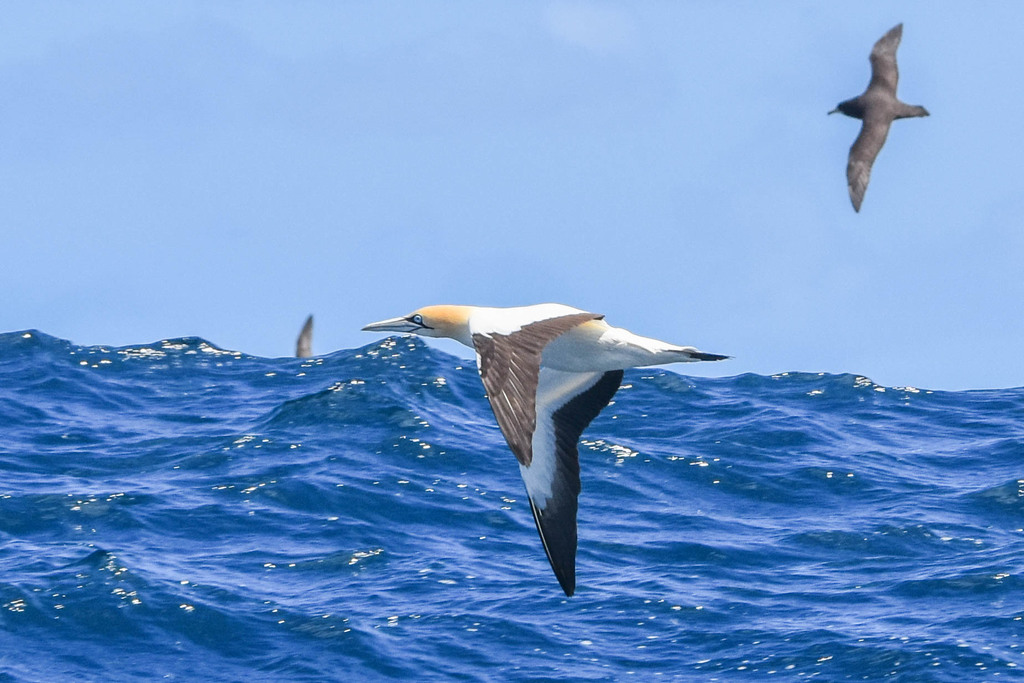
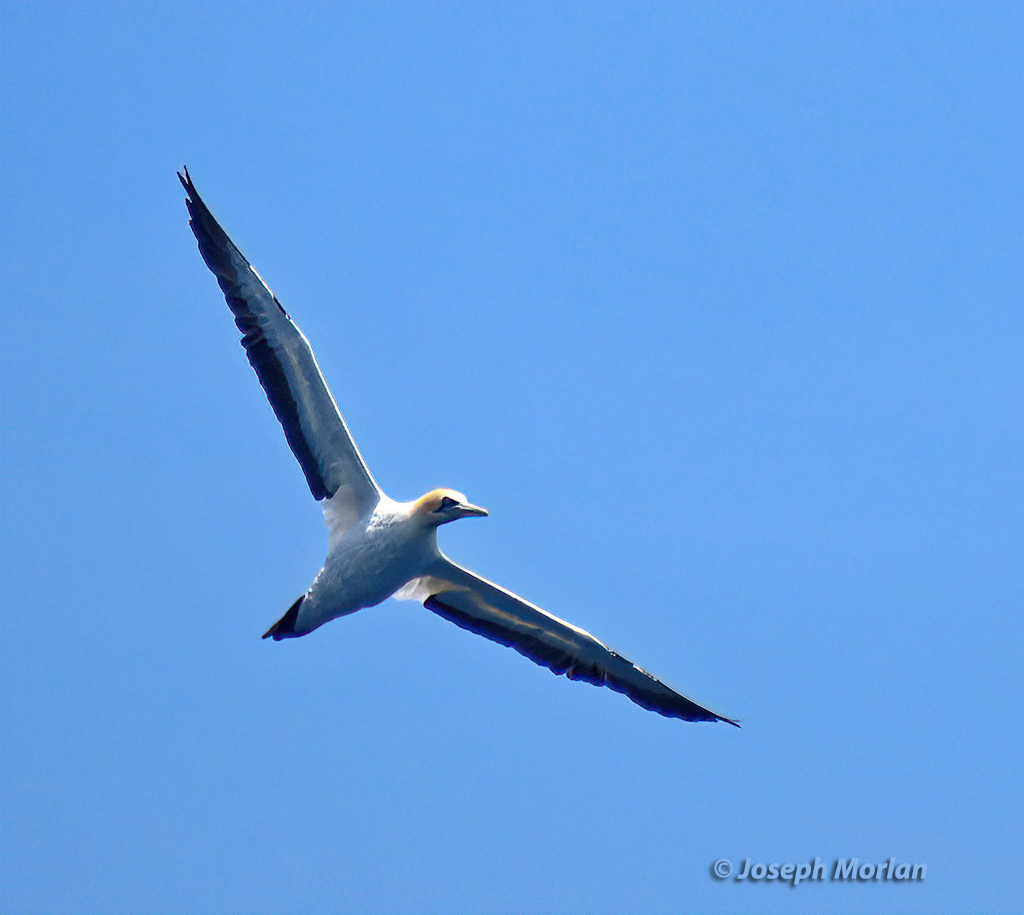
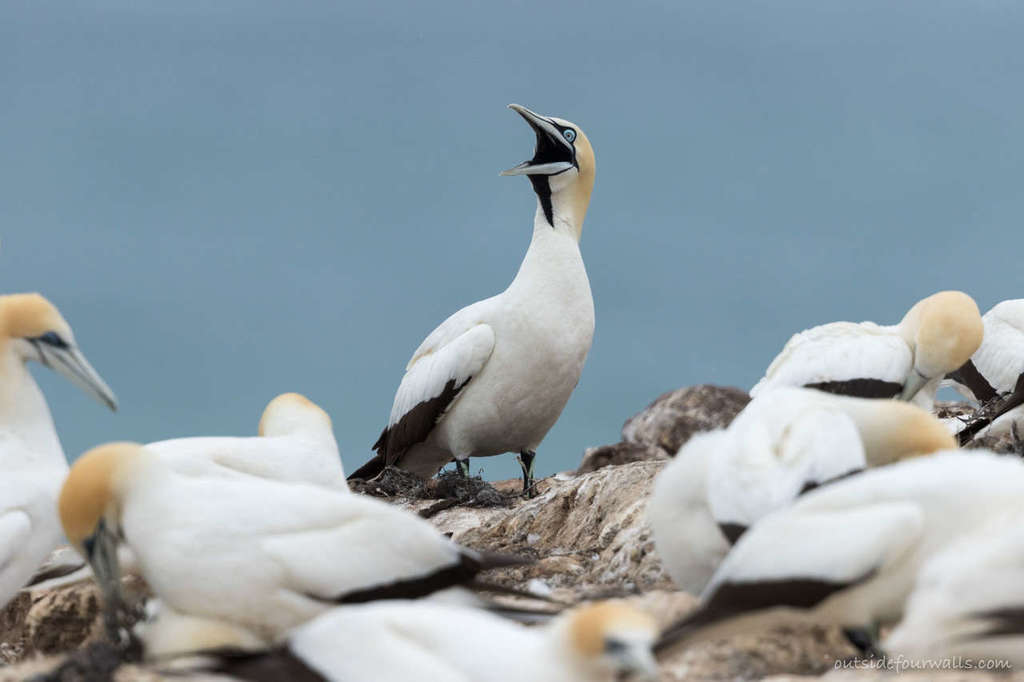
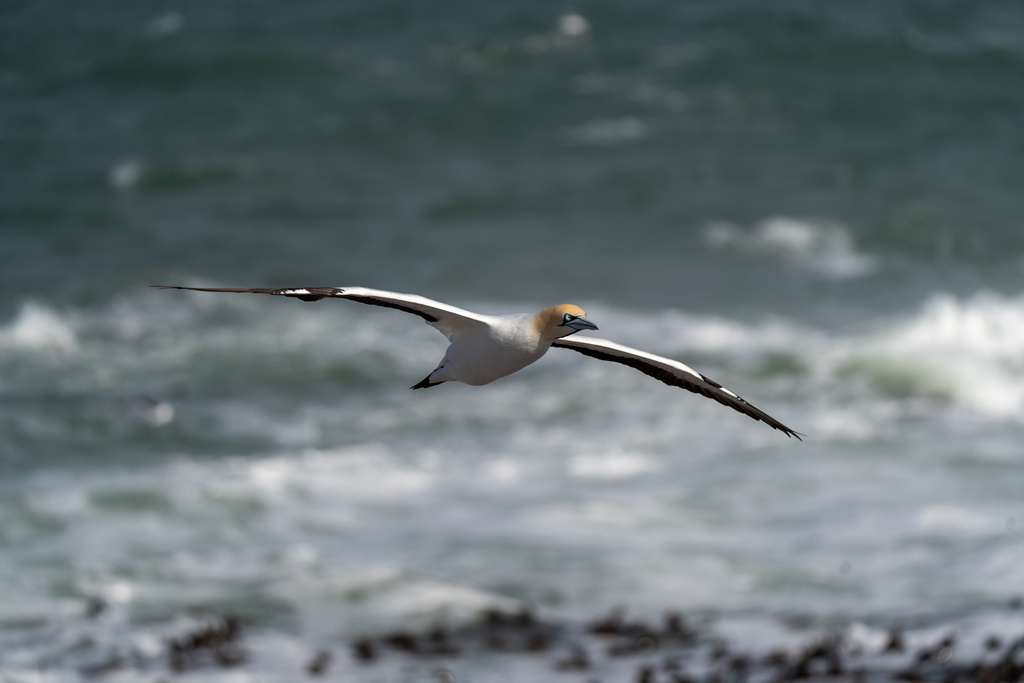
Photos show the species, not always the places on this page.
Length
Body about 84 to 94 cm (2.8 to 3.1 ft); wingspan about 1.71 to 1.85 m (5.6 to 6.1 ft)
Weight
Usually about 2.3 to 3.1 kg (5.1 to 6.8 lb)
Next to a person
The body is about as long as an adult's arm, and the wingspan about as wide as a tall adult's arm span
What it eats
Shoaling fish, mainly sardine (pilchard) and anchovy, plus saury and horse mackerel. When natural prey is scarce they also eat fish thrown back from trawlers, which is poor food for their chicks.
Around people
Calm, give space
How it lives
Cape gannets plunge-dive for shoaling fish and gather in large feeding flocks, travelling up to 450 km in a day to find food. They breed from September to April in dense colonies of more than 10,000 pairs, on just six islands in South Africa and Namibia. Young birds spread out widely and return to breed at about four years old.
Where it goes
Cape gannets can travel up to 450 km in a day in search of food. Adults often stay near their colonies all year, so they are not a classic migrant. Young birds spread out widely, sometimes more than 2,000 km along African coasts, before returning to breed at about four years old. Overall, the breeding population has shifted south-east as the fish they eat have moved.
We only draw a journey on the map when scientists have tracked it or clearly documented it. For this animal we have not found one yet.
Populations
Cape gannets breed at only six colonies, three in Namibia and three in South Africa. Namibian numbers collapsed after sardines failed, from hundreds of thousands of pairs in the mid-20th century to only thousands recently. South African numbers rose, and about 70% of the world's Cape gannets now nest at Bird Island in Algoa Bay.
Meet it respectfully
At Lambert's Bay, stay in the hide and on marked paths and never enter the colony. Other colonies are only viewed from boats or with permits. At sea, keep clear of feeding flocks and never chase or feed the birds, and do not use flash at the hide.
Fun fact
Tap the bulb to light it up.
There are only six breeding islands on Earth, and Lambert's Bay is the only colony with easy public access.
Air sacs and a strong skull help cushion the bird when it hits the water.
A long black throat stripe and a black tail tell it apart from the Northern and Australasian gannets.
The world's breeding pairs fell from about 265,000 in the 1950s to about 135,000 in 2018 and 2019.
Filmed during South Africa's sardine run, Cape gannets caught fish on about 16 percent of dives into an undisturbed school, but about 40 percent when another attack had just struck.
Source: Thiebault et al., 2016, Journal of Animal Ecology, how to capture fish in a school
A straight plunge works best. Filmed Cape gannets caught fish on 36 percent of direct plunges, but only 13 percent when they chased fish after diving.
Source: Thiebault et al., 2016, Journal of Animal Ecology, how to capture fish in a school
Cape gannet in the Ocean Atlas
Places we have researched where this animal is recorded. It is never guaranteed, and some places are for watching from the boat only.
Travel with usComing soonTrusted referralExploringOn pause, story onlyEthics pass
Country colour: pink where we travel, blue where we are exploring or refer, grey for story only.
 Angola
 Australia
 Cameroon
 Mozambique
 Namibia
 New Zealand
 South Africa
Sources for this page
- New Zealand Birds Online
- IUCN Red List, 2018
- BirdLife International, Cape gannet factsheet
- Sherley et al., 2019
- CapeNature, Lambert's Bay Bird Island Nature Reserve
- BirdLife South Africa, Cape gannet
Facts checked 26 September 2026. Photos: Unsplash licence, or Creative Commons as shown on each photo.
Work in ocean travel?
We are always happy to hear from exceptional local operators, accommodation, conservation organisations and destination experts. If your work fits responsible, small-group ocean travel, we would love to learn more.
Partner with Ocean CallingNew: mobula rays in La Ventana, May 2027
CHF 2,720