
Common eagle ray
Myliobatis aquila
A dark kite shape sliding over sand and weed, and because this ray is now Critically Endangered, any sighting is a privilege and never a promise.
Critically Endangered (IUCN, assessed 2020) means it is at extremely high risk of extinction in the wild, mainly because of fishing and its slow reproduction.
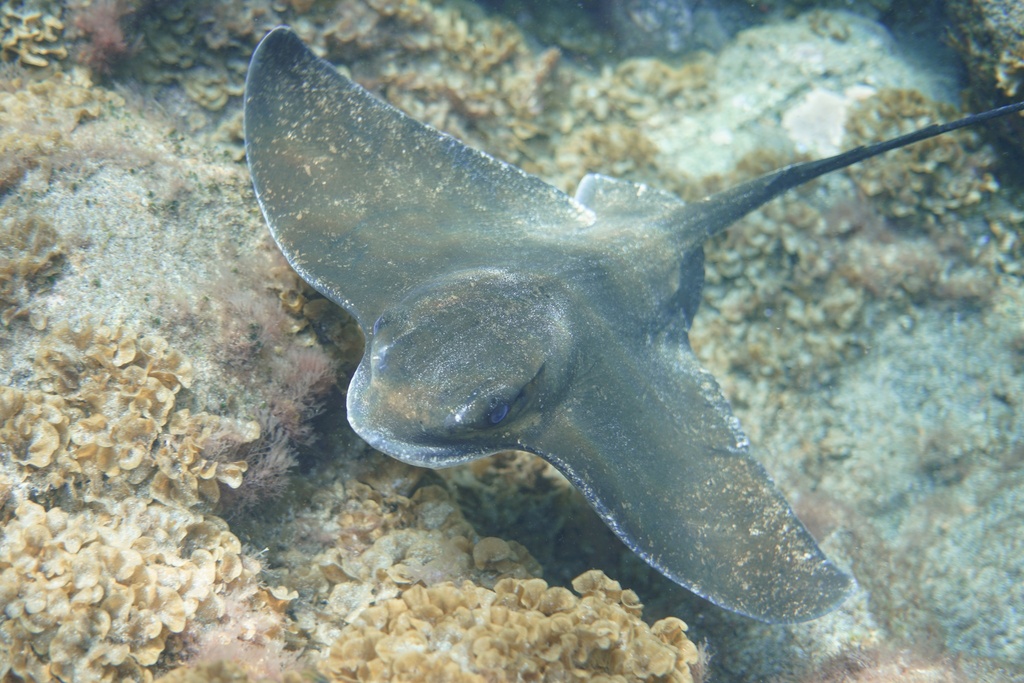
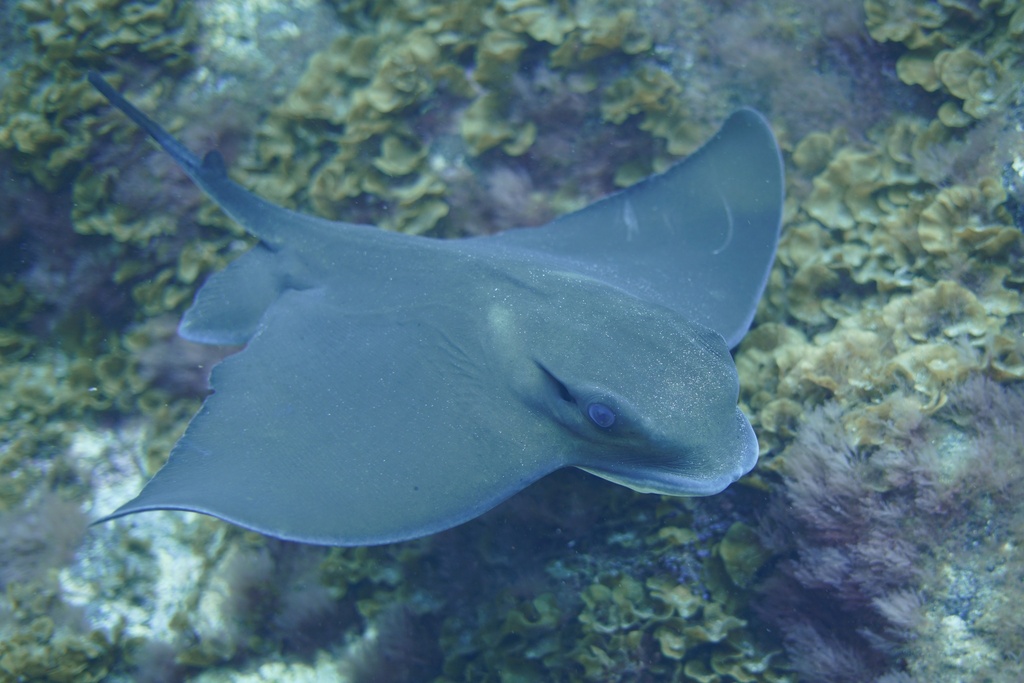
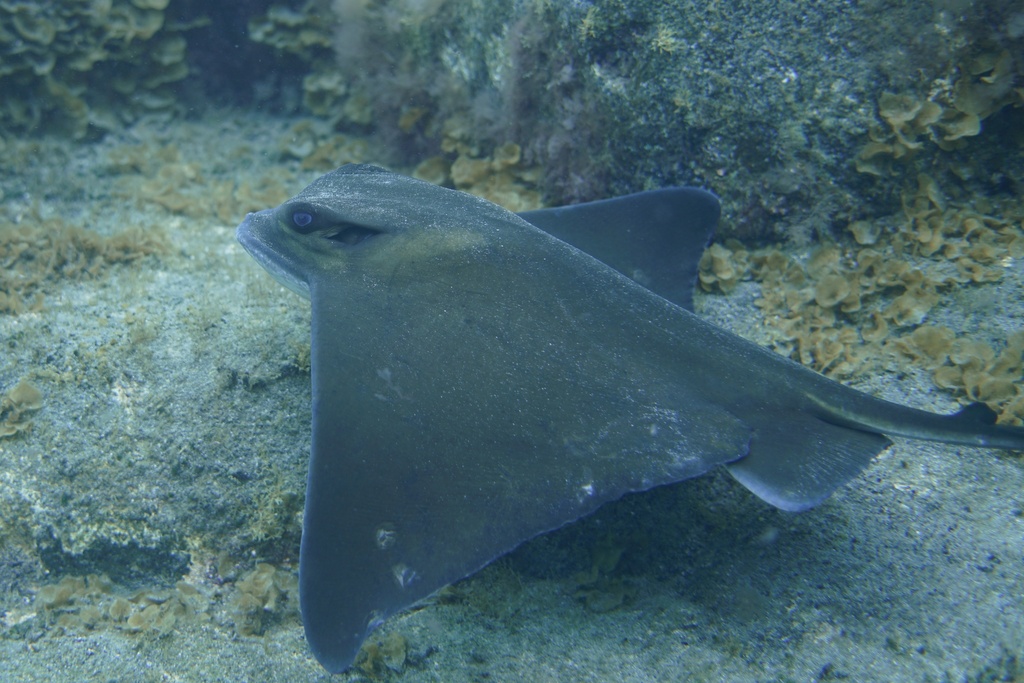
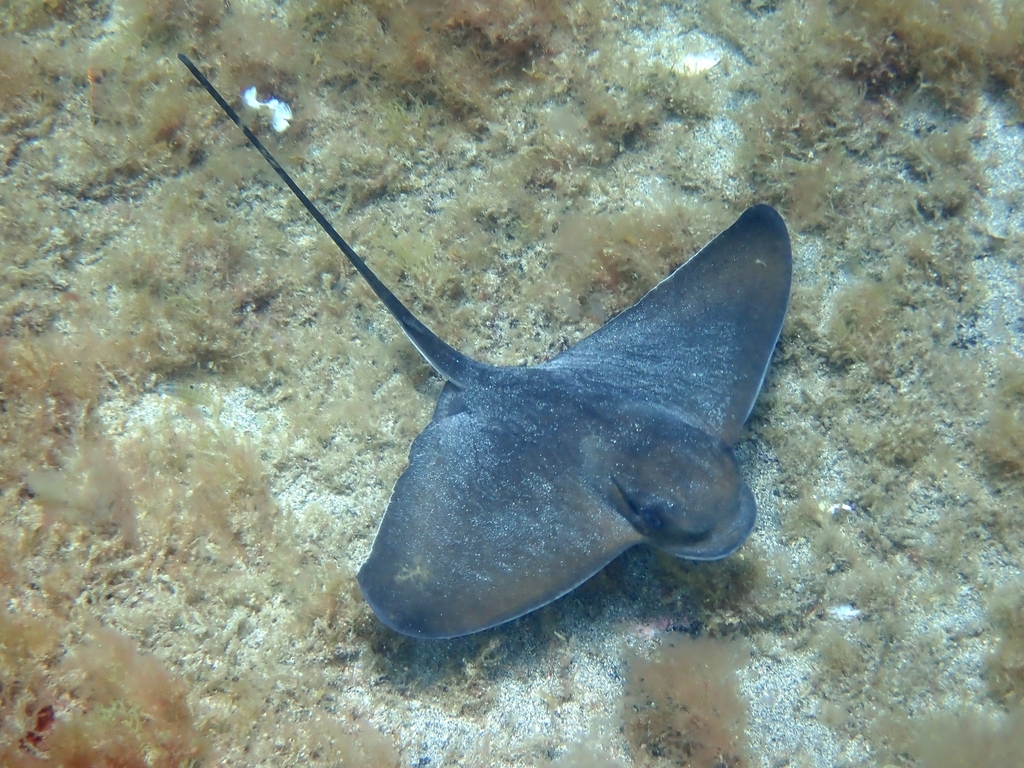
Photos show the species, not always the places on this page.
Length
Sources differ. FishBase gives a maximum of 183 cm (6 ft) disc width. Another profile gives up to 150 cm (4.9 ft), and says southern populations reach only about 80 cm (2.6 ft). The whip-like tail is about 2 to 2.5 times as long as the disc is wide. Most rays are smaller than the maximum.
Weight
Maximum published weight 14.5 kg (32 lb). A typical weight is not given in the sources I opened.
Next to a person
At the larger end of the range, as wide as an adult is tall, and up to about the weight of a medium dog.
What it eats
Crustaceans and bivalve molluscs dug from sand and mud, plus worms, sea snails and some small fish. Flat plates of fused teeth, laid out in a mosaic, crush the shells. Larger rays eat more fish than smaller ones.
Around people
Calm, give space
How it lives
It lives in sandy or muddy bays, lagoons and estuaries, often in groups. It is usually found shallower than 50 m. FishBase gives a depth range of 1 to 300 m, and one profile records it as deep as 537 m in southern Africa. In the breeding period groups of dozens can gather. Females give birth to live young, 3 to 7 pups after 6 to 8 months. The tail has one or two stinging spines at its base. The ray is not considered a risk to people, but it should never be handled.
Where it goes
The common eagle ray lives in the eastern Atlantic from the British Isles and the south-western North Sea south to South Africa, throughout the Mediterranean, and in the south-western Indian Ocean. In a lagoon on Gran Canaria it was recorded mostly in winter and summer. The sources I opened describe no long-distance migration route.
We only draw a journey on the map when scientists have tracked it or clearly documented it. For this animal we have not found one yet.
Populations
IUCN assessed the common eagle ray as Critically Endangered in 2020 (published 2021), under criteria A2bd, which are based on past decline in abundance and on levels of exploitation. It is caught as bycatch in trawls and nets, and because it schools, whole groups can be taken in one haul. A profile of the species says it has not been recorded in commercial landings in the central and eastern Mediterranean since 1980. The same profile names South Africa, where fishing pressure is lower, as the one region where numbers look relatively stable. In a study of the Adriatic Sea, trawlers caught about one eagle ray every 20 hauls, and about 79 percent of those were released alive.
Meet it respectfully
Watch quietly from a distance and let the ray choose its path. Keep fins and hands off the seabed, and never touch, chase, corner or feed rays. Some dive sites use food to draw rays in. That changes natural behaviour, so it is best avoided. Give extra space to rays resting near the bottom, because of the tail spine. Because this species is Critically Endangered, an encounter is never promised.
Fun fact
Tap the bulb to light it up.
Instead of pointed teeth, it has flat plates of teeth fused into a mosaic, which it uses to crush shells.
Females give birth to live pups, usually 3 to 7 per litter, after a pregnancy of 6 to 8 months.
The ray has a long, whip-like tail with one or two stinging spines at the base, and no tail fin.
Common eagle ray in the Ocean Atlas
Places we have researched where this animal is recorded. It is never guaranteed, and some places are for watching from the boat only.
Travel with usComing soonTrusted referralExploringOn pause, story onlyEthics pass
Country colour: pink where we travel, blue where we are exploring or refer, grey for story only.
 Cameroon
 Côte d'Ivoire
 Croatia
 France
 Gabon
Gabon Ghana
Ghana Italy
Italy Liberia
 Nigeria
 Portugal
 Sierra Leone
 Spain
SpainSources for this page
- FishBase, Myliobatis aquila, 2026
- Wikipedia, Common eagle ray, 2026
- Florida Museum of Natural History, 2026
- Sharks and Rays (Elasmodiver), 2026
- GBIF, IUCN Red List category, 2026
Facts checked 5 October 2026. Photos: Unsplash licence, or Creative Commons as shown on each photo.
Work in ocean travel?
We are always happy to hear from exceptional local operators, accommodation, conservation organisations and destination experts. If your work fits responsible, small-group ocean travel, we would love to learn more.
Partner with Ocean Calling7-day freediving course in Coron, Palawan
CHF 1,480