
Nursehound
Scyliorhinus stellaris
A spotted catshark resting in a rocky hole by day. Nursehounds keep their own hours, and no sighting is ever a promise.
Vulnerable (IUCN, assessed 2020) means it is at high risk of extinction in the wild. Overall numbers fell by an estimated 30 to 49% over about 48 years, rising in the Northeast Atlantic and falling in the Mediterranean.
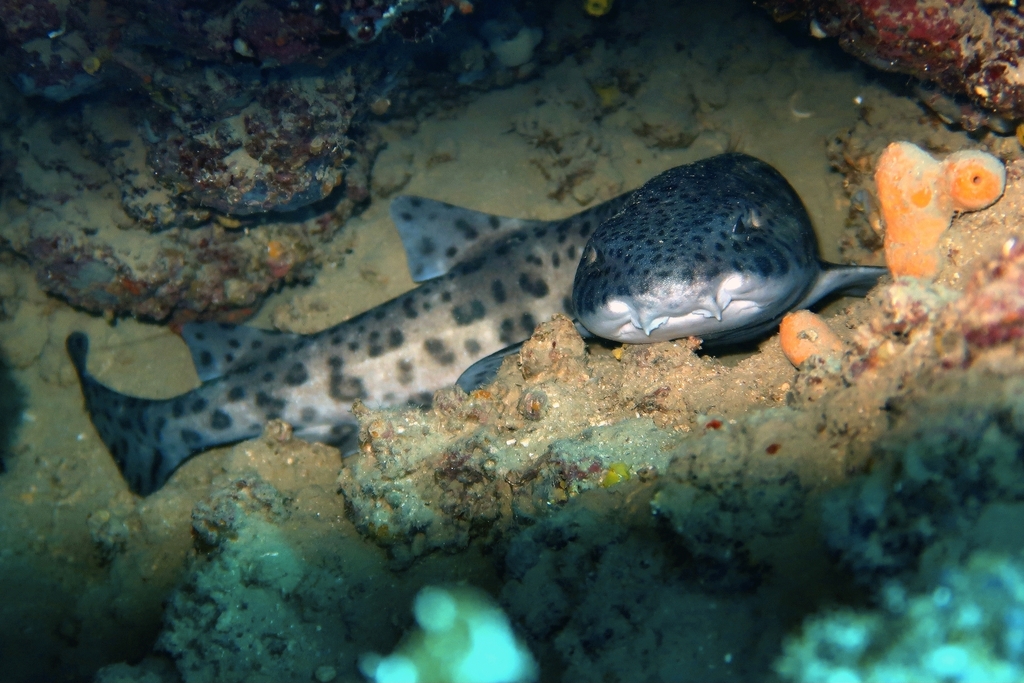


Photos show the species, not always the places on this page.
Length
Most are under about 1.3 m (4.3 ft); up to about 1.6 to 1.7 m (5.2 to 5.6 ft) is reported
Weight
Not given in the sources I read
Next to a person
Most are about as long as a young child is tall. The largest come close to an adult's height.
What it eats
Bottom-living fish, smaller sharks, crabs and other crustaceans, and cephalopods such as octopus and squid. Adults eat more fish and cephalopods, while young sharks eat more crustaceans.
Around people
Calm, give space
How it lives
The nursehound is a catshark of rocky ground and seaweed-covered seabed, usually at 20 to 63 m but found from the shallows down to about 400 m. It is mostly active at night. Females lay eggs in pairs in dark brown egg cases, 10 to 13 cm long, which they attach to seaweed between March and October. The eggs take about 7 to 12 months to hatch, and hatchlings are about 10 to 16 cm long. It matures at about 78 cm, and the oldest age reported is 19 years.
Where it goes
Studies of nursehounds in coastal waters of the UK describe animals that shelter in the same sheltered or exposed places and often return to them. Numbers there are highest in September. By day the shark rests in holes in the rocks, and at night it swims into deeper water to hunt. The sources I read do not describe long migrations.
We only draw a journey on the map when scientists have tracked it or clearly documented it. For this animal we have not found one yet.
Populations
Worldwide it is Vulnerable (assessed 2020). The IUCN estimates a fall of 30 to 49% over about 48 years, with numbers rising in the Northeast Atlantic and falling in the Mediterranean. Some local drops are large: in the upper Tyrrhenian Sea numbers are reported to have fallen by over 99% since the 1970s, and groups in the Gulf of Lion, Albania and the Balearic Islands have also declined. In the Celtic Sea, Irish Sea and Bristol Channel it is a regular catch in lobster and crab pots (2024 study). It is also a minor target of commercial fisheries. Some records from the southern Atlantic may be a different species.
Meet it respectfully
Watch from a calm distance and let the shark stay in its hole. Never chase, touch, feed or bait it, and do not shine lights in its face or block its way out. Egg cases seen underwater may still hold a developing shark, so leave them where they are. Keep fins and gear off the rocks and seaweed around it. I did not read local rules for this species, so follow your guide and local rules.
Fun fact
Tap the bulb to light it up.
The egg cases are often called mermaid's purses. They are much bigger than those of the small-spotted catshark.
Nursehounds spend the day in small holes in the rock and hunt at night.
A nursehound egg can take 7 to 12 months to hatch, depending on where it is laid.
Nursehound in the Ocean Atlas
Places we have researched where this animal is recorded. It is never guaranteed, and some places are for watching from the boat only.
Travel with usComing soonTrusted referralExploringOn pause, story onlyEthics pass
Country colour: pink where we travel, blue where we are exploring or refer, grey for story only.
 Cameroon
 Côte d'Ivoire
 Croatia
 France
 Gabon
Gabon Ghana
Ghana Guinea
 Guinea-Bissau
 Ireland
 Italy
Italy Liberia
 Netherlands
 Nigeria
 Sierra Leone
 Spain
Spain United Kingdom
Sources for this page
- IUCN Red List, 2021 (Finucci et al.)
- GBIF, IUCN category, 2026
- FishBase, 2026
- Wikipedia, Nursehound, 2026
- Shark Trust, 2026
- Cook et al., 2024, Frontiers in Marine Science
Facts checked 5 October 2026. Photos: Unsplash licence, or Creative Commons as shown on each photo.
Work in ocean travel?
We are always happy to hear from exceptional local operators, accommodation, conservation organisations and destination experts. If your work fits responsible, small-group ocean travel, we would love to learn more.
Partner with Ocean CallingNew: tiger sharks in Fuvahmulah, January or March 2027
from CHF 2,900