
White-chinned petrel
Procellaria aequinoctialis
A dark Southern Ocean seabird that follows ships, and no sighting is ever a promise.
Vulnerable (IUCN) means it is at high risk of extinction in the wild, mainly because of fishing bycatch and introduced predators on its nesting islands.
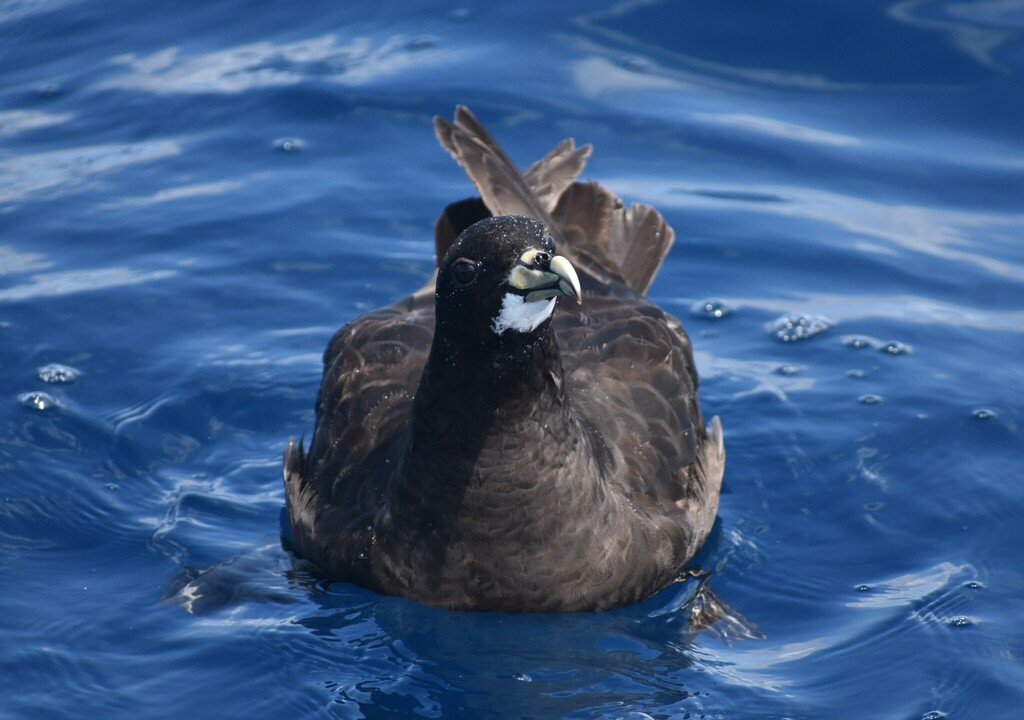
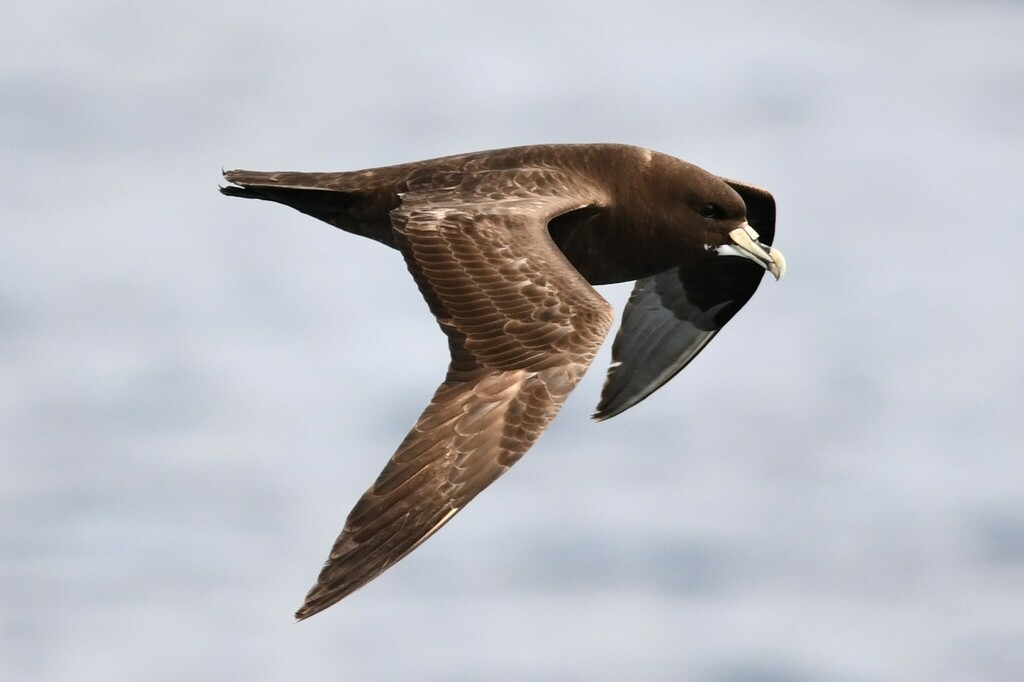
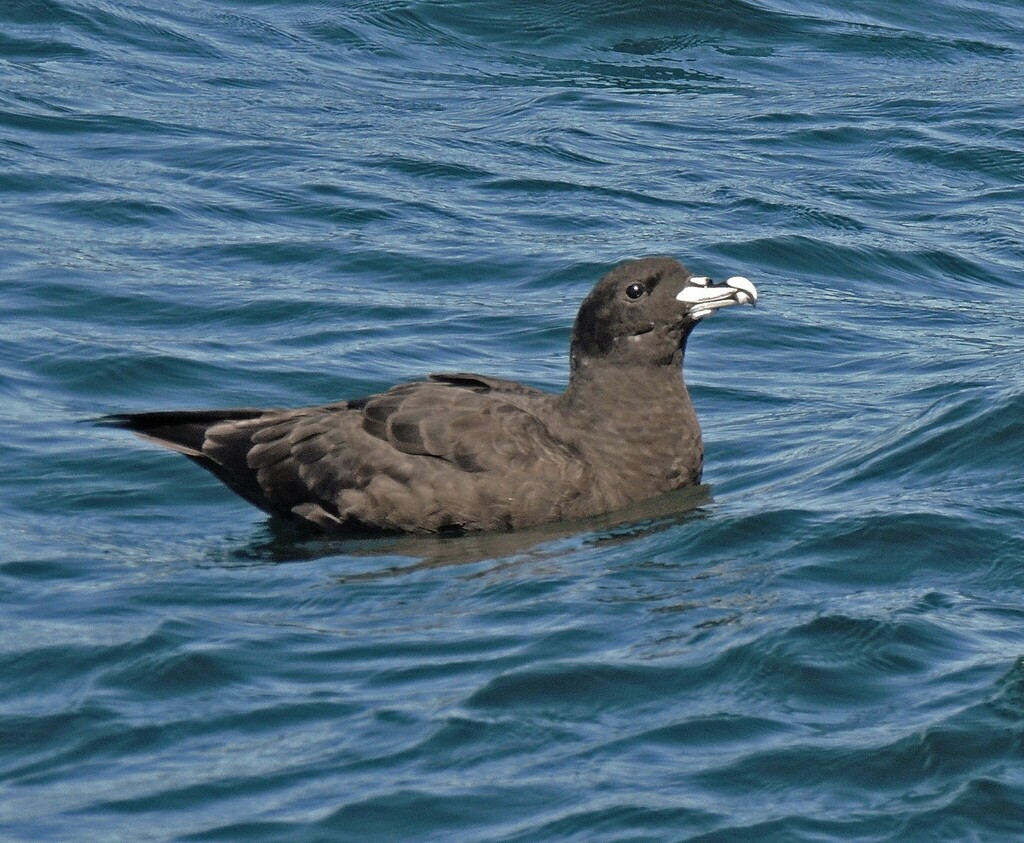
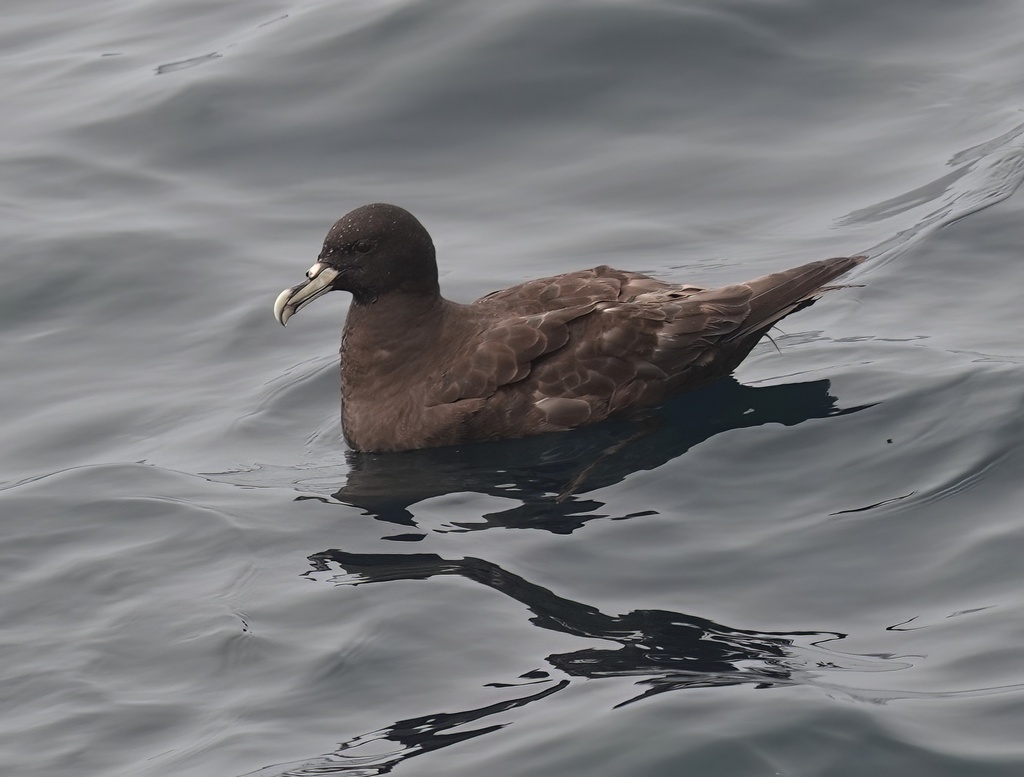
Photos show the species, not always the places on this page.
Length
About 51 to 58 cm (20 to 23 in) long, with a wingspan of about 134 to 147 cm (53 to 58 in)
Weight
About 1.3 kg (2.9 lb). Males average about 1.39 kg and females about 1.28 kg; a New Zealand source gives about 1.25 kg
Next to a person
About as long as a young child is tall, with a wingspan close to the height of an adult
What it eats
Mainly krill, then fish, squid and other small sea animals. It takes food from the surface or dives to about 15 m (50 ft), often at night. It also scavenges waste from fishing vessels.
Around people
Ocean wanderer, give space
How it lives
A large dark petrel with a white patch on the chin or throat, and a pale bill. It flies low, gliding and soaring up to about 10 m above the waves. It nests in colonies in burrows 1 to 3 m deep, with one pair laying a single egg in late November or December. The chick fledges in April or May, after 87 to 106 days. It is mostly solitary at sea but forms flocks around boats.
Where it goes
Ranges across the Southern Ocean, south to the Antarctic pack ice and north to the coasts of southern Africa and South America. It breeds on remote islands including South Georgia, the Prince Edward Islands, the Crozets, Kerguelen, the Falklands, and islands near New Zealand. It is mostly solitary at sea but gathers in numbers around fishing vessels.
We only draw a journey on the map when scientists have tracked it or clearly documented it. For this animal we have not found one yet.
Populations
Vulnerable worldwide (IUCN). About 1.2 million breeding pairs, or around 3 million adults, are estimated (ACAP). More than 100,000 pairs each breed on South Georgia, Kerguelen and the Auckland Islands, and about 200,000 pairs nest on Disappointment Island in the Auckland Islands, according to a New Zealand source. At places with trend records, numbers have fallen by a quarter to a third over about two decades. The main threats are longline hooks and trawl cables at sea, and introduced cats and rodents at nesting islands. It is covered by the Agreement on the Conservation of Albatrosses and Petrels and by Appendix II of the Convention on Migratory Species.
Meet it respectfully
Watch from a boat at a distance and let birds feed and rest undisturbed. Never throw food or fish scraps to attract it, because birds that follow boats can end up hooked or struck by cables. Never chase or bait it. Sightings depend on the sea and the season, and none is promised. I did not read any local viewing rules for this species.
Fun fact
Tap the bulb to light it up.
It is the largest species in its family outside the giant petrels.
It nests in burrows 1 to 3 m deep and lays a single egg.
It follows fishing boats and eats their waste, which exposes it to hooks and cables.
White-chinned petrel in the Ocean Atlas
Places we have researched where this animal is recorded. It is never guaranteed, and some places are for watching from the boat only.
Travel with usComing soonTrusted referralExploringOn pause, story onlyEthics pass
Country colour: pink where we travel, blue where we are exploring or refer, grey for story only.
 Antarctica
 Argentina
 Australia
 Brazil
 Chile
Chile Falkland Islands
 Mozambique
 Namibia
 New Zealand
 Peru
Peru Saint Helena
 South Africa
 United States
 Uruguay
Sources for this page
- ACAP, species summary, 2012
- Wikipedia, 2026
- New Zealand Birds Online, 2026
- GBIF and IUCN Red List category, 2026
Facts checked 5 October 2026. Photos: Unsplash licence, or Creative Commons as shown on each photo.
Work in ocean travel?
We are always happy to hear from exceptional local operators, accommodation, conservation organisations and destination experts. If your work fits responsible, small-group ocean travel, we would love to learn more.
Partner with Ocean CallingNew: tiger sharks in Fuvahmulah, January or March 2027
from CHF 2,900