
Whitespotted wedgefish
Rhynchobatus djiddensis
A shark-shaped ray that rests on sandy seabeds and is rarely met. No sighting is ever a promise.
Critically Endangered (IUCN, assessment of 2018 as reported by FishBase) means it faces an extremely high risk of extinction in the wild, mainly because of fishing.
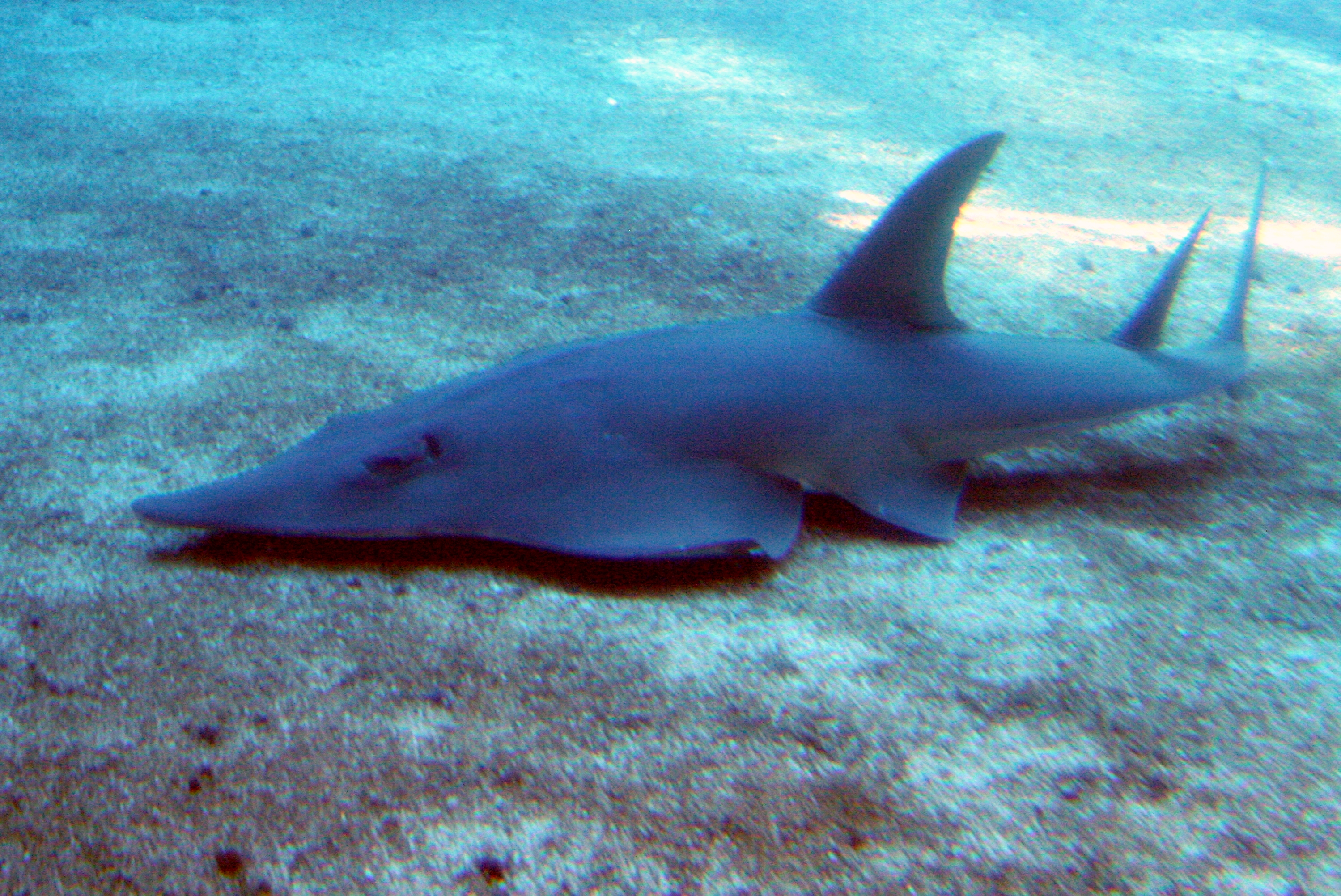
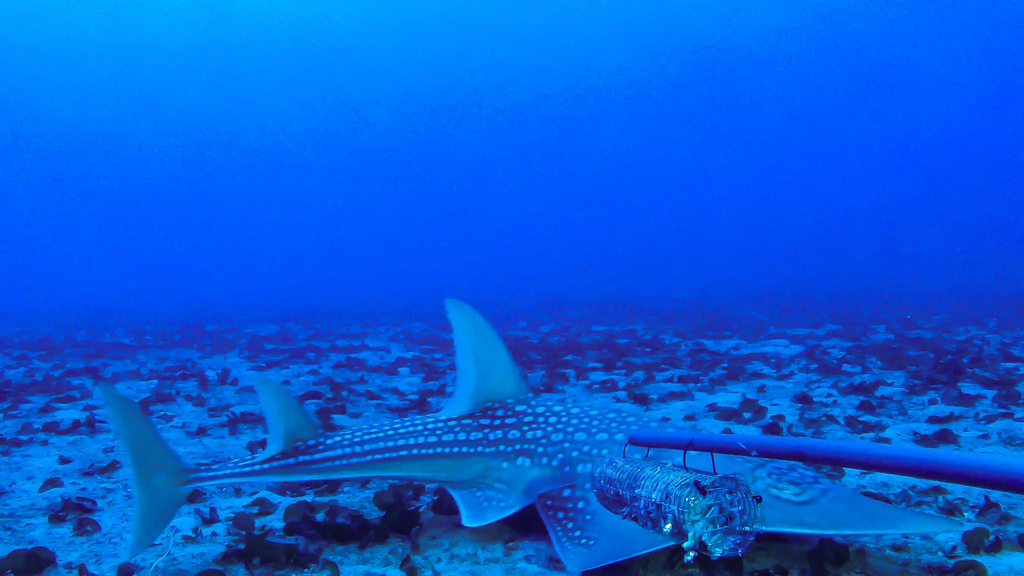
Photos show the species, not always the places on this page.
Length
Up to about 3.1 m (10 ft) total length. Newborns are about 43 to 60 cm (17 to 24 in). In Kenya, trawl catches in Malindi-Ungwana Bay ranged from 23 to 210 cm (9 to 83 in)
Weight
Up to about 227 kg (500 lb) reported as the maximum; most animals are much smaller
Next to a person
A large adult can be about 1.7 times as long as a tall person, but a young one is about the length of an arm
What it eats
Crabs, lobsters, bivalves, small fish and squid, taken from sand and mud on the bottom.
Around people
Calm, give space
How it lives
It lives near the seabed in shallow coastal water, often inshore and in estuaries, at depths of about 1 to 75 m. It gives birth to live young, about four pups per litter, born in summer at about 43 to 60 cm. It matures at about 177 cm. It is harmless to people. In Kenya, 24 newborn-sized animals (23 to 60 cm) were caught in prawn trawls in Malindi-Ungwana Bay in 2019 to 2021, and this is the only Kenyan coastal site where newborns have been documented.
Where it goes
Little is known about how far it travels. It lives in the Red Sea, the Persian Gulf and the western Indian Ocean down to South Africa. In Kenya, newborn wedgefish have been recorded in Malindi-Ungwana Bay, which suggests the bay is used as a nursery.
We only draw a journey on the map when scientists have tracked it or clearly documented it. For this animal we have not found one yet.
Populations
Critically Endangered worldwide. Fishing has reduced its numbers by more than 80 percent over three generations. It was once thought to be one widespread Indo-Pacific species, but research showed a group of four species, and this one is restricted to the Red Sea, the Persian Gulf and the western Indian Ocean to South Africa. It is on CITES Appendix II. In Kenya, the bay is recognised as an Important Shark and Ray Area, and the species is caught as bycatch in prawn trawls. In 2022, Kenya landed 1,080 tonnes of sharks and rays, and almost half the rays landed were immature.
Meet it respectfully
Wedgefish are shy bottom dwellers. If you meet one, stay still and keep your distance, hold your position above the seabed and let it move off. Never chase, touch, feed or bait it, and keep fins and cameras away from the sand around it. Although it is harmless to people, it is fragile and rare. Ask your operator what local rules apply; none were checked for this card.
Fun fact
Tap the bulb to light it up.
It is a ray with a shark-like body and tall fins, which is why wedgefish are also called sharkfin guitarfishes.
Large black eyespots on its pectoral fins and a dark mark between the eyes help to identify it.
Research has shown that what was once called one Indo-Pacific species is a group of four species.
Whitespotted wedgefish in the Ocean Atlas
Places we have researched where this animal is recorded. It is never guaranteed, and some places are for watching from the boat only.
Travel with usComing soonTrusted referralExploringOn pause, story onlyEthics pass
Country colour: pink where we travel, blue where we are exploring or refer, grey for story only.
 Australia
 India
India Indonesia
 Japan
Japan Kenya
Kenya Mozambique
 South Africa
 Taiwan
 Thailand
Sources for this page
- FishBase, Rhynchobatus djiddensis
- Wikipedia, Giant guitarfish
- Wikipedia, Wedgefish
- Important Shark and Ray Areas, Malindi-Ungwana Bay
- Mongabay, 2026
- University of Eldoret, prawn trawling research
- GBIF, IUCN category
Facts checked 5 October 2026. Photos: Unsplash licence, or Creative Commons as shown on each photo.
Work in ocean travel?
We are always happy to hear from exceptional local operators, accommodation, conservation organisations and destination experts. If your work fits responsible, small-group ocean travel, we would love to learn more.
Partner with Ocean CallingNot sure where to go? Get your Ocean Match
from CHF 19