
Moalboal Sardines: Learning to Slow Down as a Freediver
Imagine floating face down a short swim from Panagsama Beach, on the west coast of Cebu, while a silver cloud of fish turns slowly below you. That is the Moalboal sardine school. For a new freediver it is more than a beautiful scene. It is a place to learn that the slowest person in the water often sees the most.
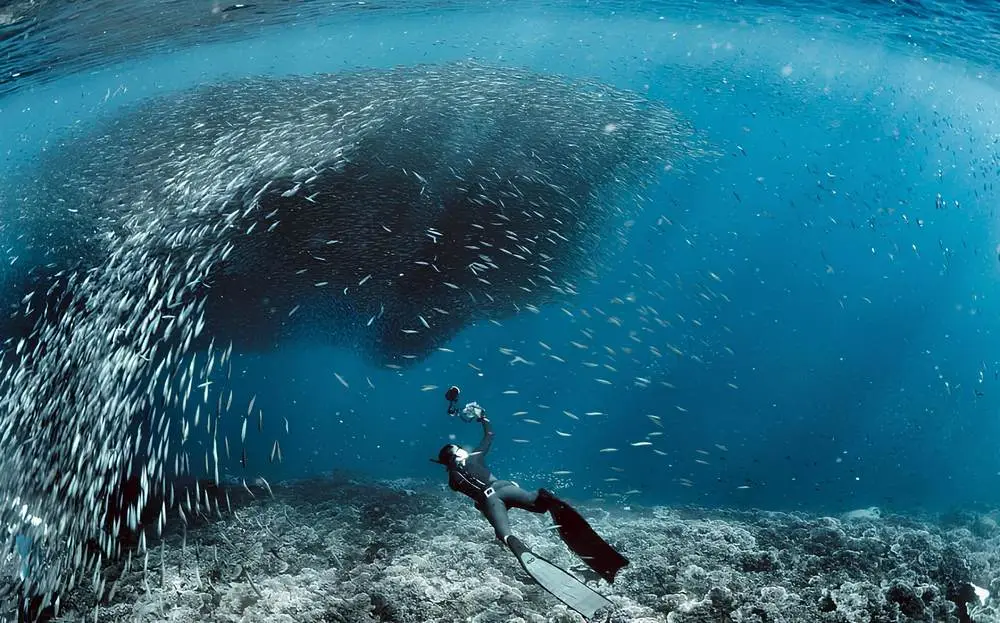
Many people arrive wanting to dive straight into the middle of it. I understand the feeling. But the fish, and your own body, have a different lesson to teach. Can a beginner freedive here? Yes, with an instructor and a buddy, and with the idea that the first goal is to float, breathe and watch, not to go deep.
A school that stays, not a run that passes
Many people call it the Moalboal sardine run. The word "run" makes the fish sound as if they race through on a short migration, and that is not what happens here.
PADI describes a school of more than a thousand sardines a short swim from the shore of Panagsama Beach, there all year round. It is resident. You can learn more on our Moalboal sardines page.
Because the school stays, planning becomes more honest. You can choose one morning for the water and another for the lesson. What you cannot choose is how many fish there will be, where exactly they will sit, or what shape they will make. The sea is never a scheduled show.
A famous scene nobody fully understands
For something so famous, the Moalboal sardine school is surprisingly little studied. Writing after an expedition in 2023, Oceanographic Magazine reported that the fish gather around the five metre mark, and that scientists have only hypotheses about why they settled here.
One idea is that changing temperatures and currents have shifted the plankton the sardines eat. Another is that overfishing or fish bombing in nearby areas reduced their predators. The authors are careful to call these "mere hypotheses".
The same article describes local rules that help the fish, including catch limits, net size limits and no-fishing periods.
Can beginners freedive with the sardines?
Yes, with instruction, and with the right idea of what "freediving with the sardines" means on a first day.
A shore entry and shallow fish can make the water feel easy. The body does not see it that way. Divers Alert Network (DAN) explains that serious accidents have been linked to freedives that ignored the one-up, one-down rule or skipped the buddy system. One-up, one-down simply means one person dives while the buddy watches from the surface, every time.
Shallow-water blackout, which means losing consciousness during a breath-hold dive, is one of the most feared risks of freediving. DAN says the risk can be reduced with training and good safety practice. It also advises never to hyperventilate before a dive, never to dive alone, and to make sure everyone in the group is a trained freediver. That applies even a few metres from the beach.
So a beginner's first goal can be very simple. Float face down and breathe slowly through the snorkel. Watch how the school moves. Practise a relaxed duck-dive with your instructor, go down only a little, and come back up to your buddy. There is nothing to prove by going deeper.
Why slow works, in the body and in the water
Slowness is not only a mood. When you hold your breath with your face in the water, your body starts something called the mammalian dive reflex. DAN describes how the heart rate drops, which lowers the need for oxygen, and how blood vessels in the arms and legs tighten so that blood goes to the brain and heart first.
Fast kicking, a tense jaw and excited movements all spend oxygen that a calm body would keep.
The fish respond to calm too, in their own way. A school of sardines is always watching for predators. Off Pescador Island, just offshore from Moalboal, researchers filmed thresher sharks hunting sardines with overhead tail-slaps, and recorded 25 hunting events. To a sardine, anything large and fast is a question.
A swimmer who moves slowly at the edge of the school lets it keep its shape. A swimmer who dives straight into the middle breaks it apart. This is the lesson I love most here: stop trying to swim through the middle of the scene. Stay at the edge, stay still, and let the fish show you what they do.
How to be a gentle guest
Enter the water gently and swim out with your buddy, leaving space for other swimmers and for the school to move. Do not chase the fish, do not dive through them for a photo, and do not reach out to touch them. If you meet a turtle on the reef on the way out, keep your distance and let it breathe and feed without company. Never stand on the reef or hold on to coral, even in shallow water.
Moalboal can be busy, and crowding changes the experience for everyone, the fish included. A good local guide knows the conditions of the day, briefs you before you enter, keeps groups small and is happy to wait for a quieter moment. Follow the local rules on fishing and on the reef. Wildlife encounters are unpredictable. Freediving near sardines and turtles should always follow local regulations and experienced professional guidance.
For long mornings at the surface I pack a simple low-volume mask and snorkel and a long-sleeve rash guard.
If you would like to learn at this slower pace, have a look at our Moalboal trip through Ocean Match. We match you with a vetted local freediving team, and you book with them directly.
Questions people ask
Is the Moalboal sardine school there all year?
It is described as there all year round. Its size, shape and exact position change, so nothing about a given day is promised.
How deep are the sardines?
Oceanographic Magazine reported the school gathering around the five metre mark. Depth changes from day to day, and a beginner can enjoy the school from the surface.
Do I need a freediving course to swim with the sardines?
You can snorkel at the surface without one. For breath-hold dives below the surface, DAN recommends certified training and a trained buddy.
Why is it called a sardine run if it does not migrate?
It is a popular tourism name borrowed from other places. In Moalboal the school is resident, so "sardine school" describes it better.
Wildlife encounters are never guaranteed and never forced. Ocean Calling works only with vetted, ethical local operators, and every animal is free to approach, or not, entirely on its own terms.
Sources & further reading
- Wormald, S., 2019. The amazing marine life of the Philippines. PADI Blog.
- Cross, A., 2023. Searching for bait in Moalboal. Oceanographic Magazine.
- Chimiak, J. and Valdivia-Valdivia, J., 2023. Freediving risk assessments. Alert Diver, Divers Alert Network.
- Brett, K., 2018. How the dive reflex protects the brain and heart. Alert Diver, Divers Alert Network.
- Oliver, S.P. et al., 2013. Thresher sharks use tail-slaps as a hunting strategy. PLoS ONE.
Further reading on Ocean Calling: Why the Moalboal sardine ball is not a sardine run · Moalboal’s reef rules beyond the sardines · What freediving safety requires of two people · Philippines in the Ocean Atlas
Moalboal scuba certification and freediving trip: sardine run, sea turtles and Alegria statues
Scuba or freediving certification · Moalboal, Cebu, Philippines
Marine life close to shore, at a calm pace. This story is about the Philippines, where we run trips in Moalboal and Coron.
Explore in the Ocean Atlas
Places in this article
Animals in this article
