
Black-browed albatross
Thalassarche melanophris
A wide-winged seabird that spends most of its life over open water and comes to land only to nest. No sighting is ever a promise.
Least Concern (IUCN, 2018) means it is not currently close to the thresholds for a threatened category. Falklands counts have mostly risen or held steady, but fisheries bycatch remains a concern.
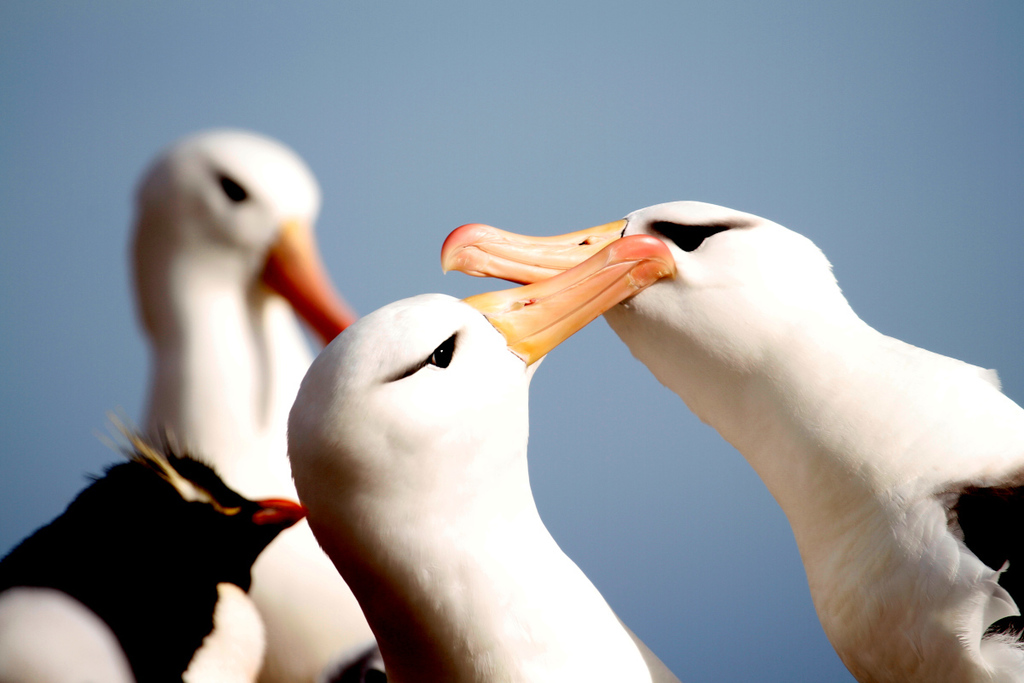
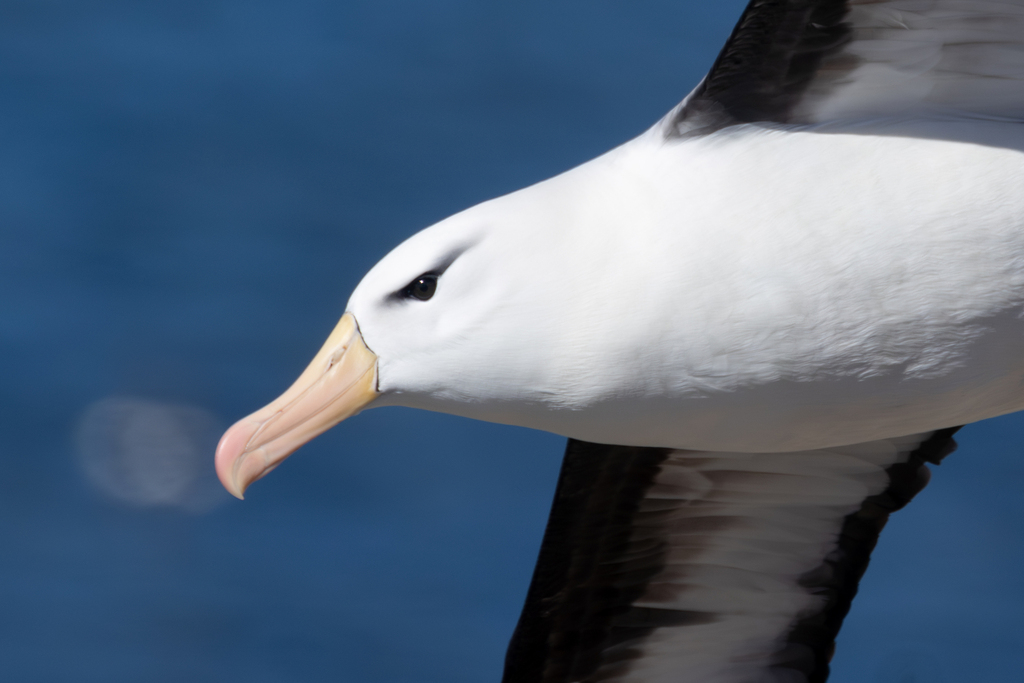
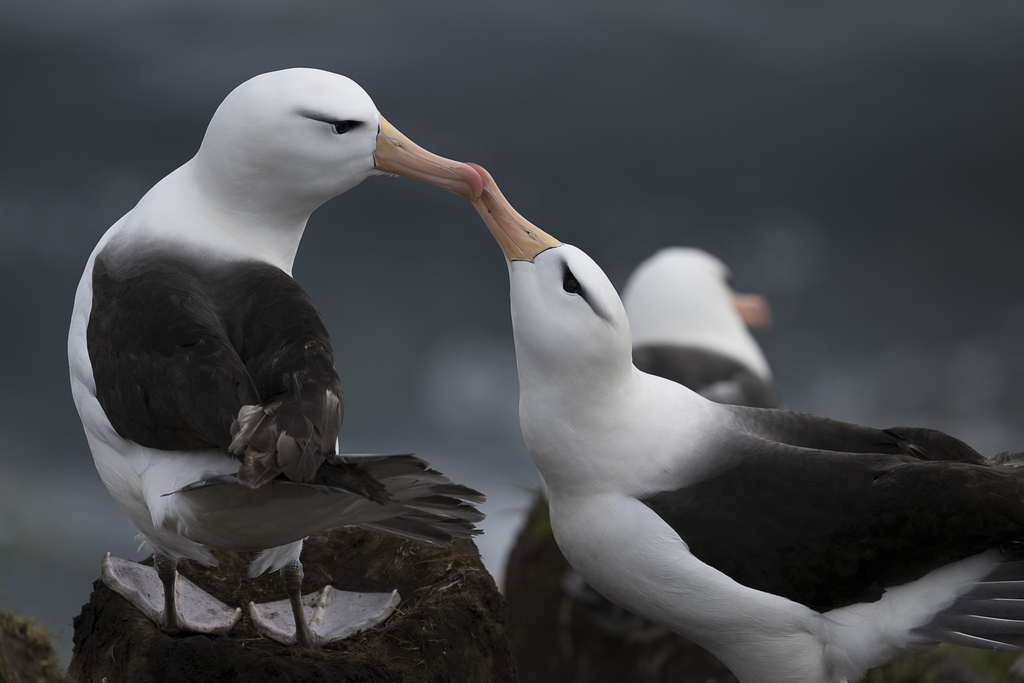
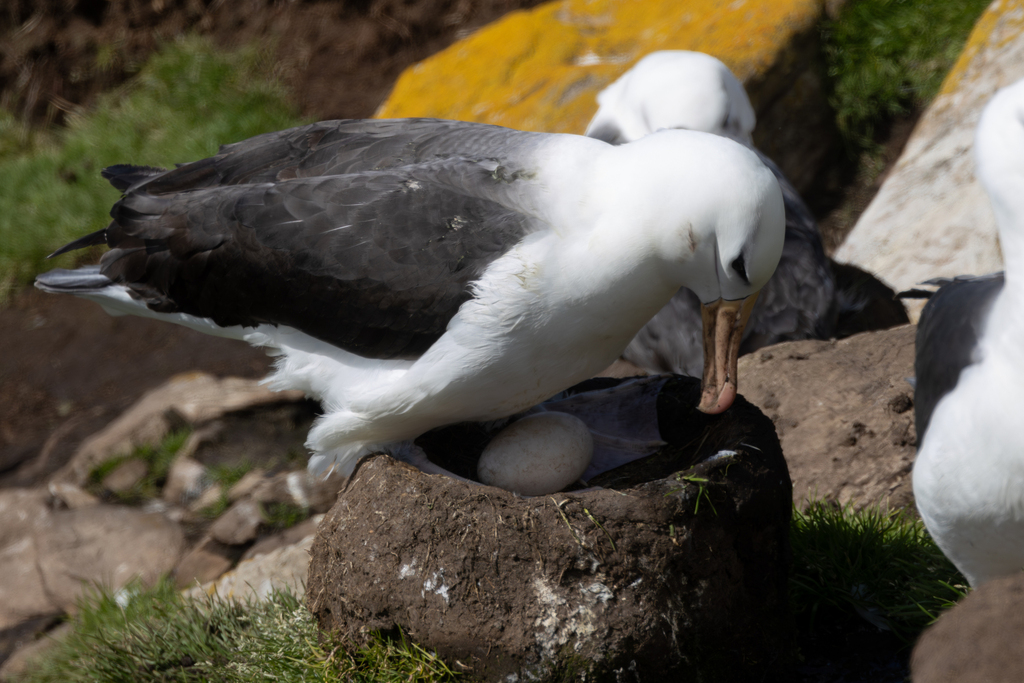
Photos show the species, not always the places on this page.
Length
About 80 to 95 cm (31 to 37 in) long, with a wingspan of about 200 to 240 cm (79 to 94 in). Falklands Conservation gives a wingspan of 210 to 250 cm (83 to 98 in).
Weight
About 2.9 to 4.7 kg (6.4 to 10.4 lb).
Next to a person
Wingspan wider than a tall adult with arms outstretched, and about as heavy as a large house cat.
What it eats
Fish, squid and crustaceans, as well as carrion and discards from fishing boats. In the Falkland Current, birds feed mainly on fish, lobster-krill and squid.
Around people
Calm, give space
How it lives
Pairs build a mud nest up to about 50 cm high and reuse it each year. They lay a single egg between late September and early November, incubate it for about 68 to 71 days, and chicks fledge after about 120 to 130 days, around April. Birds start breeding at about 7 to 10 years old. Individuals have been recorded surviving for more than 50 years. In the Falklands they often nest beside rockhopper penguins.
Where it goes
Falklands birds arrive in about September to breed and leave by about the end of April. Adults forage over more than 200 miles (320 km) per trip. Young birds go north to southern Brazil and return to breed after about 7 to 10 years.
We only draw a journey on the map when scientists have tracked it or clearly documented it. For this animal we have not found one yet.
Populations
Global: about 600,000 breeding pairs on 12 southern ocean islands (2005, Wikipedia). Falkland Islands: the largest population, about 399,416 pairs in 2007 (Wikipedia). Falklands Conservation gives about 500,000 pairs, around 70 percent of the world total, mainly on Steeple Jason and Beauchene Island. At Bird Island, counts rose from about 10,200 pairs in 2000/01 to 15,525 pairs in 2006 and 15,719 pairs in 2010 (ACAP). At Steeple Jason in 2020/21, pairs were 1 percent below 2019, and the long-term monitoring trend suggests a stable population. Breeding success there stayed below the annual average for the sixth year in a row. The species is the bird most often killed by fisheries, mainly through longline and trawl gear. IUCN status: Least Concern (2018).
Meet it respectfully
Watch from a distance and keep quiet near nests. Never chase, touch, feed or bait albatrosses, and never walk close to nesting birds, which sit on the ground and cannot easily move away. At sea, do not throw food or scraps from a boat, because albatrosses follow fishing boats and can be hooked or caught in gear. The Falkland Islands Tourist Board suggests an observation spot about 6 m (20 ft) from the birds and following the Countryside Code. Follow local rules and your guide. Colonies are active only in the breeding season and no sighting is guaranteed.
Fun fact
Tap the bulb to light it up.
The name comes from the dark line over and through the eye, which looks like a thick eyebrow.
The nest is a mud pedestal up to about 50 cm high, and pairs reuse it each year.
Young birds fly north to southern Brazil and return to breed only after about 7 to 10 years.
Black-browed albatross in the Ocean Atlas
Places we have researched where this animal is recorded. It is never guaranteed, and some places are for watching from the boat only.
Travel with usComing soonTrusted referralExploringOn pause, story onlyEthics pass
Country colour: pink where we travel, blue where we are exploring or refer, grey for story only.
 Antarctica
 Argentina
 Australia
 Brazil
 Chile
Chile Denmark
 Falkland Islands
 Germany
 Namibia
 New Caledonia
 New Zealand
 Norfolk Island
 Norway
 Peru
Peru Portugal
 Saint Helena
 South Africa
 Sweden
 United Kingdom
 United States
 Uruguay
Sources for this page
- IUCN Red List category via GBIF, 2026
- Wikipedia, Black-browed albatross, 2026
- Falklands Conservation, 2026
- ACAP, Bird Island, Falkland Islands, 2026
- ACAP, Monitoring black-browed albatrosses in the South Atlantic, 2020/21
- Falkland Islands Tourist Board, albatross viewing, 2026
Facts checked 5 October 2026. Photos: Unsplash licence, or Creative Commons as shown on each photo.
Work in ocean travel?
We are always happy to hear from exceptional local operators, accommodation, conservation organisations and destination experts. If your work fits responsible, small-group ocean travel, we would love to learn more.
Partner with Ocean CallingShop with Ocean Calling
Visit the Ocean Calling storefront on Amazon.
As an Amazon Associate I earn from qualifying purchases. You are not only choosing products that respect the ocean, you are also helping us keep going: paying our local partners fairly and keeping our retreats ethical, sustainable and honestly priced for you. 💗