
Broadclub cuttlefish
Ascarosepion latimanus
A large Indo-Pacific reef cuttlefish that can flash waves of colour while hunting or courting. Look calmly and never chase or grab it.
Data Deficient (IUCN, 2012) means there is not enough data to judge the risk. It does not mean the species is safe.
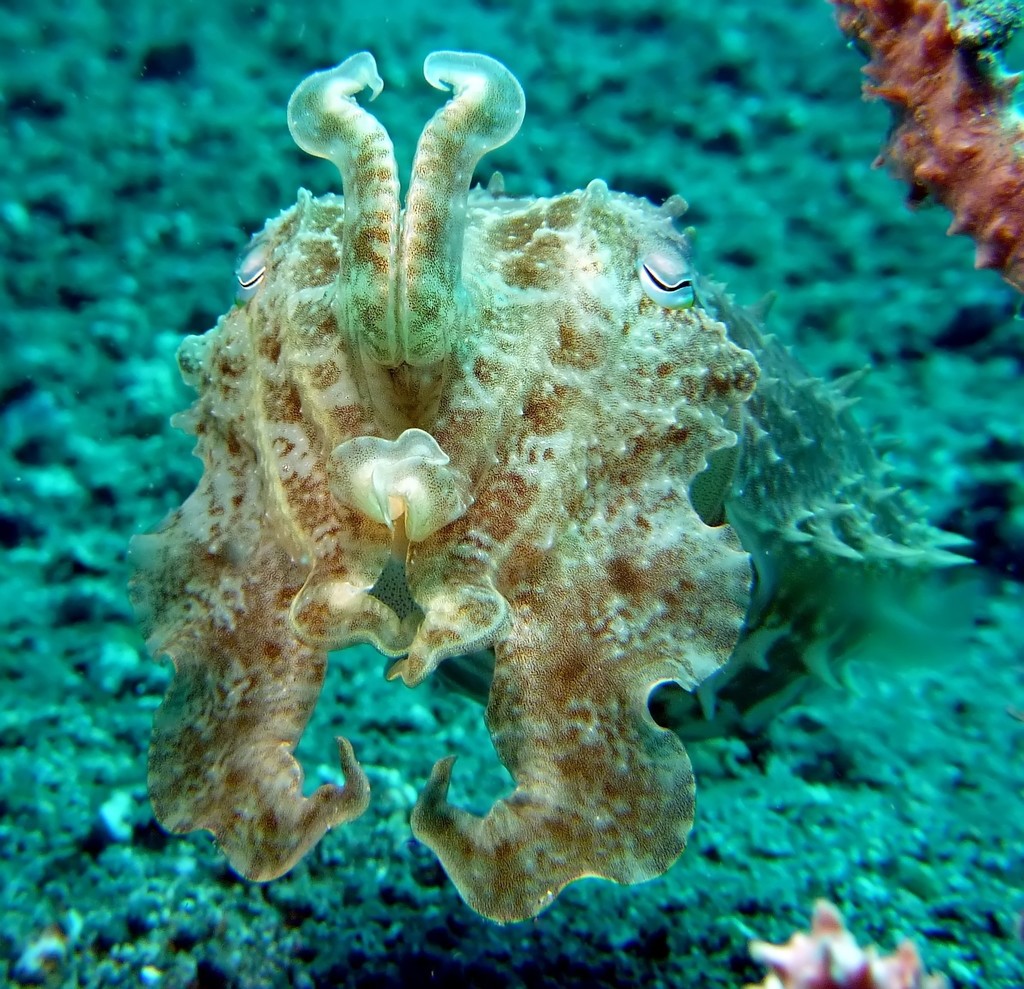
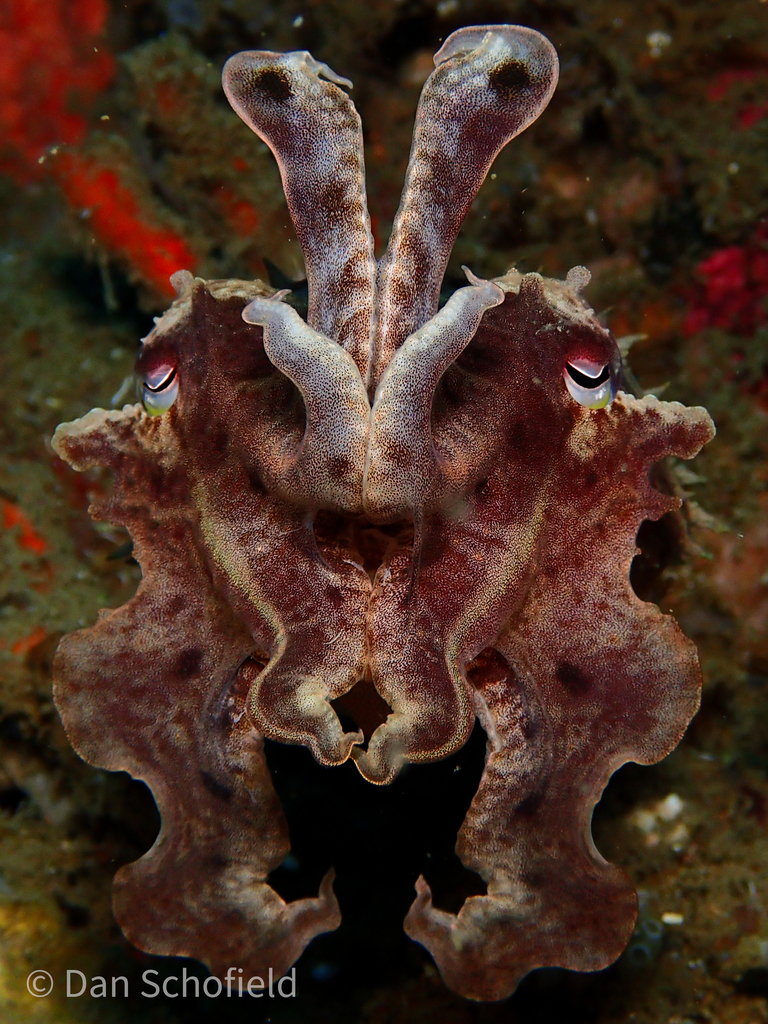
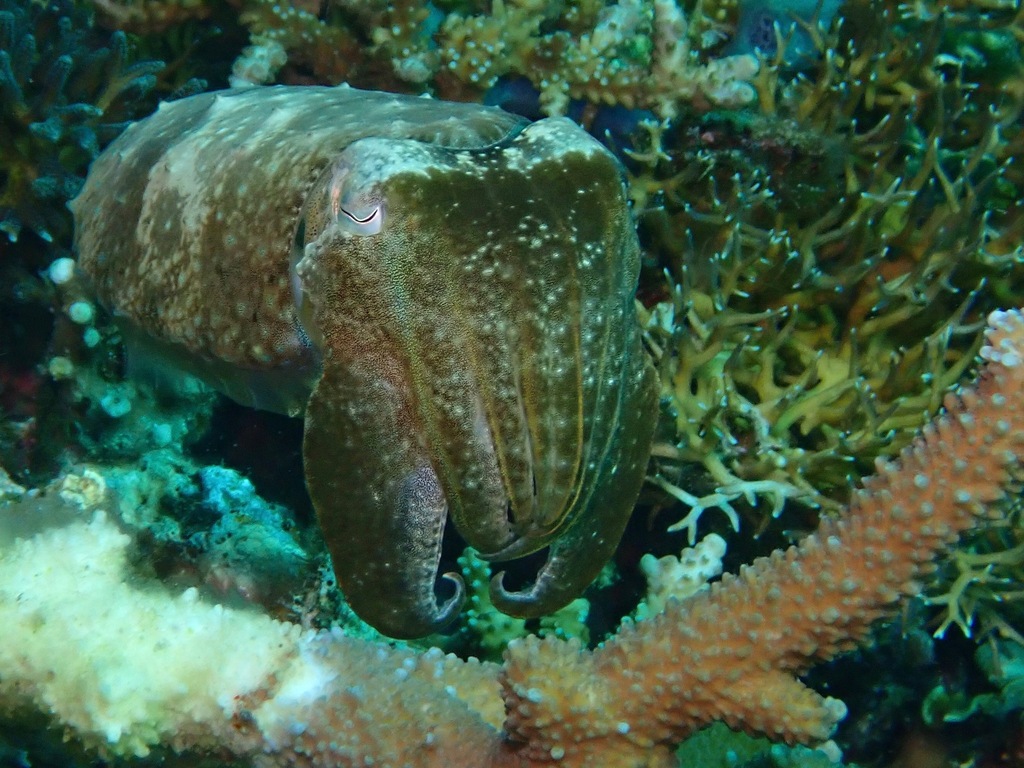
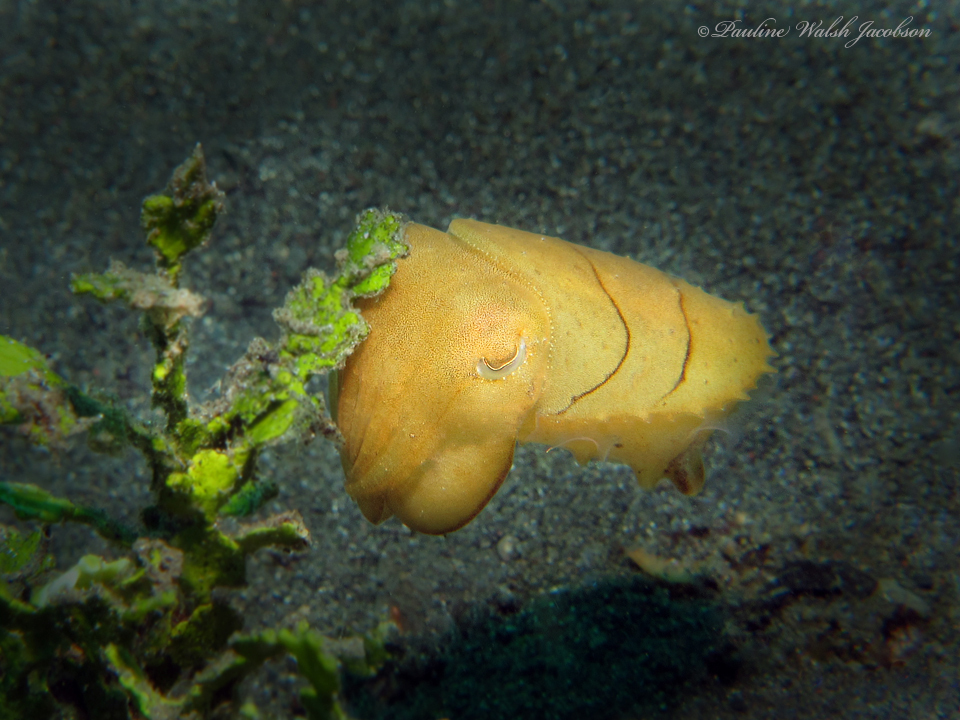
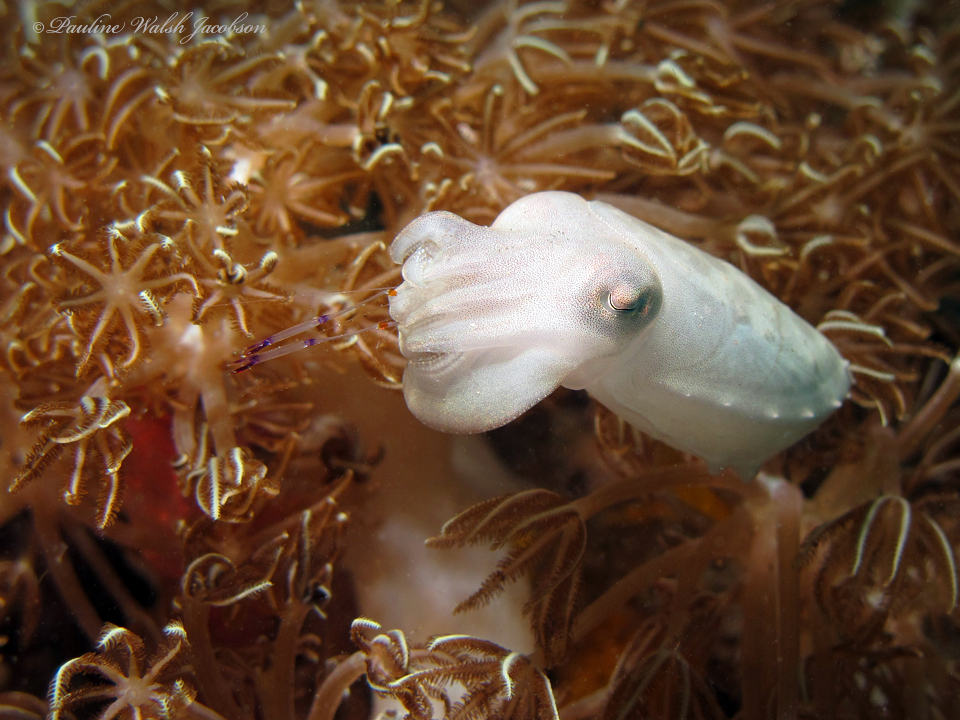
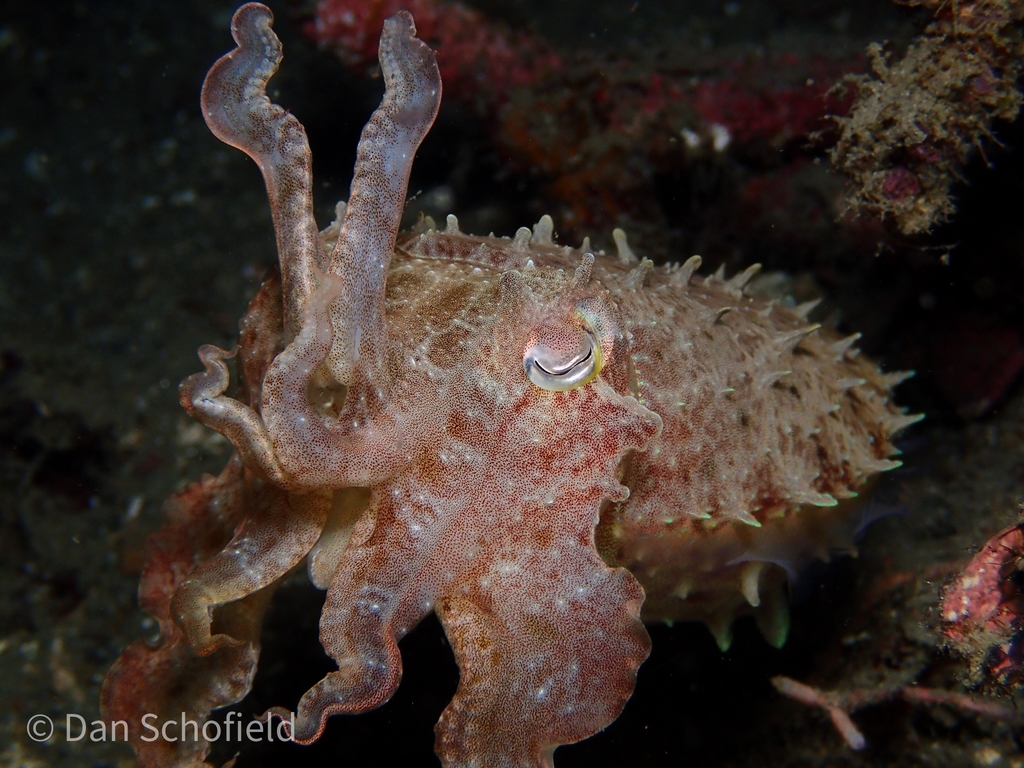
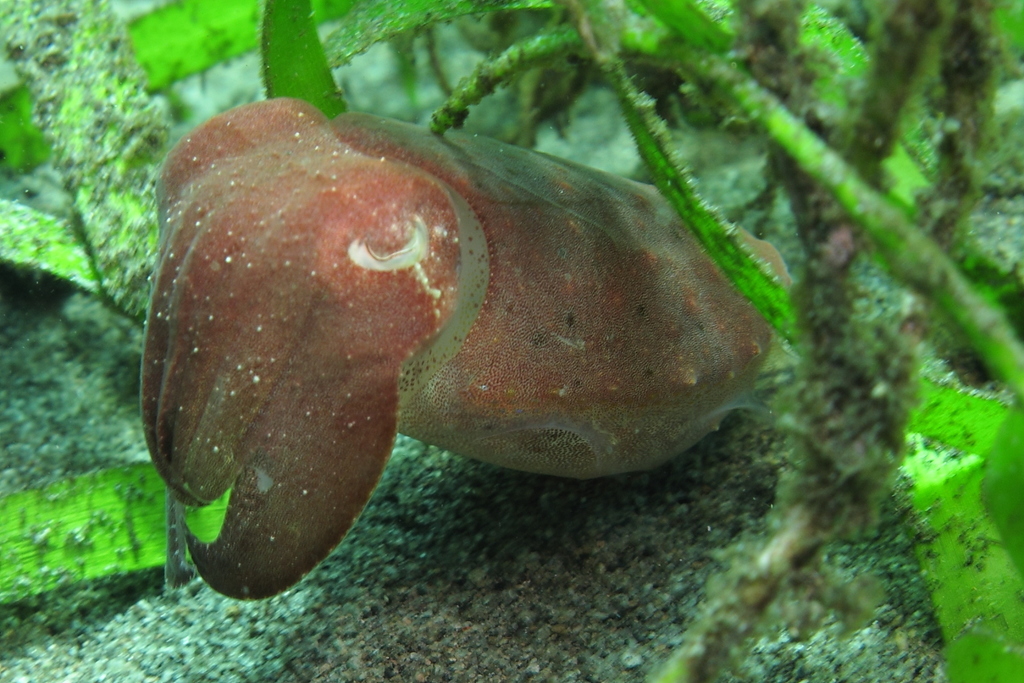
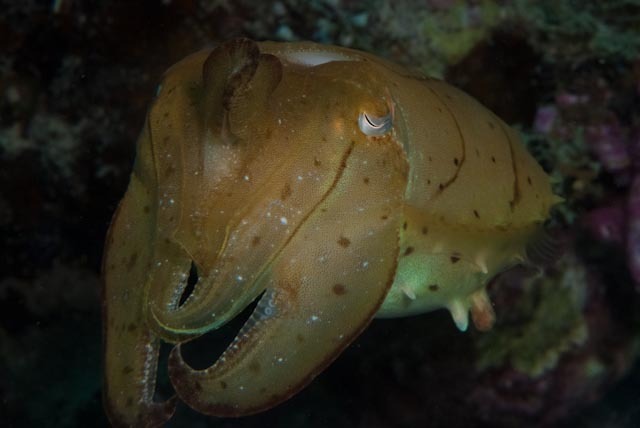
Photos show the species, not always the places on this page.
Length
Body (mantle) up to about 50 cm (20 in); typical adult size is not reliably measured, and most seen on reefs are smaller
Weight
Maximum often given as about 10 to 12 kg (22 to 26 lb), but sources disagree; typical adult weight is not reliably measured
Next to a person
The body alone can be up to about 30% of an adult's height; most are smaller
What it eats
Fish and crustaceans such as shrimp, prawns and crabs.
Around people
Calm, give space
How it lives
The broadclub cuttlefish is a large reef cuttlefish and a master of colour change. When hunting fish, shrimp and crabs, it can pulse bands of colour along its body and use different disguises as it moves closer. In the breeding season, males show bold zebra stripes in contests with other males. It is not an octopus: it has an internal cuttlebone and W-shaped pupils.
Where it goes
It is active by day and often hovers near coral and rubble. It is usually seen from shallow water down to about 30 m, with records to 55 m. It is not known to travel far; it moves to egg-laying sites near shore only where this has been observed.
We only draw a journey on the map when scientists have tracked it or clearly documented it. For this animal we have not found one yet.
Populations
Found widely on reefs from southern Mozambique and the Andaman Sea to Japan, northern Australia and Fiji. There are no named subspecies, though North Sulawesi animals show local genetic differences. Breeding sites and seasons differ: dead Lobophyllia coral heads in Guam, branching corals with crevices in Sulawesi. The IUCN lists it as Data Deficient, because its population trend is not known.
Meet it respectfully
Watch calmly and let the cuttlefish choose the distance. Never touch, grab, chase, feed or block its path. A curious cuttlefish may come close to a quiet diver, but that is not an invitation to touch. A stressed cuttlefish flees or squirts ink, which wastes its energy.
Fun fact
Tap the bulb to light it up.
It is the second-largest cuttlefish in the world, after the giant Australian cuttlefish.
Its eggs are about 2 cm across and hatch after about 38 to 40 days.
It is not venomous, but it can bite with its beak if it is handled.
Filmed hunting crabs in Raja Ampat, Indonesia, broadclub cuttlefish used at least four different disguises, with names like 'leaf' and 'branching coral', and sometimes switched between them mid-hunt.
Source: How et al., 2025, Ecology, Multiple hunting displays in wild broadclub cuttlefish
Broadclub cuttlefish in the Ocean Atlas
Places we have researched where this animal is recorded. It is never guaranteed, and some places are for watching from the boat only.
Travel with usComing soonTrusted referralExploringOn pause, story onlyEthics pass
Country colour: pink where we travel, blue where we are exploring or refer, grey for story only.
 Australia
 Indonesia
 Japan
Japan Malaysia
 Mozambique
 New Caledonia
 Palau
Palau Papua New Guinea
 Philippines
 Singapore
 Solomon Islands
 Taiwan
 Timor-Leste
 United States
 Vanuatu
Read more about the broadclub cuttlefish
Sources for this page
- Dan et al., 2012
- Animal Diversity Web
- MarineBio
- SeaLifeBase, 2005
- WoRMS
- IUCN Red List (Barratt and Allcock), 2009
- Corner and Moore, 1980, Micronesica
- How et al., 2025, Ecology
Facts checked 26 September 2026. Photos: Unsplash licence, or Creative Commons as shown on each photo.
Work in ocean travel?
We are always happy to hear from exceptional local operators, accommodation, conservation organisations and destination experts. If your work fits responsible, small-group ocean travel, we would love to learn more.
Partner with Ocean Calling7-day freediving course in Coron, Palawan
CHF 1,480