
Orange-spotted toadfish
Torquigener hypselogeneion
A small spotted fish that spends much of the day half buried in the sand. It is shy by nature, and no sighting is a promise.
Least Concern (IUCN, 2011) means it is not at high risk of extinction in its native range, but in the Mediterranean it is an invasive species.
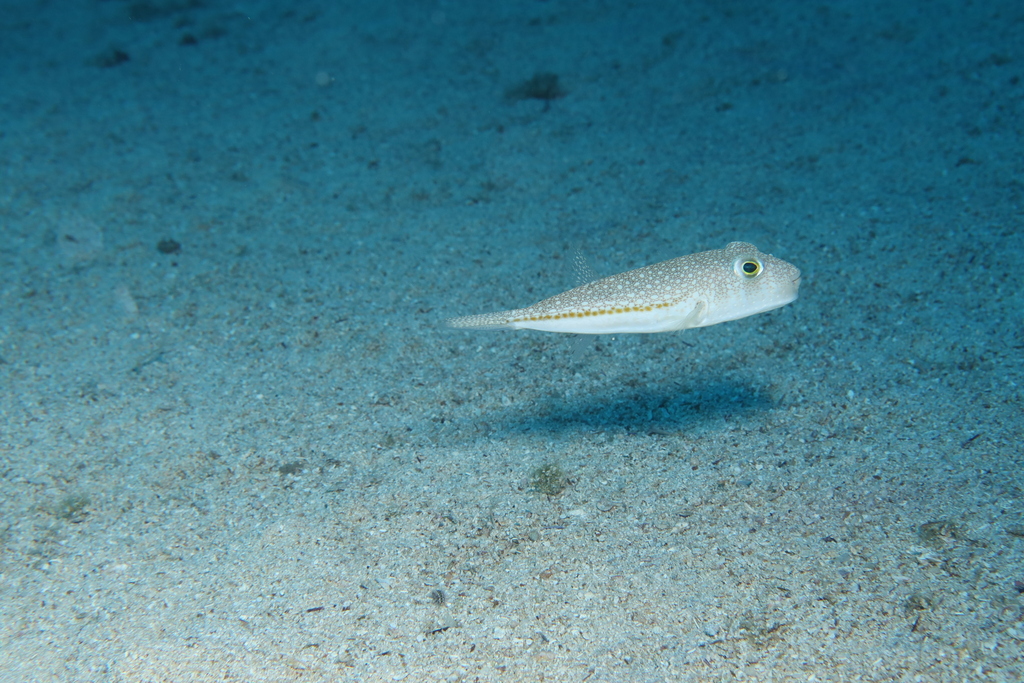
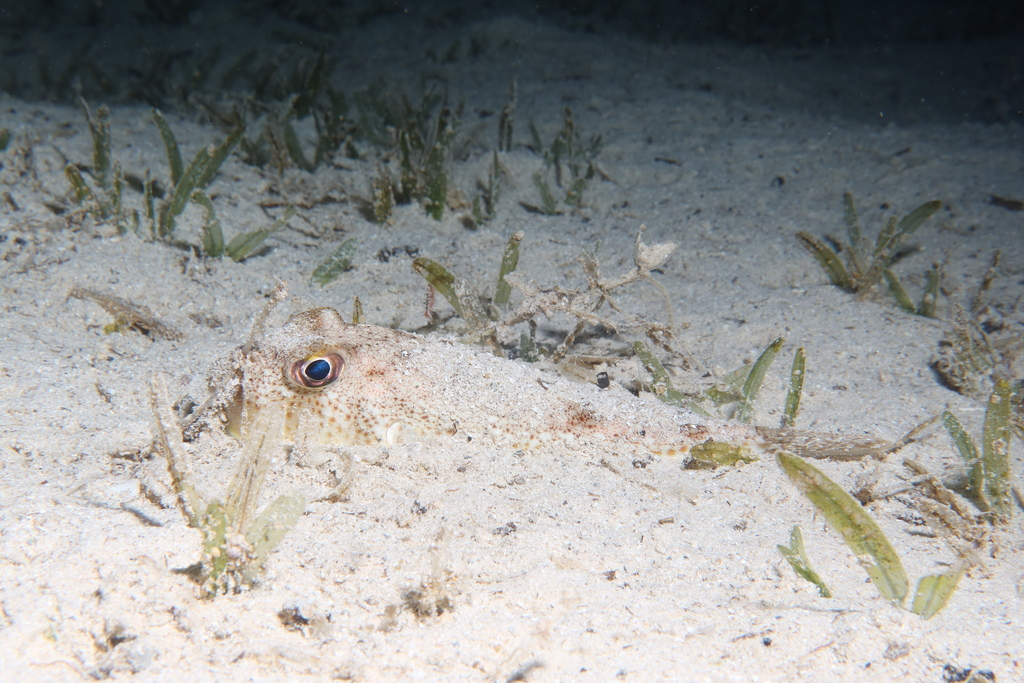
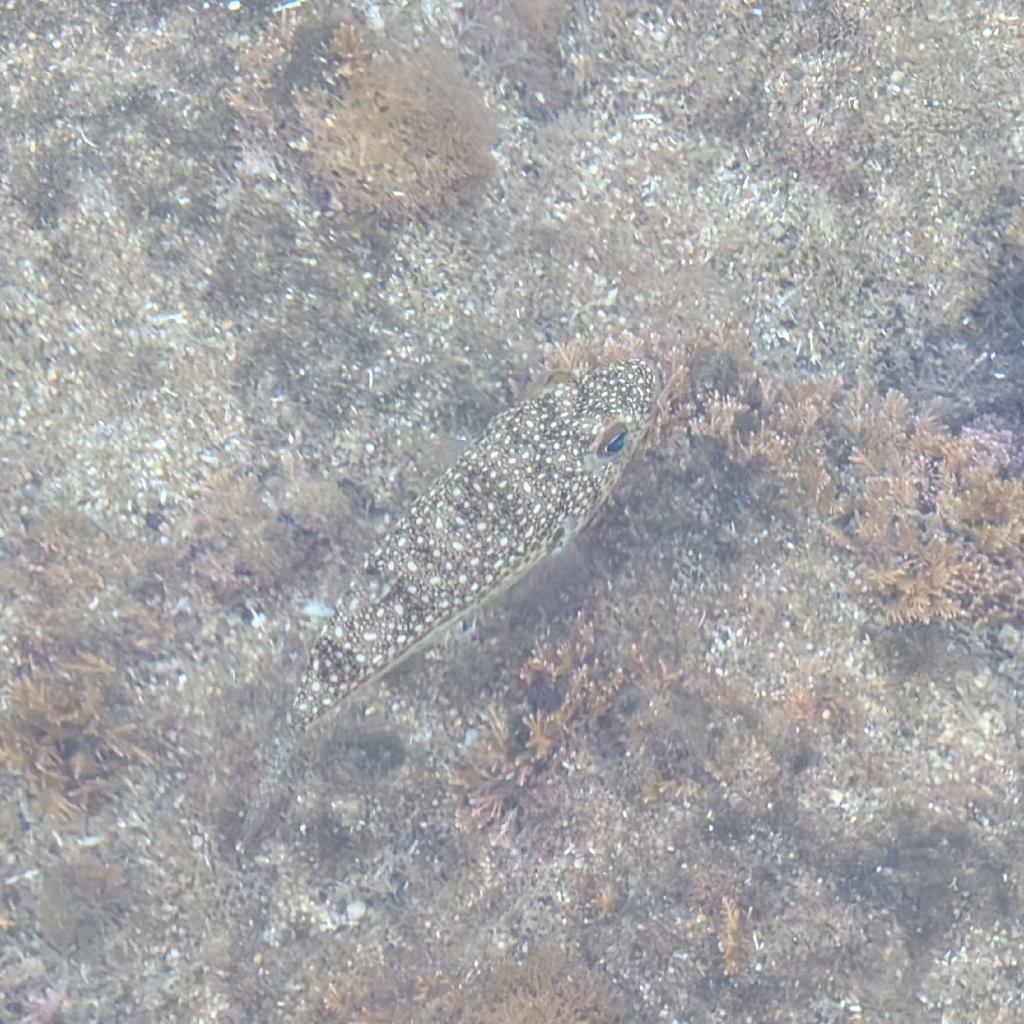
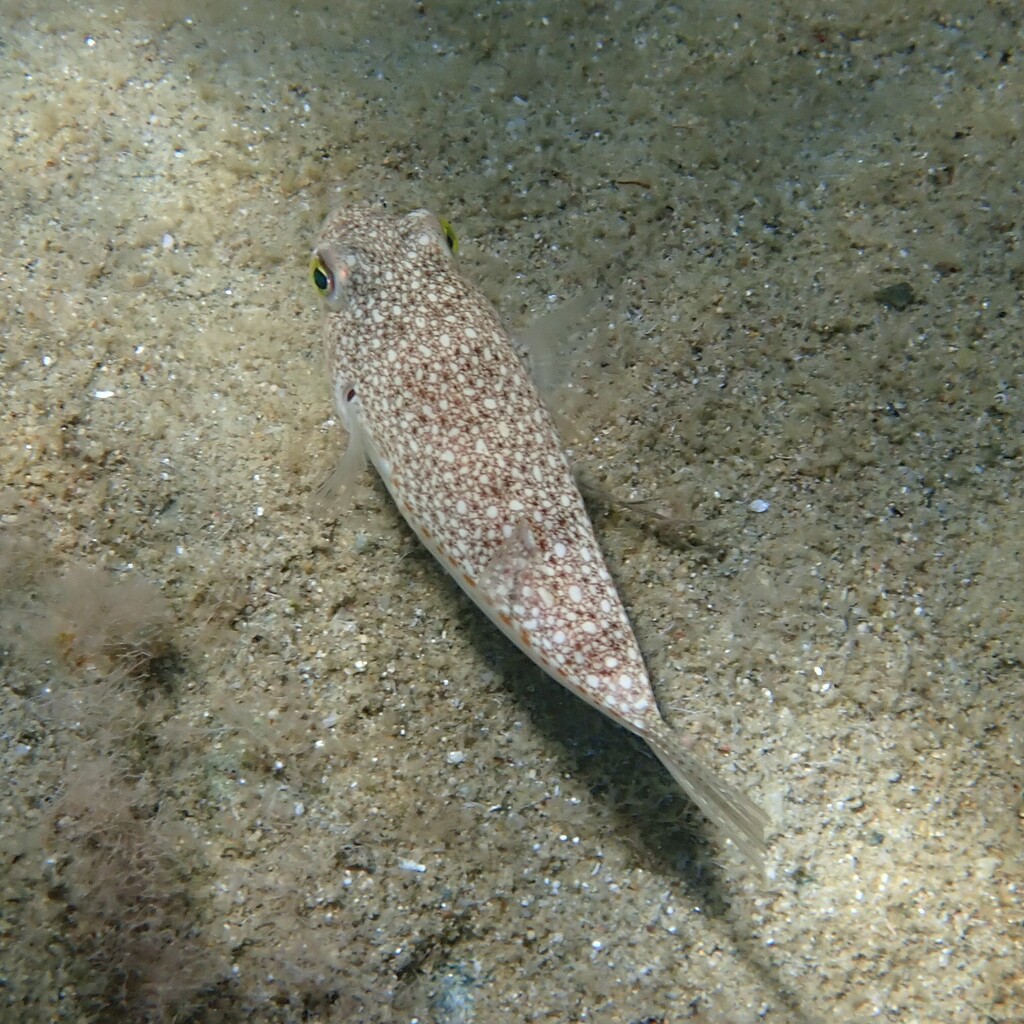
Photos show the species, not always the places on this page.
Length
FishBase gives a maximum of 13 cm (5.1 in). A 2023 study of 1,360 fish in the Eastern Mediterranean estimated they grow towards about 17.4 cm (6.9 in), with maturity at about 10 cm (3.9 in).
Weight
An average adult female of 13 cm weighed about 45.7 g (1.6 oz) in that study.
Next to a person
About as long as a hand, and about as heavy as a large egg.
What it eats
A carnivore that forages on sandy bottoms for small animals, including snails (Cerithium scabridum), hermit crabs, other crustaceans and sea urchins. It eats less during the peak spawning season.
Around people
Look, do not touch
How it lives
Lives in small loose groups on shallow sand flats and in estuaries, recorded at about 1 to 22 m. By day it often sleeps buried under the sand with only its eyes showing. In the Mediterranean it lives about 4 years. Females lay many eggs: an average adult female held about 1,250 eggs per gram of body weight. It feeds through the day and can be curious about divers.
Where it goes
A small bottom dweller that lives in loose groups on sandy flats. The sources I opened give no migration data. By day it often buries itself in the sand with only its eyes showing.
We only draw a journey on the map when scientists have tracked it or clearly documented it. For this animal we have not found one yet.
Populations
Native to the Indian and western Pacific oceans, from East and South Africa east to Samoa and north to southern Japan, and rated Least Concern by the IUCN (2011) within its native range. In the Eastern Mediterranean it is an invasive species. A 2023 study treats the fish known there as Torquigener flavimaculosus as the same species and sampled it at Finike and Fethiye in Turkey and in Cyprus. The authors recommend listing it as a priority invasive species to monitor. No population count is given.
Meet it respectfully
Look, but do not touch. A 2023 review warns that this fish can look harmless and become used to people, yet it bites if handled, and it can get excited around fresh food. Never feed, bait, handle or chase it, and never eat it. Keep your hands off the sand where one may be buried. I did not read local rules for Turkish waters, so follow your guide.
Fun fact
Tap the bulb to light it up.
By day it often buries itself in sand, leaving only its eyes showing.
Its flesh and skin hold tetrodotoxin, a strong natural poison, so it should never be eaten.
In the Mediterranean it lives about 4 years and is mature at about 10 cm.
Orange-spotted toadfish in the Ocean Atlas
Places we have researched where this animal is recorded. It is never guaranteed, and some places are for watching from the boat only.
Travel with usComing soonTrusted referralExploringOn pause, story onlyEthics pass
Country colour: pink where we travel, blue where we are exploring or refer, grey for story only.
 Australia
 Indonesia
 Japan
Japan Madagascar
 Mozambique
 Philippines
 South Africa
 Taiwan
 Türkiye
 United States
Sources for this page
- Wikipedia, Torquigener hypselogeneion
- FishBase, Torquigener hypselogeneion
- IUCN Red List record via GBIF
- Andréfouët et al., 2019, Zootaxa checklist (Zenodo)
- Aquatic Invasions, 2023, invasive pufferfish in the Eastern Mediterranean (Zenodo)
- PubMed Central, Human health impacts from invasive pufferfish in the Eastern Mediterranean
Facts checked 5 October 2026. Photos: Unsplash licence, or Creative Commons as shown on each photo.
Work in ocean travel?
We are always happy to hear from exceptional local operators, accommodation, conservation organisations and destination experts. If your work fits responsible, small-group ocean travel, we would love to learn more.
Partner with Ocean CallingShop with Ocean Calling
Visit the Ocean Calling storefront on Amazon.
As an Amazon Associate I earn from qualifying purchases. You are not only choosing products that respect the ocean, you are also helping us keep going: paying our local partners fairly and keeping our retreats ethical, sustainable and honestly priced for you. 💗