
Rough ray
Raja radula
A small Mediterranean skate that rests on sand and often goes unseen. No sighting is a promise.
Endangered (IUCN, 2016) means the species faces a very high risk of extinction in the wild.
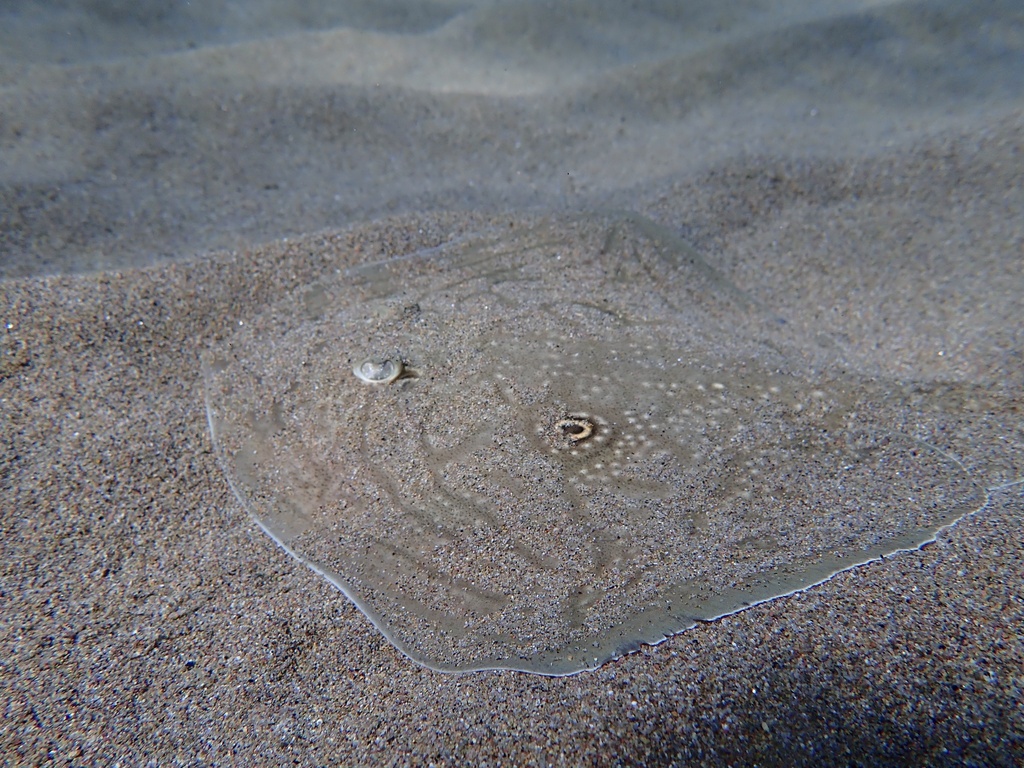
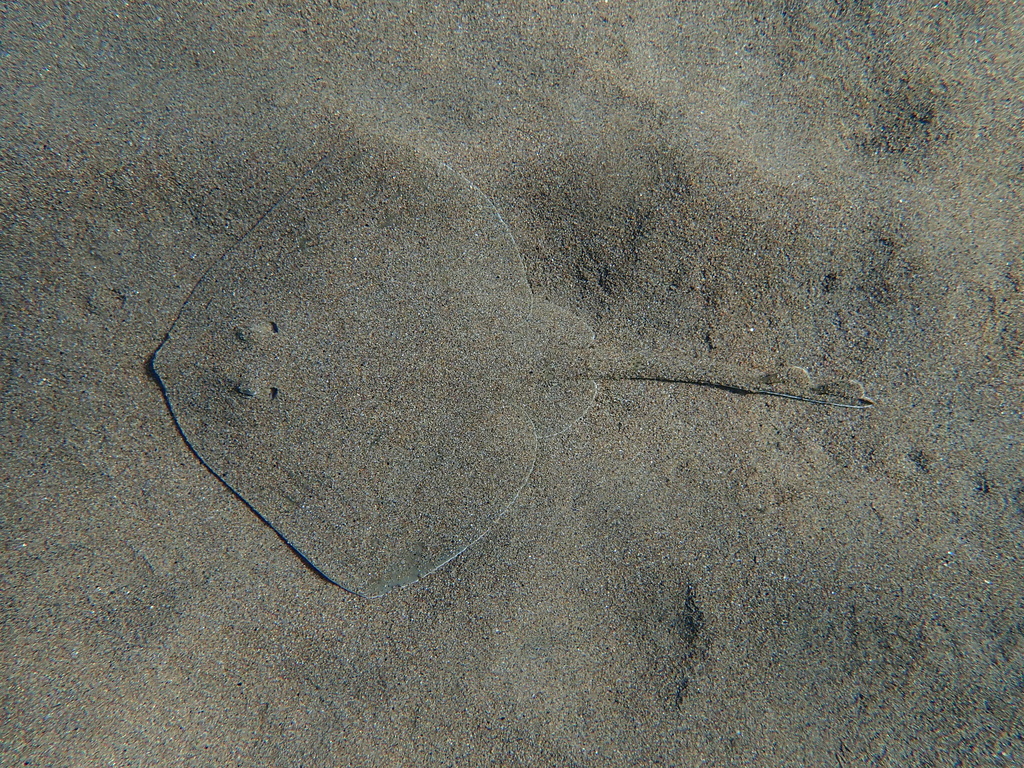
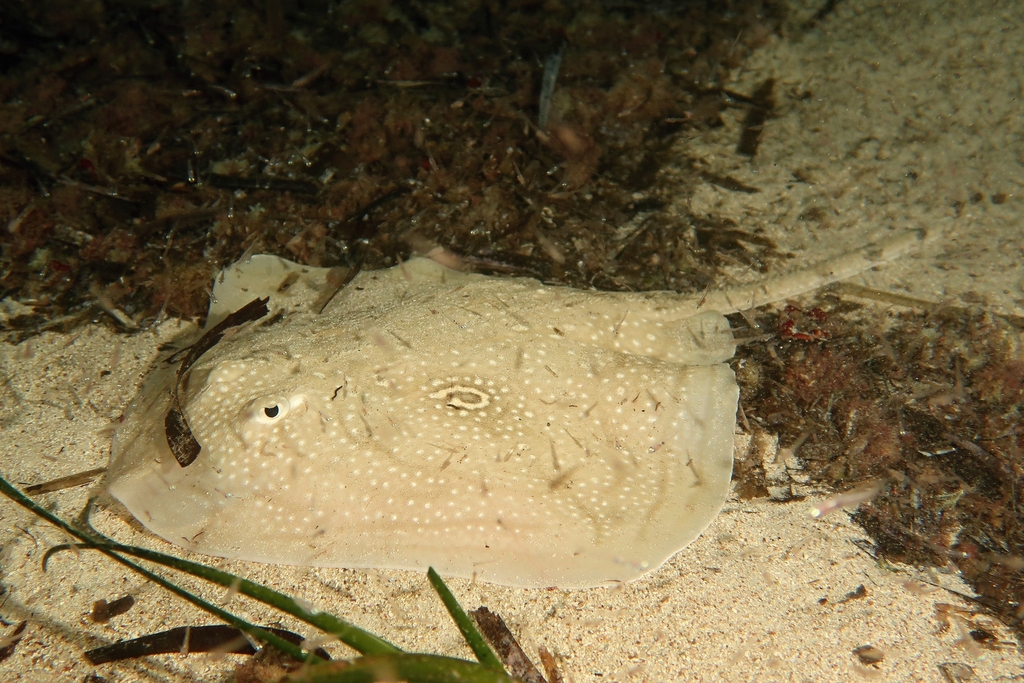
Photos show the species, not always the places on this page.
Length
Females up to about 80 cm (31 in) and males up to about 65 cm (26 in) total length, per Wikipedia
Weight
Not given in the sources I opened, so the weight is unknown here
Next to a person
At most about half as long as a tall adult is tall
What it eats
Animals living on the seabed: shrimp-like crustaceans, fish and molluscs. Small rays take mostly crustaceans, larger ones more fish. It will also scavenge.
Around people
Calm, give space
How it lives
It lives on sandy or muddy seabeds from about 2 to 300 m, though a 2026 study in the Balearic Islands found it restricted to water shallower than 150 m. It lays eggs. The egg cases are 5.1 to 5.7 cm and hatch in about four months, and hatchlings are 5 to 6 cm. Breeding goes on all year, peaking in late spring and early summer. Females mature at about 34 cm disc width and males at about 30 cm. Females live up to 12 years and males up to 9.
Where it goes
The sources I opened describe it only from the Mediterranean and do not give migration routes. A 2026 study found all three genetic variants in the Balearic Islands only there, which suggests that group is genetically isolated. Some country links on the Atlas, especially in West Africa, come from occurrence records that I could not confirm in these sources.
We only draw a journey on the map when scientists have tracked it or clearly documented it. For this animal we have not found one yet.
Populations
Listed as Endangered by IUCN (2016). It is thought to be found only in the Mediterranean. The main threat is bycatch in trawl, gill, trammel, bottom longline and purse seine fisheries. A 2026 study in the Balearic Islands found it still abundant there, with survey records nearly twice as frequent as in the Aegean Sea, but also a 15-year decline in the share of large individuals.
Meet it respectfully
Rough rays often lie still on sand, sometimes half buried. Watch from a distance, never touch, chase or feed one, and avoid kicking up sand over it. I did not read any local viewing rules for this species.
Fun fact
Tap the bulb to light it up.
Wikipedia and FishBase describe it as found only in the Mediterranean.
Its egg cases are about 5 cm long and take around four months to hatch.
Females can live up to about 12 years.
Rough ray in the Ocean Atlas
Places we have researched where this animal is recorded. It is never guaranteed, and some places are for watching from the boat only.
Travel with usComing soonTrusted referralExploringOn pause, story onlyEthics pass
Country colour: pink where we travel, blue where we are exploring or refer, grey for story only.
 Algeria
 Cameroon
 Côte d'Ivoire
 Gabon
Gabon Ghana
Ghana Greece
 Liberia
 Malta
Malta Nigeria
 Sierra Leone
 Spain
SpainSources for this page
Facts checked 5 October 2026. Photos: Unsplash licence, or Creative Commons as shown on each photo.
Work in ocean travel?
We are always happy to hear from exceptional local operators, accommodation, conservation organisations and destination experts. If your work fits responsible, small-group ocean travel, we would love to learn more.
Partner with Ocean Calling5-day freediving course in Bali
CHF 1,180