
What I Learned Training in Freediving
Personal insights from training in freediving and how the experience builds calm, awareness, and connection with the ocean.
What I Learned Training in Freediving
Training in freediving changed my relationship with the ocean in ways I did not expect. At first, the idea of holding my breath underwater felt intimidating. Like many beginners, I wondered how long I would be able to stay calm, whether I would feel comfortable at depth, and how my body would respond to an unfamiliar environment.
Freediving is often associated with performance or depth, yet the most meaningful lessons came from learning how to slow down. The experience became less about reaching a specific number of meters and more about understanding how the mind and body respond when external distractions disappear.
Through training in freediving, I began to understand how awareness, patience, and trust influence the way we experience the ocean.
Learning to become comfortable with discomfort
One of the first lessons freediving teaches is how to observe discomfort without reacting immediately. The natural urge to breathe can feel urgent, even when the body still has sufficient oxygen reserves.
Training introduces breathing techniques that help regulate heart rate and support relaxation. Slow, controlled breathing prepares the nervous system for immersion. Over time, the body adapts to increased carbon dioxide levels, and the urge to breathe becomes more manageable.
Freediving highlights how often discomfort is linked to anticipation rather than real physical limits. Learning to remain calm creates a sense of stability that extends beyond the water.
This process encourages trust in the body's natural abilities.
The importance of relaxation and efficiency
Energy conservation plays an essential role in freediving. Small movements can significantly affect oxygen consumption. Efficient technique allows the body to use less energy, which can extend dive time and improve comfort.
Learning to move slowly and intentionally encourages greater awareness of body position and muscle tension. Relaxation reduces unnecessary effort and allows movement to feel more fluid.
Freediving often rewards patience rather than force. The ocean responds differently when approached calmly.
Many beginners discover that progress happens when effort is reduced rather than increased.
The mental aspect of freediving
Freediving training often emphasises mental presence as much as physical ability. Thoughts can influence breathing rhythm and muscle tension. Distraction may increase anxiety, while focused awareness supports relaxation.
Visualization techniques are sometimes used to prepare for dives. Imagining calm descent and smooth equalisation can help the mind become familiar with unfamiliar sensations.
Training encourages observation of thoughts without attaching urgency to them. This perspective creates space between sensation and reaction.
Freediving can become a practice in attention and presence.
Respect for the ocean environment
Spending extended time underwater naturally increases awareness of marine environments. Details that may be overlooked during faster-paced activities become more noticeable.
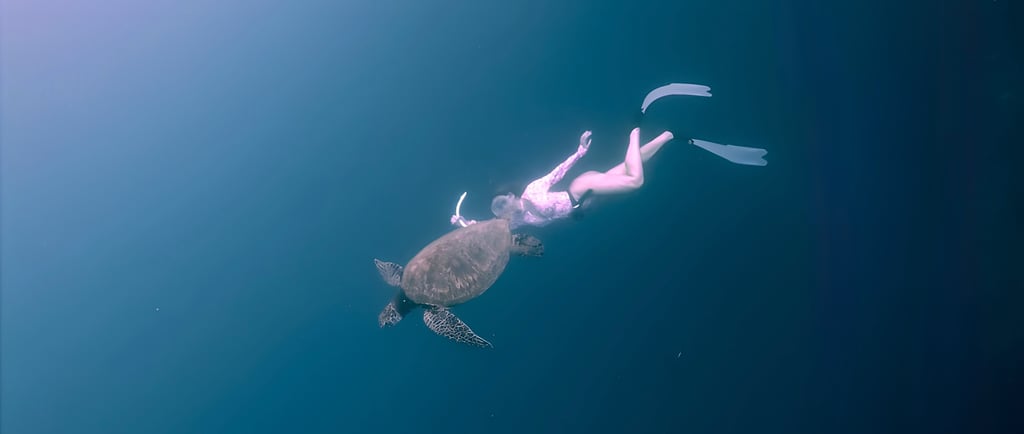
Changes in light, sound, and movement create a different perception of time. Marine life often appears less disturbed when approached slowly.
Freediving encourages a quieter presence in the water. Reduced noise and slower movement can minimise disturbance to marine species.
This slower approach often leads to more natural wildlife encounters.
Safety as a foundation of learning
Freediving training places strong emphasis on safety practices. Learning with qualified instructors provides structure and support for skill development.
Buddy systems ensure that divers are monitored during breath-hold activities. Safety protocols are designed to reduce risk while allowing gradual progression.
Understanding physiological responses such as equalisation and pressure adaptation supports more comfortable experiences underwater.
Structured learning environments encourage responsible skill development.
Adaptation happens gradually
Progress in freediving rarely occurs instantly. Adaptation takes time as the body becomes familiar with breath-hold conditions.
Training sessions often focus on technique and comfort rather than depth alone. Improvements may occur gradually as relaxation increases.
Consistency often produces more sustainable progress than pushing beyond comfort levels.
Freediving emphasises long-term learning rather than immediate results.
A different perspective on achievement
Freediving can shift the way achievement is perceived. Depth or time measurements become secondary to comfort and awareness.
Moments of calm descent or effortless floating can feel as meaningful as measurable progress.
Learning to appreciate small improvements encourages patience and self-observation.
Freediving often becomes less about performance and more about experience.
Connection with natural rhythms
Ocean environments operate according to natural rhythms influenced by tides, currents, and weather patterns.
Freediving encourages adaptation to these conditions rather than resistance. Observing environmental changes supports safer and more comfortable dives.
This awareness often extends beyond diving itself. Sensitivity to natural cycles can influence travel choices and environmental behaviour.
Experiencing the ocean in this way often creates appreciation for its complexity.
Continuous learning and curiosity
Freediving is often described as a continuous learning process. Each session provides new observations about physical sensation, breathing patterns, and environmental conditions.
Progress may feel non-linear, with periods of rapid improvement followed by slower phases of adaptation.
Curiosity often becomes an important part of the learning process.
Freediving encourages exploration of both internal awareness and external environment.
How freediving influences perspective
Spending time underwater can influence how time and attention are experienced. Without external noise, awareness may feel more focused.
Some divers describe feeling more present and less distracted after training sessions.
The experience can create space for reflection and observation.
Freediving does not require competition to feel meaningful.
Small moments of calm often become the most memorable aspects of training.
An evolving relationship with the ocean
Learning freediving often creates a sense of respect for marine environments. Increased understanding of underwater ecosystems may influence how individuals interact with nature.
Awareness often encourages more thoughtful decision-making related to travel and environmental impact.
Freediving can become part of a broader perspective on responsible ocean experiences.
Each training session offers an opportunity to learn not only about technique, but about presence and observation.
What I learned training in freediving continues to evolve as experience grows. The process remains open-ended, shaped by curiosity and respect for the environment.
Freediving often becomes less about how deep one can go, and more about how attentively one can experience the ocean.
© 2026 Ocean Calling Retreats.
All rights reserved.
Ocean Calling Retreats
Ethical ocean retreats for solo travellers. Small-group experiences built on depth, safety, and meaningful connection.
Certifications
All ocean experiences follow strict ethical guidelines.