
Gili Trawangan in peak season: what the water data shows
You are floating off Gili Trawangan in August. The sun is strong, the sea looks blue, and the island behind you is full of music and bicycles. It all feels perfect. A team of scientists who measured this water asked a simple question: does the sea notice how many of us are here? Their answer is worth knowing before you choose when to go.
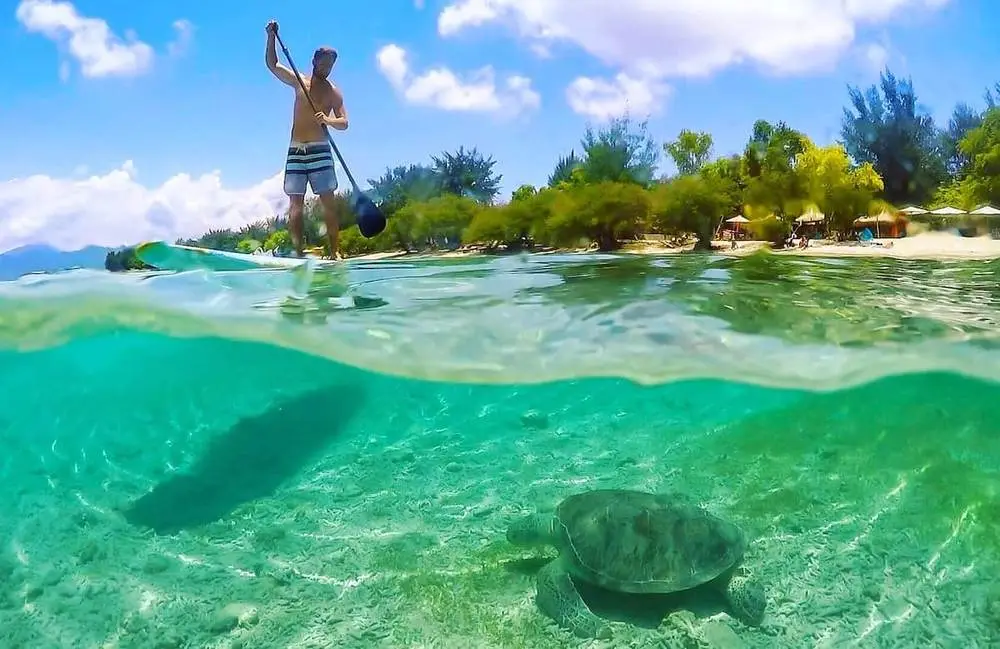
Short answer: yes, it does. In one study, the water around the Gili Islands scored worst in August, the busiest month, and better in the quiet season. More people, poorer water.
This is not a story about blame. It is a story about small islands, and how closely the sea around them follows what happens on land.
A marine park with a busy island inside it
Gili Trawangan, Gili Meno and Gili Air are three small islands off north-west Lombok, and Trawangan is the busiest. Together they sit inside the Gili Matra Marine Tourism Park, a national marine conservation area managed by Indonesia's Ministry of Marine Affairs and Fisheries.
Here is the detail that explains a lot. The park's zoning covers about 2,273.56 hectares of water, but not the land. And the land is where the hotels, restaurants and houses are. What happens on land flows into the sea.
The reef is rich. One study notes up to 40 genera of hard corals and 344 species of reef fish. It describes the park as bringing about 500,000 tourists a year, with up to 61,000 in a single peak month.
Visitor data from North Lombok put the peak in August and the low season between February and April. At the peak, residents and visitors together were estimated at around 65,661 people, on three islands with only a few thousand permanent inhabitants.
What did the water quality data show?
A team from IPB University built a simple score for coastal water, called a water-quality index. It combines ten physical and chemical measures, such as nitrate, orthophosphate, ammonia and how cloudy the water is. The score was checked against standards for marine life and for activities like snorkelling.
They took samples at six points during August peak-season surveys, and at twelve points in a March low-season survey.
In the first August sampling, the score for marine life was between 9.95 and 21.49, which the authors rate as poor. A second August sampling was also poor, at 39.52 to 44.42. In March, it was between 41.92 and 61.84, poor to moderate. The difference between the seasons was statistically significant for every measure except salinity.
Nitrate was the main problem. On average, it was above the marine water-quality standard in all sampling years. Orthophosphate was well above the standard in most of the park during the peak.
Where does it come from? The authors point to wastewater from homes and tourism, runoff from coconut plantations and rivers on Lombok, and weak management of water and solid waste.
Why the west side looked better
The water followed the currents. The west side of Gili Trawangan, facing the open Lombok Strait, scored better than the east side of Trawangan and the waters around Gili Meno and Gili Air. When surface currents ran south or south-east, the lowest scores gathered in those directions.
In simple words, the side facing the open sea gets washed more. The sheltered channels hold more of what comes off the land.
The reef shows the strain too. The paper cites earlier work where coral cover in the area fell from 25.13% to 16.50% over about thirteen years. It warns that a lot of nitrate over time helps algae win over corals, and weakens seagrass.
There is good news as well. A technical report by a local conservation group, not peer-reviewed, found that the dive sites around Gili Trawangan still gave the most sightings of fish, sharks and rays, and the highest live coral cover at one site, Halik.
What the study cannot tell you
I want to be fair to the science. The authors openly call their design a hypothetical effects assessment. There were a limited number of samples and no repeated monitoring. They measured chemistry only, not bacteria, so the study says nothing direct about whether swimming is safe. The two seasons were sampled in different years, before the pandemic, so today may look different.
What it does show is a steady signal: more people, poorer water. The authors call for treatment plants for large tourism businesses, and shared systems for small ones.
Small choices that help
Timing is the easiest thing you can change. Travelling outside the August peak spreads the pressure, though it does not guarantee clearer water.
On the water, choose operators that tie up to moorings instead of dropping anchor, since anchoring is widely blamed for structural reef damage in the park. Keep groups small at popular spots. One study notes that at times as many as 100 tourists may gather in the same place.
Around green turtles, stay back, never touch, chase or feed them, and let them come up to breathe in peace.
On land, small habits add up: short showers, refillable water, and a place to stay that can explain how it treats its wastewater. It is a fair question, and good hosts will have an answer. I also pack a mineral sunscreen for long days on the water.
Local groups such as Gili Matra Bersama run coral health monitoring and restoration in the park, and supporting their work is a practical way to give something back. Whether you come through our Gili Trawangan referral trip or on your own, come in the quieter months if you can.
Questions people ask
Is it safe to swim at Gili Trawangan?
This study did not measure bacteria or health risk, so it cannot answer that. Its score uses chemistry only, from a limited set of samples. Follow local advice on the day.
When is the quietest time to visit the Gili Islands?
The North Lombok visitor data used in the study show the peak in August and the low season between February and April. These are the rainier months, so expect some changeable weather.
Is Gili Air or Gili Meno better for the reef than Gili Trawangan?
Not simply. In this study the open-sea west side of Gili Trawangan had better water than the channels around Meno and Air. How you and your operator behave matters more.
Water conditions change with the season, the currents and the day, so always follow local advice. Ocean Calling works only with vetted, ethical local operators, and every animal is free to approach, or not, entirely on its own terms.
Sources & further reading
- Kurniawan F, Adrianto L, Bengen DG, Prasetyo LB, 2023 (online 2022). Hypothetical effects assessment of tourism on coastal water quality in the Marine Tourism Park of the Gili Matra Islands, Indonesia. Environment, Development and Sustainability 25: 7959-7985.
- Rahmadyani RF, Dargusch P, Adrianto L, 2023. Assessment of stakeholder's perceptions of the value of coral reef ecosystem services: the case of Gili Matra Marine Tourism Park. IJERPH 20(1): 89.
- Saputra RA, 2020. Gili Shark Conservation Technical Report 2019 (NGO report, not peer-reviewed), hosted by Reef Check.
- Gili Matra Bersama. Our research.
Further reading on Ocean Calling: Trawangan, Meno or Air: how the Gili Islands compare · Seeing Gili turtles responsibly · Indonesia in the Ocean Atlas
Scuba diving certification on Gili Trawangan: turtles, calm days and no cars
Scuba certification · Gili Trawangan, Lombok, Indonesia
Turquoise water, no cars, no stress. This story is about the Gili Islands, where we run a trip.
Explore in the Ocean Atlas
Places in this article
Animals in this article
