
Moalboal Sardine School: Learning to Slow Down
In Moalboal the sardines do not perform on a clock. The school gathers, splits and forms again along the drop-off, and the people who see it best are the ones who stop chasing.
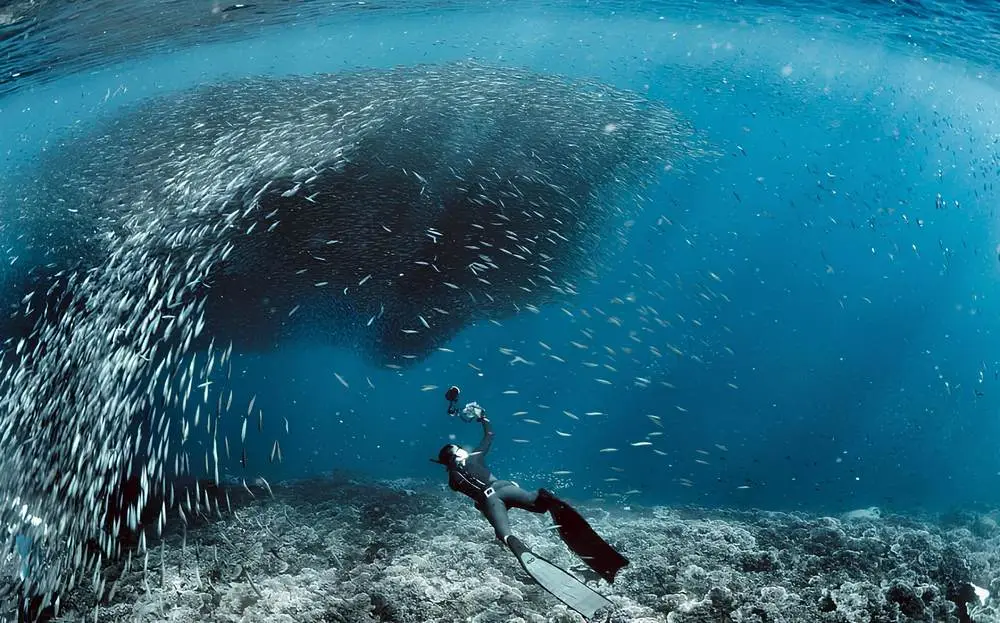
How do you see the Moalboal sardine school without spoiling it? Arrive slowly, stay at the edge, keep your fins under control and let the fish decide the shape of the morning. The sardines are close to the beach and easy to reach, which is a gift and a risk at the same time. The kindest way to enjoy them is to do less than the crowd.
Panagsama Beach looks ordinary until you put your face in the water. A few kicks off the sand, the reef drops away, and a living curtain of silver fish fills the blue. It is one of the easiest famous ocean sights in the Philippines to reach. That ease is also the problem, and it makes this a good place to practise the thing most of us find hardest at the sea: waiting.
What you are actually looking at
The school is a very large group of small fish. Travel sources place it about 20 to 30 metres off Panagsama Beach, close to the drop-off. It is not one animal. It is thousands of bodies making one shape, which turns and tightens when something moves near it. Reports name predators that work the edges: tuna, trevally and jacks, and sometimes thresher sharks. Turtles are often reported on the same slope too.
I should be honest about what is not known. Travel writers call the fish sardines of the genus Sardinella, and one planning site names a particular species, but I did not find a scientific source I could cite, so I will not name one. Reports also say the school has been here for more than 15 years and has moved between Pescador Island, Ronda and Panagsama. Why it came so close to shore is, as one writer put it, a mystery. I do not know either.
Why does slowing down work better than chasing?
I could not find a study of how Moalboal’s sardines react to swimmers, or a published study of how many people the site can hold. So what follows is common sense from dive and snorkel etiquette, not a measured result. Small schooling fish tighten and scatter when something large moves toward them fast, and they react to noise and bubbles. That is why operators ask you to float at the side, breathe quietly and let the school move around you.
What you see tells the same story. When people kick over the school or drop down through it for a photo, the shape breaks and the sardines move away. What looked like a miracle from the beach becomes a chase. When one or two quiet swimmers hover at the edge, the curtain closes again, and the view is better. This is also why a simple low-volume snorkel and mask that fits well matters more than extra gear. You want to float, not fight.
The local rules and the reef they protect
Moalboal has written rules. SunStar reports that the municipality passed an ordinance on 27 September 2021 that regulates snorkelling and island hopping at Pescador Island, the marine protected areas and other coastal waters, and sets up an environmental user fee. SunStar reports that touching any marine life is one of the violations listed in the ordinance, and that fines apply. I could not find the ordinance text itself, on the municipality’s site or anywhere else, so I do not repeat the fine amount or the number of violations quoted in the press. Bantay Dagat, the local sea watchers, are reported at known tourist spots. Rules and fees can change, so check the current rule with the Municipality of Moalboal or your operator, and pay the fee when you arrive.
The wider water is part of the Tañon Strait Protected Seascape, which one conservation directory describes as the largest marine protected area in the Philippines, at 5,182 square kilometres. On fishing, travel sources say mass or net fishing of the sardines is not allowed and local fishers use hook and line from small boats. I could not read the ordinance’s fishing clauses myself, so I treat this as reported, not confirmed. Our guide to the reef rules locals want visitors to know goes further.
How to enjoy the sardines, step by step
Go early, when fewer people are in the water. Enter from the beach when conditions allow, or take a small boat that drops you at the side of the school, not on top of it. Keep your fins below the surface. Do not follow turtles into the school. Give other snorkellers space, so nobody has to kick to hold position. If the school has already been broken up that morning, leave. There will be another hour, or another day.
A few small things help. Wear a rash guard for the sun and for the chill you feel after an hour of floating, and choose a mineral sunscreen if you need one, put on well before you get in, so less washes off in the water. Sunscreen is not a reason to stay in too long. If you want to learn how to float quietly, our article on learning to slow down as a freediver is a gentle place to start.
Is the school always there?
It is often present along this stretch of coast, and reports say it stays all year, but wind, current and fishing pressure change where it sits. SunStar has also reported a “sardine rush” of tuloy, Indian oil sardines, swimming toward the shore, and a local news index notes that this rush usually happens in September, October and November. Nothing here is guaranteed, and a day without the full curtain is still a day on a beautiful reef. If you want to know how this feels compared with other marine encounters, read why the Moalboal sardine run feels different.
An honest word about visiting
Getting to Cebu means a flight, and that is a real climate cost. A longer stay, fewer transfers and a small group are the least we can do. Moalboal does not need more noise. It needs fewer people in the water at once, and those people staying at the edge. You can read more about the country in the Philippines pages of the Ocean Atlas.
That same patience is how we think about ocean days: one group, one site, no race for the picture, and any activity can be skipped. If this made you curious about Moalboal, you can explore our Moalboal trip through Ocean Match, where we match you with a vetted local team and you book with them directly.
Questions people ask
Can I scuba through the school?
You can dive the wall, but swimming through the middle of the school breaks the shape everyone came to see. Stay to the side and below the main mass, and follow your guide’s briefing.
Is the school always there?
It is often present along this stretch of coast, but wind, current and fishing pressure change where it sits. Nothing here is guaranteed.
Is freediving better than snorkelling?
A calm snorkel at the surface is enough. Deep dives through the fish add stress without adding much understanding. If you freedive, do it at the edge, with a guide, and keep your movements slow.
Is it allowed to touch the fish or the turtles?
No. A 2021 Moalboal ordinance, as reported by SunStar, makes touching any marine life a violation, and fines apply. We could not read the ordinance text, so check the current rule and fine with the municipality, and keep your hands to yourself.
Is there a fee to snorkel or dive here?
Local reports mention an environmental user fee under the 2021 ordinance. Amounts and rules can change, so ask your operator or the municipality before you go.
What is the best time of day?
Early mornings are usually quieter, and fewer boats and snorkellers mean the school is less likely to be broken up. Conditions change daily, so follow the briefing of the day, not a social video.
Wildlife encounters are never guaranteed and never forced. Ocean Calling works only with vetted, ethical local operators, and every animal is free to approach, or not, entirely on its own terms.
Sources & further reading
- SunStar Cebu, Moalboal tourists warned vs. violations (municipal ordinance of 27 September 2021)
- Municipality of Moalboal, official site
- Adventure Collective, Moalboal Marine Sanctuary (Tañon Strait Protected Seascape)
- Remote Lands, Yes, there is a sardine run in Cebu
- Cathay Pacific, Moalboal’s sardine run: inside the living ocean
- Outlook Traveller, How to float with millions of sardines in Moalboal
- Liveaboard.com, Diving into the Moalboal sardine run
- SunStar Cebu, Sardine rush captured on video, 2024
Further reading on Ocean Calling: Philippines in the Ocean Atlas · Snorkelling with turtles without crowding them · Moalboal reef rules · Why the sardine run feels different
Moalboal scuba certification and freediving trip: sardine run, sea turtles and Alegria statues
Scuba or freediving certification · Moalboal, Cebu, Philippines
Marine life close to shore, at a calm pace. This story is about the Philippines, where we run trips in Moalboal and Coron.
Explore in the Ocean Atlas
Places in this article