
Bluntnose sixgill shark
Hexanchus griseus
A sixgill shark lives mostly in the deep and comes up at night, so no sighting is ever a promise.
Near Threatened (IUCN, 2019) means it is close to qualifying as threatened. It grows and breeds slowly and is caught in fisheries around the world.
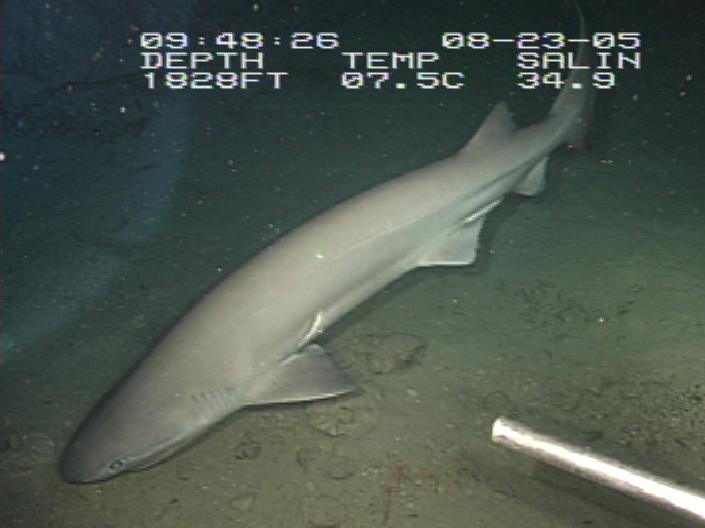


Photos show the species, not always the places on this page.
Length
Adult females about 3.5 to 4.2 m (11.5 to 13.8 ft) and males about 3.1 to 3.3 m (10.2 to 10.8 ft) on average (Wikipedia). Up to about 5.5 m (18 ft), with a maximum of 6 m (20 ft) published by FishBase
Weight
Up to about 590 kg (1,300 lb) (FishBase and Washington Department of Fish and Wildlife). Wikipedia mentions up to 1,000 kg (2,200 lb) for the largest, so sources differ
Next to a person
An adult female is about as long as a small car, and the heaviest are about as heavy as eight adults
What it eats
A very wide diet: bony fish, other sharks, rays, squid, crabs, shrimps, carrion and sometimes marine mammals (Wikipedia and FishBase). Washington Department of Fish and Wildlife calls it an opportunistic scavenger.
Around people
Calm, give space
How it lives
Sixgills give live birth. Litters are large, reported as 47 to 108 pups (FishBase) or 22 to 108 (Wikipedia), and pups are 60 to 75 cm long at birth. Males mature at about 3.15 m and 11 to 14 years, and females at about 4.4 to 4.5 m and 18 to 35 years. Gestation is thought to be more than two years. Females have been recorded entering Puget Sound to give birth.
Where it goes
The sixgill is mostly a deep-water shark. By day it stays deep, and at night it rises toward shallower water to feed. Off Oahu, four tagged sharks swam up to a minimum depth of about 300 m between midnight and 3 AM and reached 600 to 700 m around noon (Wikipedia). It is usually found at 180 to 1,100 m but has been recorded as deep as 2,500 m. Young sharks in Puget Sound show strong site fidelity (Washington Department of Fish and Wildlife).
We only draw a journey on the map when scientists have tracked it or clearly documented it. For this animal we have not found one yet.
Populations
Near Threatened (IUCN, assessed November 2019 per FishBase). FishBase rates its resilience as low, with a population doubling time of 4.5 to 14 years at minimum. It is caught commercially and by sport fishing worldwide, and sold fresh, frozen or dried and salted. In Washington State, recreational fishing for it is closed. A 2025 preprint, not yet peer reviewed, found a 93 percent decline in predicted abundance in the Mediterranean from 2012 to 2021, mainly from bycatch, and noted that the regional assessment still lists it as Least Concern.
Meet it respectfully
Most people will never see a sixgill, because it lives mostly in deep water. If you are lucky enough to meet one, stay calm, keep your distance and let it choose where to go. Never chase, touch, feed, bait or block its path. FishBase says it is not known to have attacked people without provocation. Rules differ by place: in Washington State, recreational fishing for sixgills is closed. Follow your guide and any local rules. Sightings are never promised.
Fun fact
Tap the bulb to light it up.
It has six gill slits on each side. Most sharks have five.
It spends the day in deep water and moves toward the surface at night to feed.
Litters can reach 108 pups, each about 60 to 75 cm long at birth.
Bluntnose sixgill shark in the Ocean Atlas
Places we have researched where this animal is recorded. It is never guaranteed, and some places are for watching from the boat only.
Travel with usComing soonTrusted referralExploringOn pause, story onlyEthics pass
Country colour: pink where we travel, blue where we are exploring or refer, grey for story only.
 Albania
 Cameroon
 Canada
 Chile
Chile Côte d'Ivoire
 France
 Gabon
Gabon Ghana
Ghana Greece
 Ireland
 Italy
Italy Liberia
 New Zealand
 Nigeria
 Sierra Leone
 Spain
Spain United Kingdom
 United States
Sources for this page
- Wikipedia, Bluntnose sixgill shark
- FishBase, Hexanchus griseus
- Washington Department of Fish and Wildlife, Bluntnose sixgill shark
- bioRxiv preprint, 2025, bluntnose sixgill shark in the Mediterranean
- Shark Foundation, Sixgill Sharks in the Mediterranean, 2020
- GBIF, IUCN Red List category
Facts checked 5 October 2026. Photos: Unsplash licence, or Creative Commons as shown on each photo.
Work in ocean travel?
We are always happy to hear from exceptional local operators, accommodation, conservation organisations and destination experts. If your work fits responsible, small-group ocean travel, we would love to learn more.
Partner with Ocean CallingSwim with humpback whales in Moʻorea, September 2027
from CHF 4,500