
Lemon shark
Negaprion brevirostris
Some female lemon sharks born at Bimini in the Bahamas came back to the same nursery 14 to 17 years later to give birth themselves.
Vulnerable (IUCN, 2020) means it is at high risk of extinction in the wild.


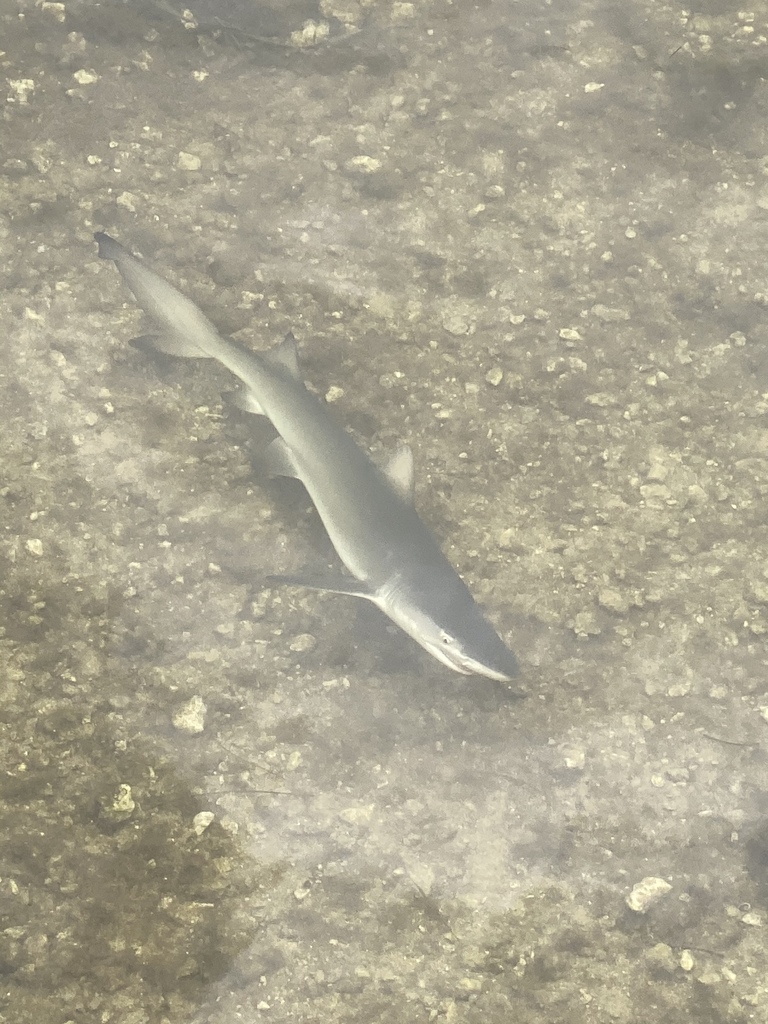
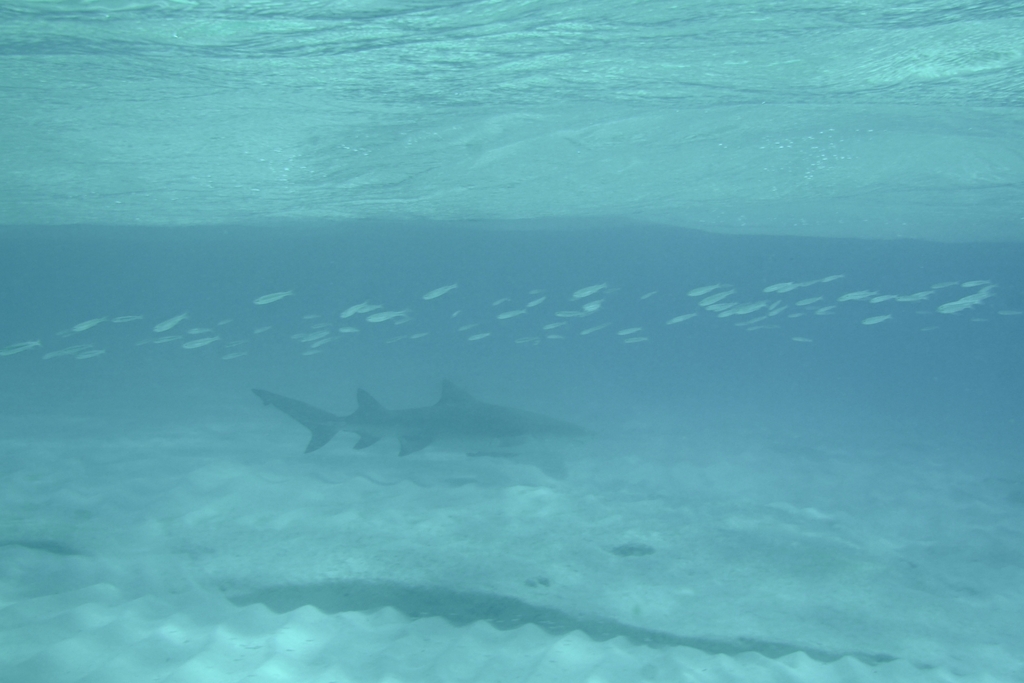
Photos show the species, not always the places on this page.
Length
Adults usually 2.4 to 3 m (7.9 to 9.8 ft); largest recorded about 3.4 m (11.2 ft). Newborn pups are about 60 to 65 cm (2 to 2.1 ft)
Weight
Typical adult weight not reliably measured; largest published about 184 kg (406 lb)
Next to a person
An adult is longer than a tall person; the young ones in nursery bays are about the length of an arm to a leg
What it eats
Mostly bony fish and crabs, plus rays, small sharks and sometimes seabirds.
Around people
Calm, give space
How it lives
Lemon sharks give birth to live pups, usually 4 to 17 at a time, after a pregnancy of 10 to 12 months. Mothers leave the pups in warm, shallow nursery areas, where the young stay for several years before moving into deeper water.
Where it goes
Young lemon sharks often stay close to their nursery for years. Adults travel further along the coast. In Florida, some young sharks from Cape Canaveral moved hundreds of kilometres north in spring and came back in later winters. At Bimini, females return to their nursery to give birth, often about every two years.
We only draw a journey on the map when scientists have tracked it or clearly documented it. For this animal we have not found one yet.
Populations
Lemon sharks live in the western Atlantic from the United States to Brazil, in the eastern Atlantic off West Africa and Cabo Verde, and in the eastern Pacific. In Cabo Verde, a rocky bay on the east coast of Sal is a known nursery for young lemon sharks.
Meet it respectfully
Stay still and calm in the shallows and let the sharks pass. Never touch, lift, chase, block, feed or bait a shark, and avoid trips that use bait. Young sharks in nursery bays need extra space and quiet. Calm behaviour does not mean harmless: adults are strong coastal predators.
Fun fact
Tap the bulb to light it up.
On Sal, young lemon sharks may stay in their nursery bay for about 18 months to five years before heading to deeper water.
In experiments, young lemon sharks learned from other lemon sharks and preferred to swim with sharks they already knew.
Lemon sharks at Bimini in the Bahamas were followed with genetic tests for about twenty years. Scientists found that females return to the nursery where they were born to have their own pups.
Lemon shark in the Ocean Atlas
Places we have researched where this animal is recorded. It is never guaranteed, and some places are for watching from the boat only.
Travel with usComing soonTrusted referralExploringOn pause, story onlyEthics pass
Country colour: pink where we travel, blue where we are exploring or refer, grey for story only.
 Aruba
Aruba The Bahamas
 Belize
 Brazil
 British Virgin Islands
 Cabo Verde
 Colombia
 French Polynesia
 Guadeloupe
 Guinea-Bissau
 Honduras
 Mexico
 Panama
 Turks and Caicos Islands
 United States
 US Virgin Islands
Sources for this page
- Florida Museum of Natural History, Negaprion brevirostris
- Project Biodiversity, Sharks of Sal, 2026
- IUCN PPI, Parda Bay shark sanctuary project, 2022
- FishBase, Negaprion brevirostris
- Florida FWC, Lemon shark
- Kessel et al., 2014, PLOS ONE
- Feldheim et al., 2002, Proceedings B
Facts checked 26 September 2026. Photos: Unsplash licence, or Creative Commons as shown on each photo.
Work in ocean travel?
We are always happy to hear from exceptional local operators, accommodation, conservation organisations and destination experts. If your work fits responsible, small-group ocean travel, we would love to learn more.
Partner with Ocean CallingShop with Ocean Calling
Visit the Ocean Calling storefront on Amazon.
As an Amazon Associate I earn from qualifying purchases. You are not only choosing products that respect the ocean, you are also helping us keep going: paying our local partners fairly and keeping our retreats ethical, sustainable and honestly priced for you. 💗