
Northern gannet
Morus bassanus
White wings folding into a plunge towards the sea. A sighting is always a gift of the day, never a promise.
Least Concern (IUCN, 2018) means it is not at high risk of extinction. The species is widespread and numerous, though bird flu caused heavy losses in colonies in 2022.
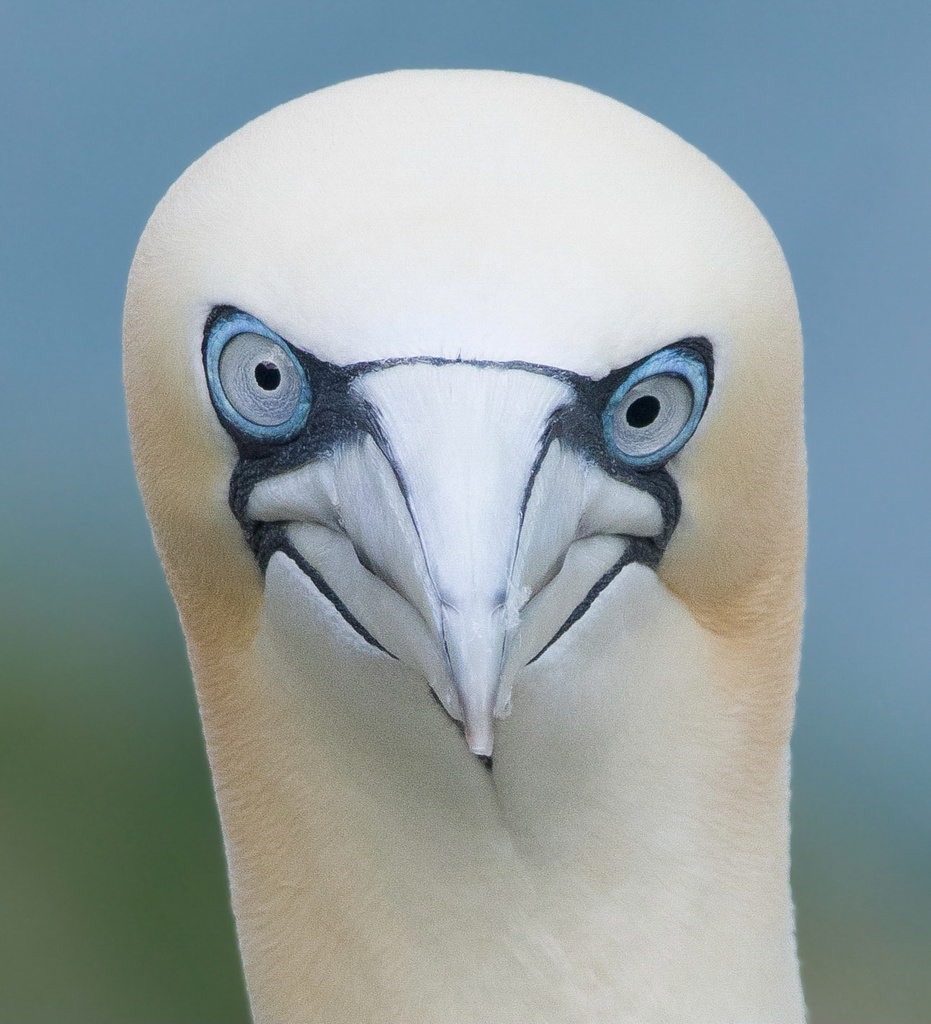
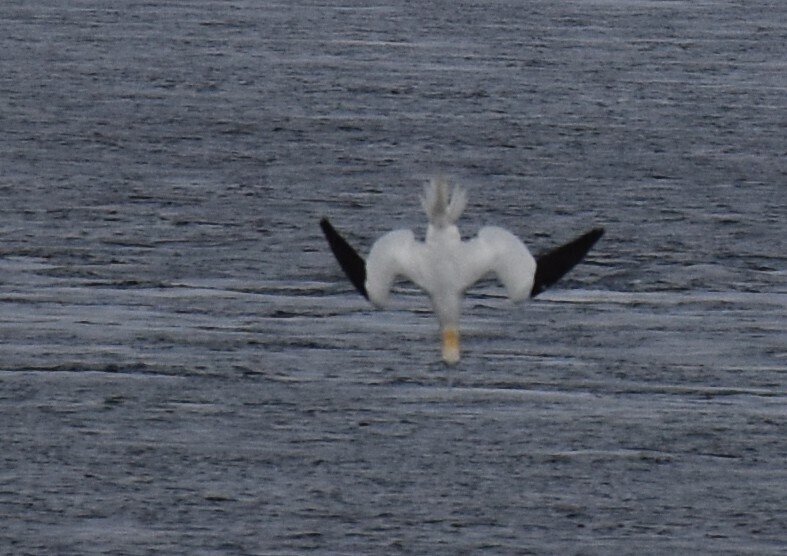
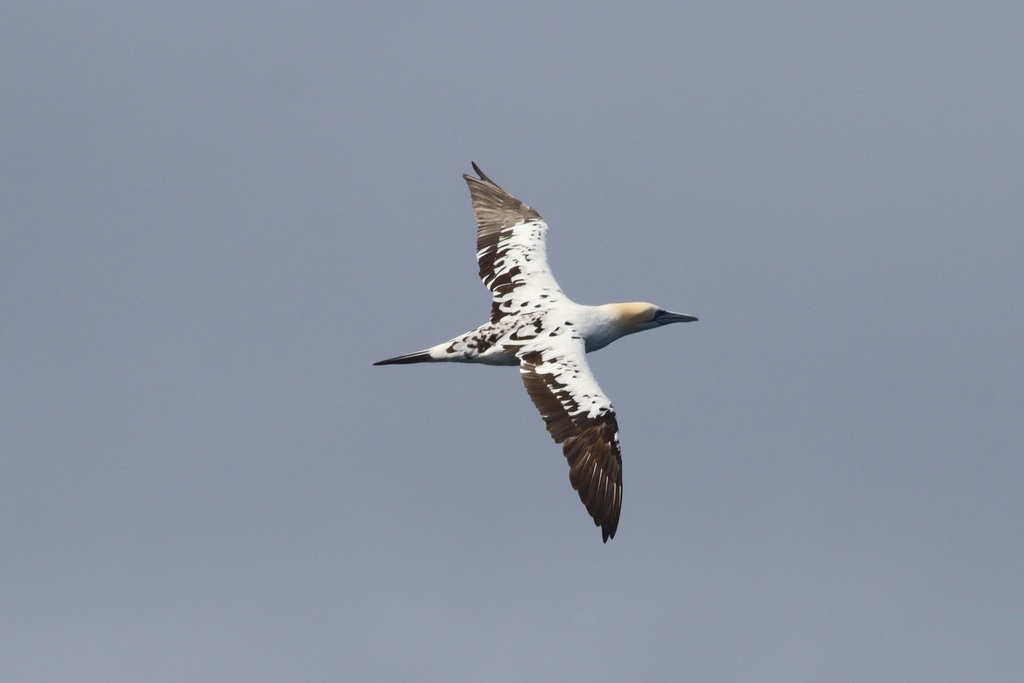
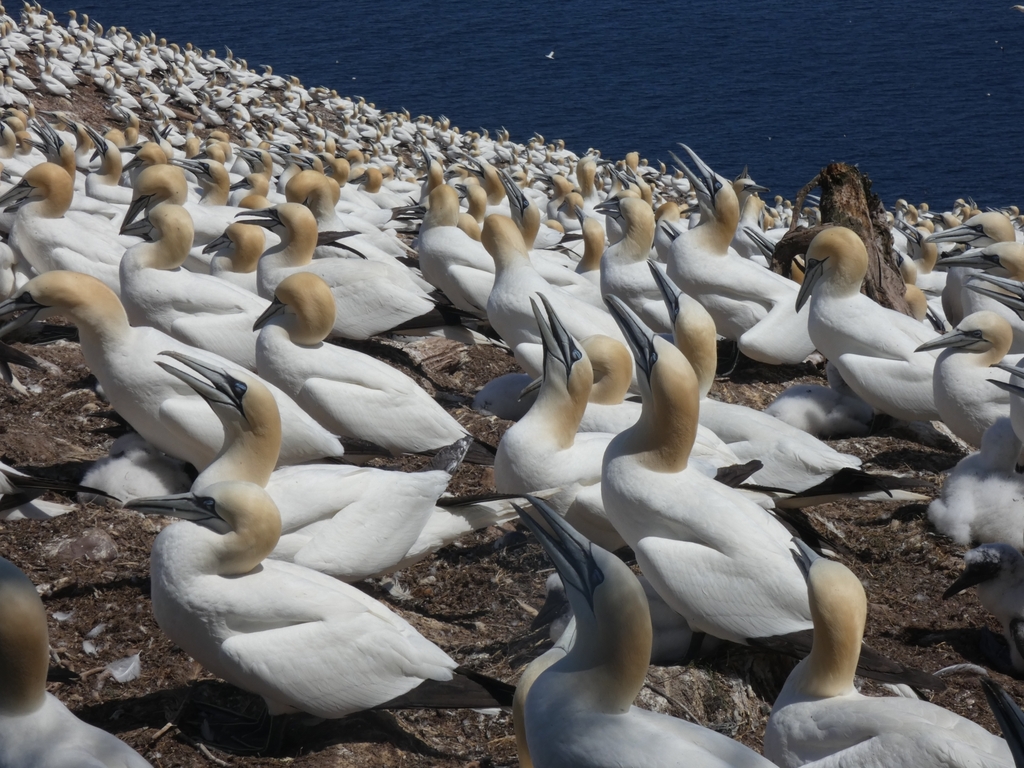
Photos show the species, not always the places on this page.
Length
About 87 to 100 cm (34 to 39 in) long, with a wingspan of about 170 to 180 cm (67 to 71 in). Audubon gives a slightly wider wingspan range, up to about 198 cm (6 ft 6 in).
Weight
About 2.3 to 3.6 kg (5 to 8 lb). BTO gives about 3 kg (6.6 lb) for a typical bird.
Next to a person
A wingspan about as wide as a tall adult is tall, or a little more. It weighs as much as two to three 1 kg bags of sugar.
What it eats
Small shoaling fish 2.5 to 30.5 cm long, such as herring, sand lance, cod and pollack, plus some squid. It plunge-dives from up to about 70 m, hits the water at about 100 km/h, and can reach about 11 m below the surface.
Around people
Calm, give space
How it lives
Northern gannets nest in tightly packed colonies. A pair raises one chick a year. The single egg hatches after about 42 to 46 days, and the chick fledges at 84 to 97 days. Birds first breed at about 4 to 5 years. About 92% of adults survive each year. A bird that reaches breeding age lives about 17 years on average, and the oldest recorded in the UK reached 37 years 4 months. Young birds are grey-brown and take about five years to become mostly white.
Where it goes
After breeding, birds disperse up to about 800 to 1,600 km from their colonies. Adults head towards the Mediterranean and the African Atlantic coast. Young birds travel further, and there are records as far as Ecuador. Audubon says birds in North America move south offshore along the Atlantic coast, with young birds going further south than adults.
We only draw a journey on the map when scientists have tracked it or clearly documented it. For this animal we have not found one yet.
Populations
Wikipedia gives a global population of 950,000 to 1,200,000 birds, and Audubon says about 720,000. Over two thirds of the world population breeds around the British Isles, and the Scottish Seabird Centre says Scotland holds 56%. The UK had about 295,000 nests in 2013 to 2014, and the species is Amber-listed in the UK. Bass Rock in Scotland has been the largest colony on Earth since 2014, at about 75,000 sites that year. Avian flu reached Bass Rock in 2022, when more than 5,000 dead birds were counted in a single June survey. Adult survival fell 42% below the previous 10-year average, and by 2023 about 55,000 sites remained. Wikipedia reports about 75% of known colonies were affected in 2022. In Newfoundland, the Cape St. Mary's colony grew from about 5,515 pairs in 1984 to about 14,600 pairs by 2018. IUCN assessed the species as Least Concern in 2018.
Meet it respectfully
Watch from a distance, from a viewing point or a boat that keeps well back from the colony. Never chase, touch, feed or bait gannets, and never throw fish to bring them in. Bird flu has hit gannet colonies. The Scottish Seabird Centre relays East Lothian Council advice not to pick up or touch dead or sick wild birds and to keep pets away from them. Follow your guide.
Fun fact
Tap the bulb to light it up.
It plunge-dives from heights of up to about 70 m and hits the water at about 100 km/h.
Bass Rock in Scotland has been the largest northern gannet colony on Earth since 2014.
Young birds are grey-brown and take about five years to turn mostly white.
Northern gannet in the Ocean Atlas
Places we have researched where this animal is recorded. It is never guaranteed, and some places are for watching from the boat only.
Travel with usComing soonTrusted referralExploringOn pause, story onlyEthics pass
Country colour: pink where we travel, blue where we are exploring or refer, grey for story only.
 Algeria
 The Bahamas
 Belgium
 Bermuda
 Canada
 Croatia
 Denmark
 Estonia
 Faroe Islands
 Finland
 France
 Gambia
 Germany
 Gibraltar
 Greece
 Greenland
 Iceland
 Ireland
 Israel
 Italy
Italy Libya
Libya Malta
Malta Mauritania
 Mexico
 Morocco
 Netherlands
 Norway
 Poland
 Portugal
 Russia
 Senegal
 Spain
Spain Sweden
 Tunisia
 Türkiye
 United Kingdom
 United States
 Western Sahara
Sources for this page
- Wikipedia, Northern gannet, 2026
- RSPB, Gannet, 2026
- BTO BirdFacts, Gannet, 2026
- Audubon, Northern gannet, 2026
- Scottish Seabird Centre, Avian flu, 2026
- Scottish Seabird Centre, Bass Rock count, 2023
- Cape St. Mary's gannet colony study, Scientific Reports, 2024
- GBIF, IUCN Red List category, 2026
Facts checked 5 October 2026. Photos: Unsplash licence, or Creative Commons as shown on each photo.
Work in ocean travel?
We are always happy to hear from exceptional local operators, accommodation, conservation organisations and destination experts. If your work fits responsible, small-group ocean travel, we would love to learn more.
Partner with Ocean CallingShop with Ocean Calling
Visit the Ocean Calling storefront on Amazon.
As an Amazon Associate I earn from qualifying purchases. You are not only choosing products that respect the ocean, you are also helping us keep going: paying our local partners fairly and keeping our retreats ethical, sustainable and honestly priced for you. 💗