
Tropical shearwater
Puffinus bailloni
A small dark-and-white shearwater skimming low over tropical waves. It follows its own path, and no sighting is ever a promise.
Least Concern (IUCN, 2018) means it is not at high risk at present. It is widespread and locally abundant, and the population appears stable.
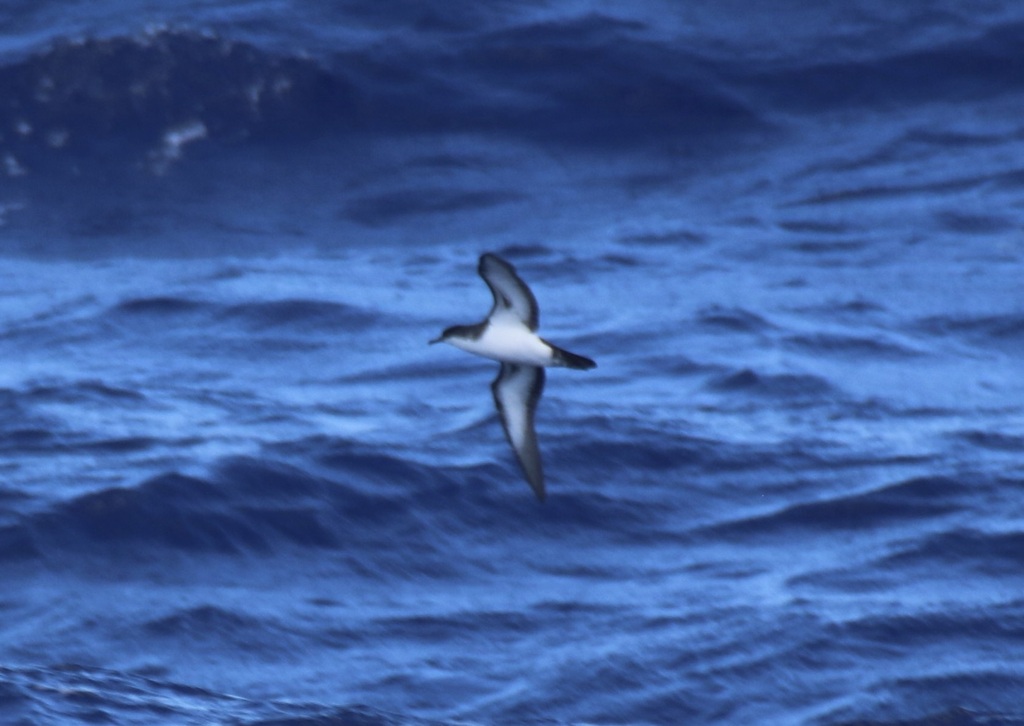
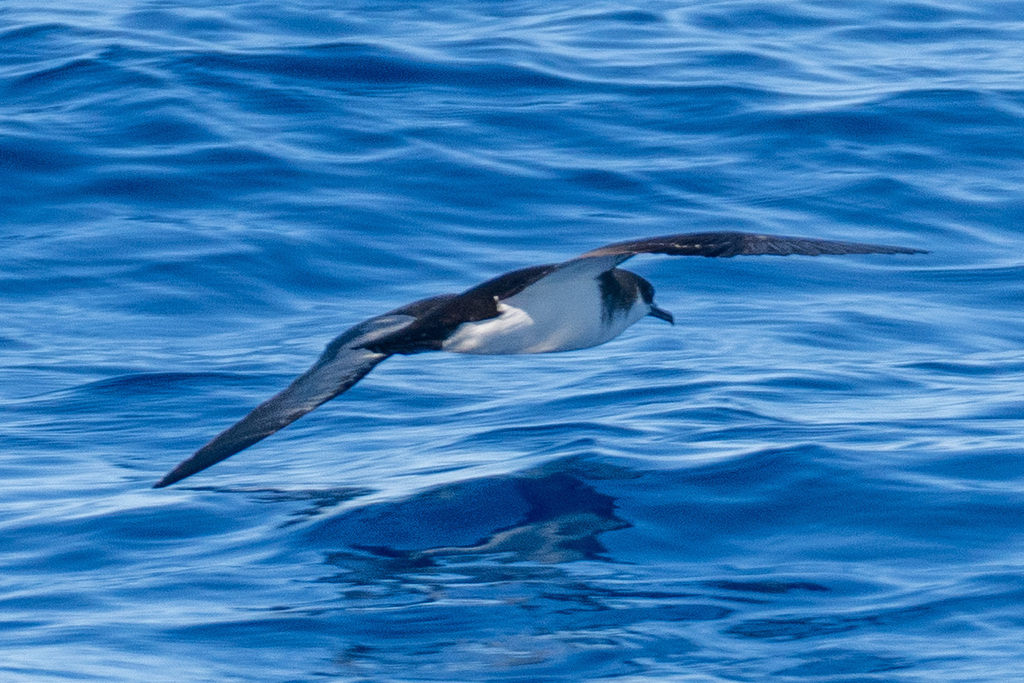
Photos show the species, not always the places on this page.
Length
About 27 to 33 cm (11 to 13 in) long, with a wingspan of about 64 to 74 cm (25 to 29 in)
Weight
About 165 to 259 g (5.8 to 9.1 oz), from one secondary source
Next to a person
About as long as a school ruler, and lighter than a standard drink can.
What it eats
Small fish, small crustaceans and squid. It catches them by diving, to about 35 m, or by plunging, pattering and seizing prey at the surface. It often feeds alongside other seabirds.
Around people
Distant, watch quietly
How it lives
It breeds in colonies on islands, rocky islets and coral reefs, and nests in rock crevices, self-dug burrows and other ground cavities. It lays a single white egg, which is incubated for about 50 days, and the chick leaves the nest about 75 days after hatching. Colonies are on oceanic islands and atolls. Threats named include introduced predators and loss of habitat.
Where it goes
The sources I read do not describe set migration routes. Outside the breeding season it stays in offshore waters, in the western Indian Ocean and across parts of the Pacific. It nests on islands from East Africa to southern India, and from southeast Japan to French Polynesia.
We only draw a journey on the map when scientists have tracked it or clearly documented it. For this animal we have not found one yet.
Populations
Least Concern worldwide (IUCN, 2018). The total population has not been counted. More than 100,000 pairs nest in Seychelles, with about 26,000 pairs on Aride Island alone. Estimates for the Line Islands are 1,000 to 10,000 pairs, and for the Phoenix Islands 10,000 to 100,000 pairs. In the Pacific, 54 colonies are recorded in the waters of American Samoa, Cook Islands, Fiji, French Polynesia, Micronesia, Palau, Phoenix Group, Solomon Islands, Tonga, Vanuatu, and Wallis and Futuna. Several subspecies are recognised, and the population appears stable.
Meet it respectfully
Watch from a boat that keeps its distance and moves slowly, and let the birds carry on feeding. Never chase, feed or bait them, and do not throw anything near them. Do not land on nesting islets or put a hand into a burrow, because ground-nesting seabirds are easily disturbed and introduced predators are a known threat. I did not read local rules for this species, so follow your guide and local rules.
Fun fact
Tap the bulb to light it up.
It was once treated as the same species as Audubon's shearwater of the Atlantic, and is now a species of its own.
It can dive to about 35 m to catch small fish and squid.
It lays one egg, which is incubated for about 50 days.
Tropical shearwater in the Ocean Atlas
Places we have researched where this animal is recorded. It is never guaranteed, and some places are for watching from the boat only.
Travel with usComing soonTrusted referralExploringOn pause, story onlyEthics pass
Country colour: pink where we travel, blue where we are exploring or refer, grey for story only.
 Chagos (British Indian Ocean Territory)
 Fiji
Fiji French Polynesia
 Kiribati
 Maldives
 Mauritius
 Micronesia (FSM)
 Palau
Palau Réunion
 Samoa
Samoa Seychelles
 Solomon Islands
 South Africa
 Tonga
Tonga Vanuatu
Sources for this page
- GBIF, IUCN category, 2026
- Wikipedia, Tropical shearwater, 2026
- SPREP Pacific Seabird Database, 2026
- Birds of the World, Cornell Lab, 2026
- Oiseaux-Birds, 2026
Facts checked 5 October 2026. Photos: Unsplash licence, or Creative Commons as shown on each photo.
Work in ocean travel?
We are always happy to hear from exceptional local operators, accommodation, conservation organisations and destination experts. If your work fits responsible, small-group ocean travel, we would love to learn more.
Partner with Ocean CallingGili Trawangan in 5 days
from CHF 790