
Velvet belly lanternshark
Etmopterus spinax
A small shark of the deep that glows faintly in the dark. It keeps to its own depths, and no sighting is a promise.
Vulnerable (IUCN, assessed 2020) means the species faces a high risk of extinction in the wild, mainly because deep-sea fishing catches it and it breeds slowly.
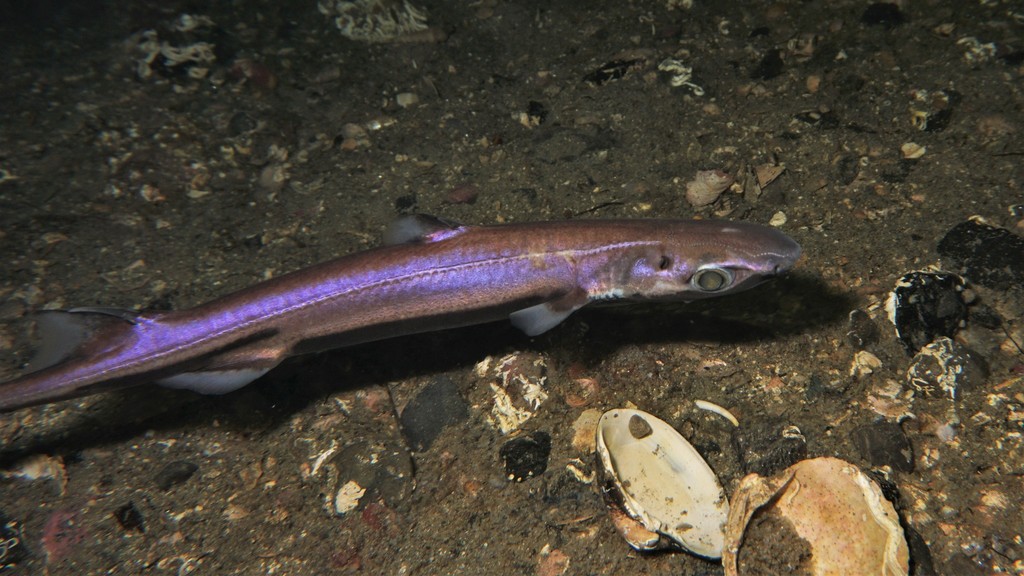
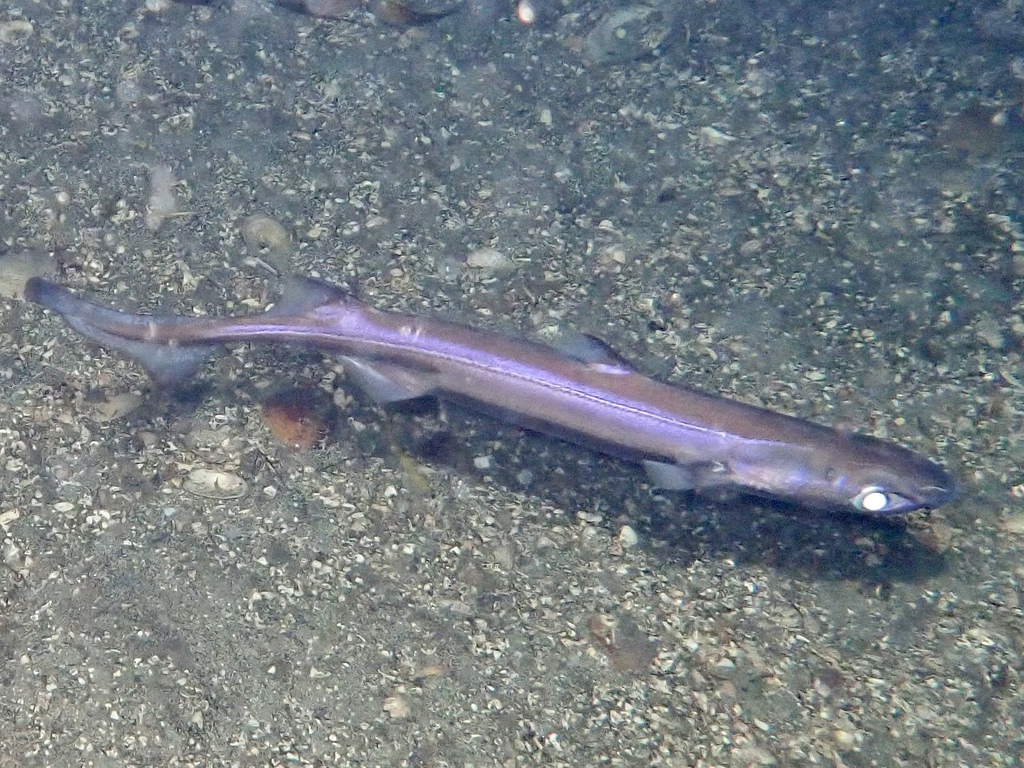
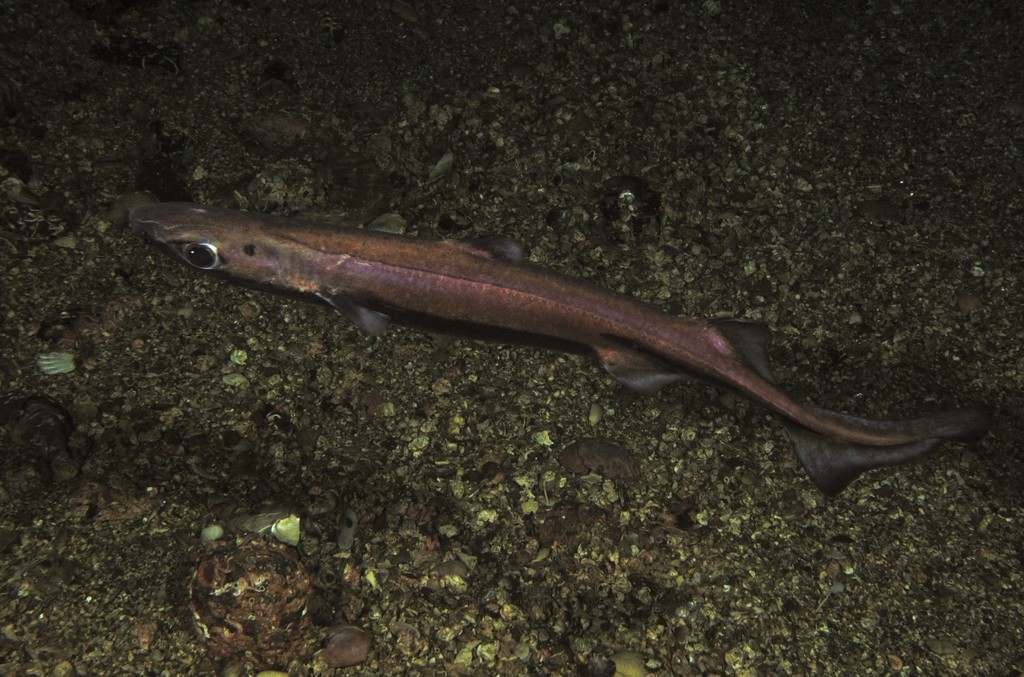
Photos show the species, not always the places on this page.
Length
Up to about 60 cm (24 in), and few are longer than 45 cm (18 in) (FishBase, Wikipedia). A study in Iceland measured one of 66 cm (26 in), the largest confirmed
Weight
Up to about 850 g (30 oz) (FishBase)
Next to a person
About as long as an adult forearm and hand, and lighter than a bag of sugar
What it eats
Small fish, squid and crustaceans (FishBase). Young sharks feed mainly on krill and small fish, and adults take more squid and shrimp (Wikipedia). In Icelandic waters, fish made up about 82 percent of the diet by weight, crustaceans 11 percent and squid 7 percent.
Around people
Deep-sea, rarely met
How it lives
A bottom-living shark of the outer shelf and upper slope, found at depths of about 70 to 2,490 m (230 to 8,170 ft) and usually at 200 to 500 m (FishBase). Pups develop in eggs inside the mother and are born live, in litters of about 6 to 20. Newborns are about 12 to 14 cm long, and the reproductive cycle takes two to three years (Wikipedia). In Iceland, females were half mature at about 50 cm and males at about 45 cm. It has many light-making organs that give off a blue-green glow visible at 3 to 4 m (10 to 13 ft).
Where it goes
It prefers a narrow temperature band. In Iceland it was found mostly at 400 to 500 m, in water of about 6.3 to 8.0 C, in the south and west only. Long migrations were not described in the sources I read.
We only draw a journey on the map when scientists have tracked it or clearly documented it. For this animal we have not found one yet.
Populations
Worldwide: Vulnerable on the IUCN Red List (assessed in 2020, FishBase). Wikipedia reports a decline of almost 20 percent between 1970 and 1998 to 2004 in some areas, and notes that it is often caught as bycatch and discarded with very high mortality. FishBase rates its resilience as very low, with a population doubling time of over 14 years. In Iceland, a survey from 2010 to 2021 found no significant decline.
Meet it respectfully
This shark lives mostly below normal dive depth, so a meeting is a rare chance event. If you do see one, stay calm, keep your distance and use light gently. Never chase, touch, feed or bait it, and follow your guide and local rules. No sighting is ever a promise.
Fun fact
Tap the bulb to light it up.
Its belly is black and its back is brown, hence the name velvet belly.
Light organs along its sides, belly and fins glow blue-green.
It is a bycatch species with little market value, so it is usually thrown back, often dead.
Velvet belly lanternshark in the Ocean Atlas
Places we have researched where this animal is recorded. It is never guaranteed, and some places are for watching from the boat only.
Travel with usComing soonTrusted referralExploringOn pause, story onlyEthics pass
Country colour: pink where we travel, blue where we are exploring or refer, grey for story only.
 Cameroon
 Côte d'Ivoire
 Denmark
 France
 Gabon
Gabon Ghana
Ghana Guinea
 Ireland
 Italy
Italy Liberia
 Nigeria
 Norway
 Portugal
 Sierra Leone
 Spain
Spain Sweden
 United Kingdom
Sources for this page
- FishBase, Etmopterus spinax
- Wikipedia, Velvet belly lanternshark
- PLOS ONE, Velvet belly lanternshark in Icelandic waters, 2024
- GBIF, IUCN category lookup, 2026
Facts checked 5 October 2026. Photos: Unsplash licence, or Creative Commons as shown on each photo.
Work in ocean travel?
We are always happy to hear from exceptional local operators, accommodation, conservation organisations and destination experts. If your work fits responsible, small-group ocean travel, we would love to learn more.
Partner with Ocean CallingGili Trawangan in 5 days
from CHF 790