
Amed Freediving: A Quiet Base on Bali’s East Coast
Early morning, a beach of dark stones, Mount Agung behind you and small fishing boats resting on the shore. No engine, no rush. A few strokes out, a line is waiting over real depth. This is Amed freediving, and the quiet is the whole point.

The first time you float above the line in Jemeluk Bay, the strangest thing is the silence. No boat engine, no long ride out, no crowd. Just your breath in the snorkel and the blue going down below you.
Is Amed a good place to learn freediving? For most beginners, yes: calm bays, entries straight from the beach and real depth close to shore. Amed is not the Bali most people see first. It is not one town but a string of small fishing villages and bays on Bali’s north-east coast, like Jemeluk and Lipah, joined by one coast road. The day starts early here, and the evenings stay quiet.
Why Amed freediving feels so gentle for beginners
When you start freediving, three things help you feel safe: calm water, depth you can reach without a long boat ride, and time to repeat the same simple dive many times.
Jemeluk Bay is the classic training spot. SSI, one of the big diving schools, describes Amed as having “calm, clear waters and easy shore access”, with Jemeluk’s coral garden sloping from 5 to 30 metres. So you walk in from the beach, swim a short distance, and train on a line over real depth, without the noise of an engine. For many beginners this small detail changes everything. Your first breath-hold is already hard enough.
PADI notes that diving is possible here all year, with the best months between April and June and between September and December. Calm is typical, not a promise. A good instructor checks the conditions every day and changes the site without drama when the sea says no. If you are new to all of this, our guide on how to learn freediving safely in Bali explains courses, buddies and first depths.
A slow village rhythm
Many freedivers like to be in the bay in the morning, when it is quieter and the body is still fresh. After the session the day becomes very simple: rest, a long lunch, some theory, stretching, maybe a nap.
Freediving asks for a rested body and a calm mind, and both come easier when the place around you is resting too.
So let me be honest about what Amed is not. It is not a nightlife place. The beaches are dark volcanic sand and stones. It is a long drive from the airport, so a two-night stop rarely makes sense. And it is not known as the place for manta rays or mola, which people usually look for elsewhere in Bali. If you read this and feel relieved, Amed is probably for you.
A wreck that became a reef
A short drive north of Amed is Tulamben. Off its black volcanic pebbles lies the USAT Liberty, a wreck that SSI places just 30 metres from the shore, at depths from about 3 to 29 metres. Over the years it has slowly become a reef.
For freedivers, the shallow parts can be a beautiful, soft challenge. The deeper sections and swim-throughs need experience, good depth control and a supervisor. And an easy depth is not the same as an easy dive: the entry over rolling stones is often the hardest part.
By day, bigeye trevally often hang over the wreck in a slow, shimmering school. FishBase, the big online fish encyclopaedia, describes them as often seen in large schools by day but alone at night, when they hunt. Hover quietly and let the school decide how close it comes. Never swim into it.
On the sand slope beside the wreck, spotted garden eels sway up from their burrows. They can reach 45 cm long, yet their body is only about 14 mm wide. They live in colonies of up to several hundred, eat tiny drifting plankton, and disappear into the sand when approached, usually on slopes below 15 metres. Move slowly, keep your fins off the sand, and the little meadow may rise again.
Turtles and other quiet neighbours
Along Amed’s reefs you may meet two kinds of turtles. Green turtles are, as NOAA Fisheries puts it, unique among sea turtles because they are mainly herbivores, eating mostly seagrasses and algae. Hawksbill turtles are the only sea turtle that can live on a diet made mainly of sponges, using a beak like a hawk’s to reach into cracks in the reef.
Hawksbills are Critically Endangered on the IUCN Red List, so never buy anything made of tortoiseshell. Wildlife encounters are unpredictable. Freediving near sea turtles should always follow local regulations and experienced professional guidance.
If you stay very still, a broadclub cuttlefish may pass by. The Monterey Bay Aquarium describes how it hypnotises its prey with flashing bands of colour that ripple along its skin. Stress can make it ink, so watch, and never follow.
Reefs that need a lighter touch
These reefs are beautiful, but they are not untouched. At Lipah Beach, researchers from Udayana University worked with the local community to transplant corals: 100 hexagon-shaped structures and 500 coral fragments, checked every week for four months. The fragments grew between 0.2 and 0.45 cm per month. It is a hopeful story, and a reminder that restoration is slow.
In Tulamben, a study from IPB University found only 13.72% of the surveyed coral colonies were healthy, and damage from sediment was the most common problem. This measures the colonies surveyed, not how much of the reef is alive. But the author names high-intensity dive tourism as a key pressure. That is something each of us can change.
How to freedive Amed with care
Never freedive alone. Train with a certified instructor and a buddy who watches you from the surface, and carry insurance that covers freediving.
In the water, do not touch, stand or kneel on coral, and do not hold on to the wreck. Practise buoyancy and fin kicks over sand, not coral. A low-volume mask that fits well means you are not stopping to fix it above the reef.
Give turtles space, never block their way up to breathe, and never chase or touch any animal. Six sea turtle species, including green and hawksbill turtles, are protected in Indonesia under Government Regulation No. 7/1999. If anyone offers turtle meat or shell products, the answer is simply no.
On land, Bali’s Governor Circular No. 4 of 2023 asks visitors to respect temples and to dress modestly at sacred areas, tourist sites and public places. Keep swimwear for the beach.
If learning slowly, close to the ocean, speaks to you, our Amed freediving trip through Ocean Match can connect you with a local team in Amed. You book with them directly.
Questions people ask
Is Amed good for complete beginners in freediving?
Yes, for most of the year. Calm bays, shore entries and a coral slope from about 5 to 30 metres in Jemeluk make it a gentle place to learn. Conditions still change, so follow your instructor’s daily choice of site.
Can freedivers visit the USAT Liberty wreck?
The shallow parts, from about 3 metres, are within reach of many freedivers with a buddy and supervision. Deeper sections and swim-throughs need real experience. Take care on the pebble beach entry.
Do I need malaria tablets for Amed?
NHS fitfortravel describes the malaria risk in Bali as low to no risk, and antimalarial tablets are not usually advised. Check current advice with your own health professional before you travel.
Will I see turtles in Amed?
Green and hawksbill turtles are regularly met along Amed’s reefs, but no sighting is ever guaranteed. If one comes close, stay still and let it choose.
Wildlife encounters are never guaranteed and never forced. Ocean Calling works only with vetted, ethical local operators, and every animal is free to approach, or not, entirely on its own terms.
Sources & further reading
- SSI. Freediving in Bali: 9 Things You Need to Know.
- PADI. Diving in Amed.
- FishBase. Caranx sexfasciatus, Bigeye trevally.
- FishBase. Heteroconger hassi, Spotted garden-eel.
- FishBase. Bolbometopon muricatum, Green humphead parrotfish.
- NOAA Fisheries. Green turtle.
- NOAA Fisheries. Hawksbill turtle.
- IUCN Red List. Eretmochelys imbricata, Hawksbill turtle.
- Monterey Bay Aquarium. Broadclub cuttlefish.
- Atmaja, P.S.P. et al., 2023. Transplantasi terumbu karang untuk tujuan rehabilitasi di Pantai Lipah. Buletin Udayana Mengabdi.
- Wisnu, G.P., 2024. Kesehatan Karang di Perairan Desa Tulamben Bali. IPB University.
- As-singkily, M., Nijland, R. and Becking, L.E., 2025. Sea turtle protection in Indonesia: A review of constitutional and customary regulations. Environmental Challenges.
- Indonesia Travel, Ministry of Tourism, 2023. New rules for foreign tourists in Bali (Governor Circular No. 4 of 2023).
- fitfortravel, NHS Scotland. Indonesia.
Further reading on Ocean Calling: Spotted garden eel in the Ocean Atlas · Bumphead parrotfish in the Ocean Atlas · Green turtle in the Ocean Atlas · Hawksbill turtle in the Ocean Atlas · Observing sea turtles respectfully · Indonesia in the Ocean Atlas · Amed scuba through Ocean Match
Freediving certification in Bali: Amed, USAT Liberty wreck and Ubud
Freediving certification · Amed & Ubud, Bali, Indonesia
Ocean breath first, sacred water after. This story is about Indonesia, where we run our Bali trips.
Explore in the Ocean Atlas
Places in this article
Animals in this article
 Bumphead parrotfishBolbometopon muricatum
 Bigeye trevallyCaranx sexfasciatus
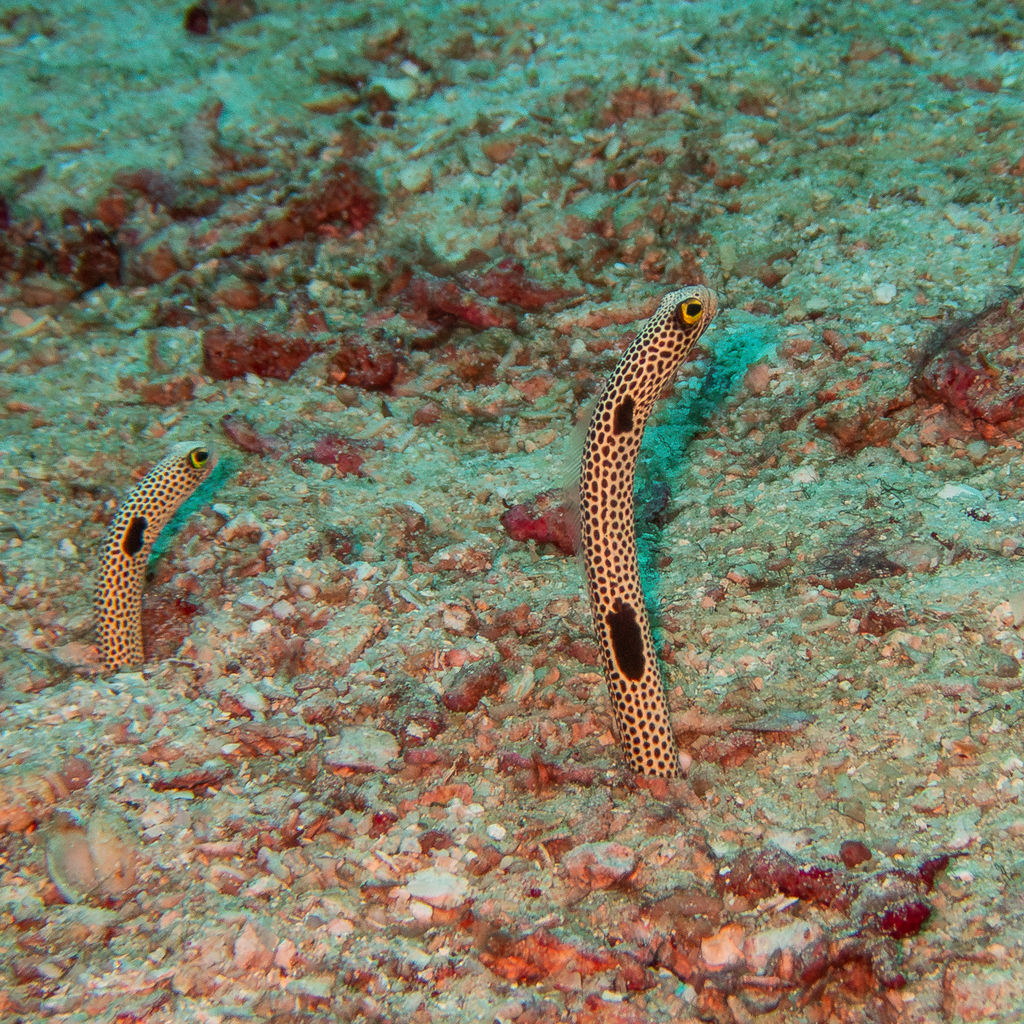 Spotted garden eelHeteroconger hassi
 Green turtleChelonia mydas
 Hawksbill turtleEretmochelys imbricata
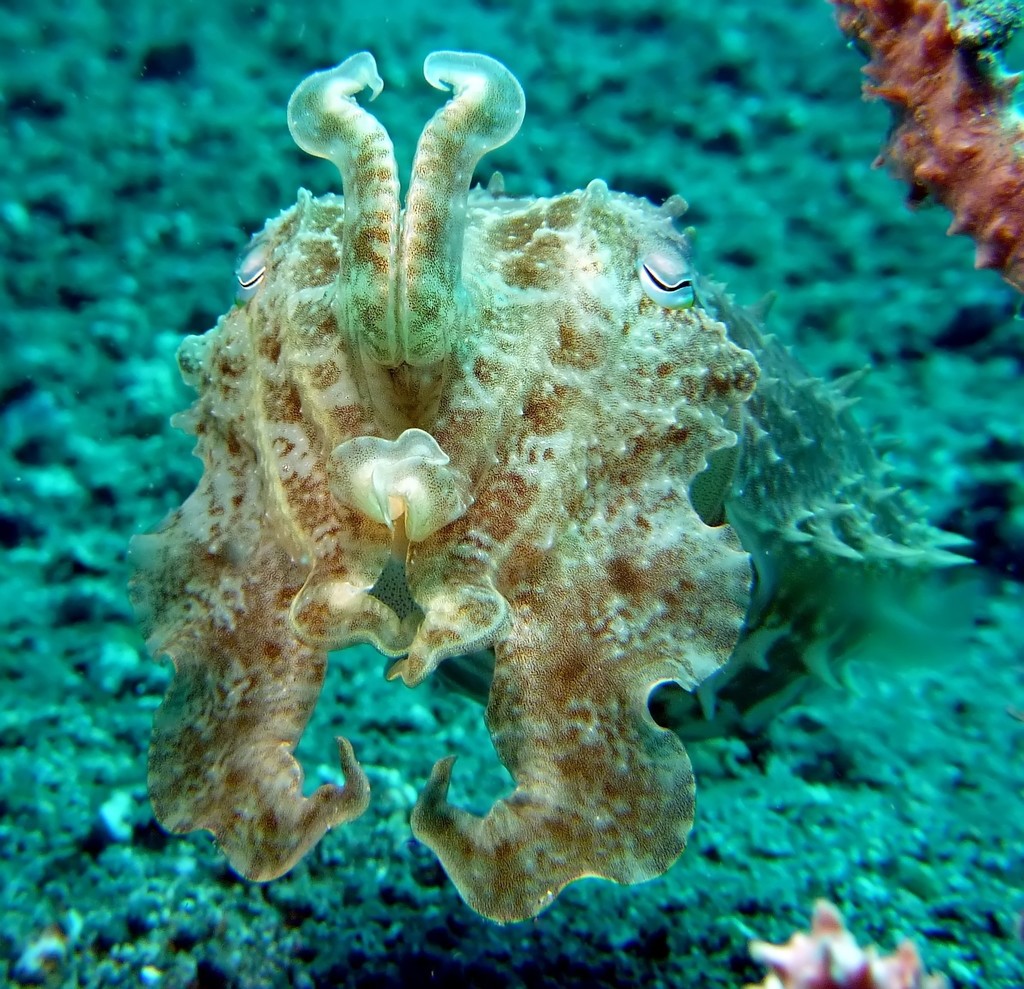 Broadclub cuttlefishAscarosepion latimanus