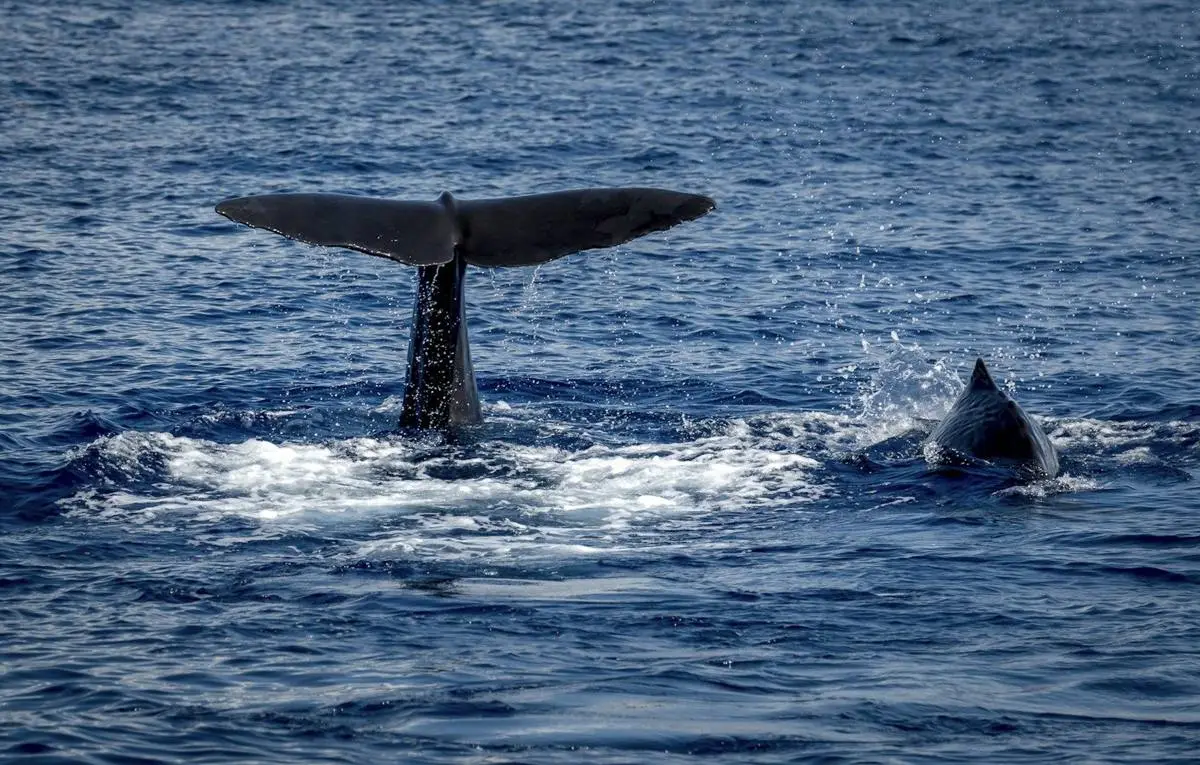
How Sperm Whales Dive Deep Without Crushing Their Lungs
Lungs that fold away on purpose, and muscles that carry their own oxygen. It is one of the cleverest pieces of engineering in the ocean, and it is built from flesh and bone.

Imagine holding your breath, stepping into a lift and going down hundreds of metres into the dark, hunting as you go, and coming back up about three quarters of an hour later. For a sperm whale, that is a normal working day. So how do sperm whales dive so deep without their lungs being crushed? In short, they let the lungs collapse on purpose, and they do not depend on them for oxygen.
Tagging studies give us the numbers. In a study of 37 sperm whales in the Atlantic, the Gulf of Mexico and the Ligurian Sea, the average maximum dive depth in each region was between about 644 and 985 metres. An average dive cycle was about 45 minutes under the surface, followed by about 9 minutes at the surface. Individual whales are reported to go deeper, but I did not find a primary study to quote for a record, and sources disagree, so I will not give you one.
The problem: pressure
Every ten metres of depth adds roughly one more atmosphere of pressure. At 900 metres, the total pressure is roughly ninety times what we feel at the surface. For a body that is mostly water, that is manageable, because water hardly compresses. Think of a bottle full of water next to a balloon. The bottle barely changes. The balloon shrinks and may burst.
A whale’s body is mostly water, so most of it handles pressure well. The air-filled spaces are the difficult part, and that is where deep divers have special adaptations. The lungs, the ears and the sinuses all hold air, and air is the part that gets squeezed.
How do sperm whales dive deep with a chest that gives way?
Diving mammals have chest walls that are flexible and can be compressed. The ribs are jointed and partly flexible, so the whole chest can fold in as the water pushes harder. The lungs collapse, and the little air that remains is pushed into the stronger, reinforced airways, away from the delicate tissue where gas is exchanged. That protects the lung tissue from damage caused by pressure.
A submarine solves the same problem the opposite way. It carries an air-filled cabin inside a rigid hull, and if the pressure goes beyond what the hull can take, the hull can collapse. A sperm whale does not resist the pressure. Its chest gives way to it. I find that very beautiful, and a little humbling for our engineers.
There is also a quiet benefit. When the lungs collapse, less nitrogen gets pushed into the blood at depth, which helps to avoid decompression sickness, the bends that human divers fear. It is not a perfect protection, though. Studies of stranded whales have found more gas bubbles in deep-diving species such as sperm and beaked whales than in shallow divers, so scientists still debate how well deep divers avoid the problem, and why.
Packing supplies for a long trip downstairs
Muscle holds oxygen thanks to a protein called myoglobin, which grabs oxygen and releases it when the muscle needs it. Diving mammals have much higher myoglobin concentrations than land mammals. In a 2013 study in the journal Science, researchers traced how this protein changed over about 200 million years of mammal evolution. They found that in all diving lineages, from tiny water shrews to whales of 80,000 kilograms, the myoglobin carries a higher electric charge on its surface. This is thought to let the muscle hold more of it while keeping the protein stable.
Popular sources often say that sperm whales have ten times as much myoglobin as humans, or that about half of their oxygen is stored in muscle. Those numbers vary from page to page and I could not trace them to one clear source, so I do not repeat them as facts. The direction is clear, though. A lot of oxygen is stored in muscle, and it is used slowly.
It is like packing supplies for a very long trip downstairs, and then using them slowly. While we decide what to have for lunch, a sperm whale may be hundreds of metres below the surface, holding its breath and looking for its own. The tag data say the whale clicks regularly for most of the dive, around 80 percent of it in that study, and the clicks rise into rapid buzzes when it closes in on prey.
Why a deep diver needs a quiet sea
All this machinery shows how little margin a deep diver has. Every dive is a long trip on a single breath, and the surface rest between dives is short. That is why noise, ships and nets matter so much for them.
NOAA lists the sperm whale as endangered under the US Endangered Species Act and protected under the Marine Mammal Protection Act. Commercial whaling from about 1800 to 1987 nearly wiped out all sperm whale populations, and NOAA says that although whaling is no longer the major threat, populations are still recovering. The IUCN Red List treats the species as Vulnerable worldwide and the Mediterranean subpopulation as Endangered, with fewer than 2,500 animals estimated. Ship strikes and entanglement in fishing gear are the main threats named there, and research in the Hellenic Trench, off Greece, has looked at shipping routes that pass through core sperm whale habitat.
Watching with respect
When a whale surfaces after a long dive, it needs to breathe and rest, so we keep our distance and let it. Sperm whales are best met from a boat with a patient crew, and each place has its own rules, so check the current rule before you travel. Wildlife encounters are unpredictable. Whale watching should always follow local regulations and experienced professional guidance. To see what a boat-only approach looks like, read Azores sperm whales from a boat. On a long day on the water, a roll-top dry bag keeps a phone and a spare layer dry, and a small action camera on a wrist strap lets you keep your eyes on the whale instead of the screen.
Flying to see whales has a carbon cost, and I will not pretend it does not. I would rather you take one longer trip than three short ones. If you would like to know which ocean suits you, try our Ocean Match. To keep reading, see what happens in the hunt itself in what happens when a sperm whale disappears, or meet the species in the Ocean Atlas. If this made you curious about meeting the ocean yourself, you can explore our retreats.
Questions people ask
How deep do sperm whales dive?
In one tagging study of 37 whales, average maximum dive depths in different regions were about 644 to 985 metres. Some dives are deeper, but I did not find a primary study to quote for a record.
How long can a sperm whale hold its breath?
A typical foraging dive in that study lasted about 45 minutes, followed by about 9 minutes at the surface. Longer dives may happen, but 45 minutes is the figure I can source.
Do sperm whales get the bends?
Their collapsing lungs limit how much nitrogen enters the blood, which helps. But stranded deep-diving whales have shown more gas bubbles than shallow divers, so scientists still study how well they avoid it.
What is myoglobin?
A protein in muscle that stores oxygen and releases it when the muscle needs it. Diving mammals have much higher levels than land mammals.
Are sperm whales endangered?
NOAA lists the sperm whale as endangered under the US Endangered Species Act. The IUCN lists the species as Vulnerable worldwide and the Mediterranean subpopulation as Endangered. Categories are updated, so check the current listing.
Can you swim with sperm whales?
Rules differ by place and often do not allow it. We do not sell swims with sperm whales. We watch from the boat, keep our distance and let the animal decide.
Wildlife encounters are never guaranteed and never forced. Ocean Calling works only with vetted, ethical local operators, and every animal is free to approach, or not, entirely on its own terms.
Sources & further reading
- Sperm whale species profile NOAA Fisheries, current page.
- Deep-diving foraging behaviour of sperm whales (Physeter macrocephalus) (Watwood et al.) Journal of Animal Ecology 75, 2006.
- Evolution of Mammalian Diving Capacity Traced by Myoglobin Net Surface Charge (Mirceta et al.) Science 340, 2013.
- How do deep-diving sea creatures avoid the bends? Scientific American, 2002.
- Physeter macrocephalus (sperm whale) assessment IUCN Red List of Threatened Species, see current listing.
- Shipping routes through core habitat of endangered sperm whales along the Hellenic Trench, Greece: can we reduce collision risks? PLOS ONE, 2019.
Further reading on Ocean Calling: Sperm whale in the Ocean Atlas · What happens when a sperm whale disappears · Do sperm whales really poop to escape orcas? · Azores sperm whales from a boat
Swim with humpback whales in Moʻorea: an ethical whale retreat
Whale encounter retreat · Moʻorea, French Polynesia
Time in the blue, on the whales’ terms. September 2027. If you love whales, this is our whale retreat: small group, slow pace, on the animals’ terms.
Explore in the Ocean Atlas
Animals in this article