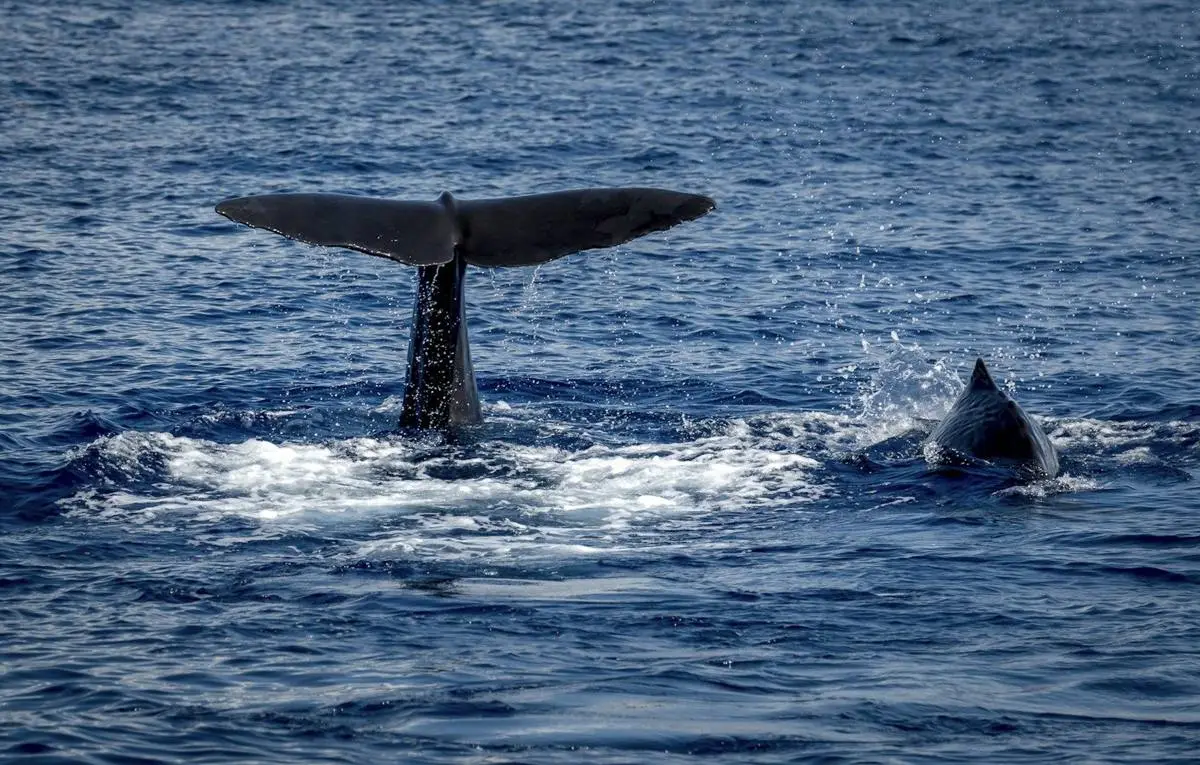
What Happens When a Sperm Whale Disappears Below
An animal this enormous lifts its tail, slides down, and the sea is empty again. It plays with your sense of scale. But for a sperm whale, disappearing is not the end of the story. It is where the hunt begins.
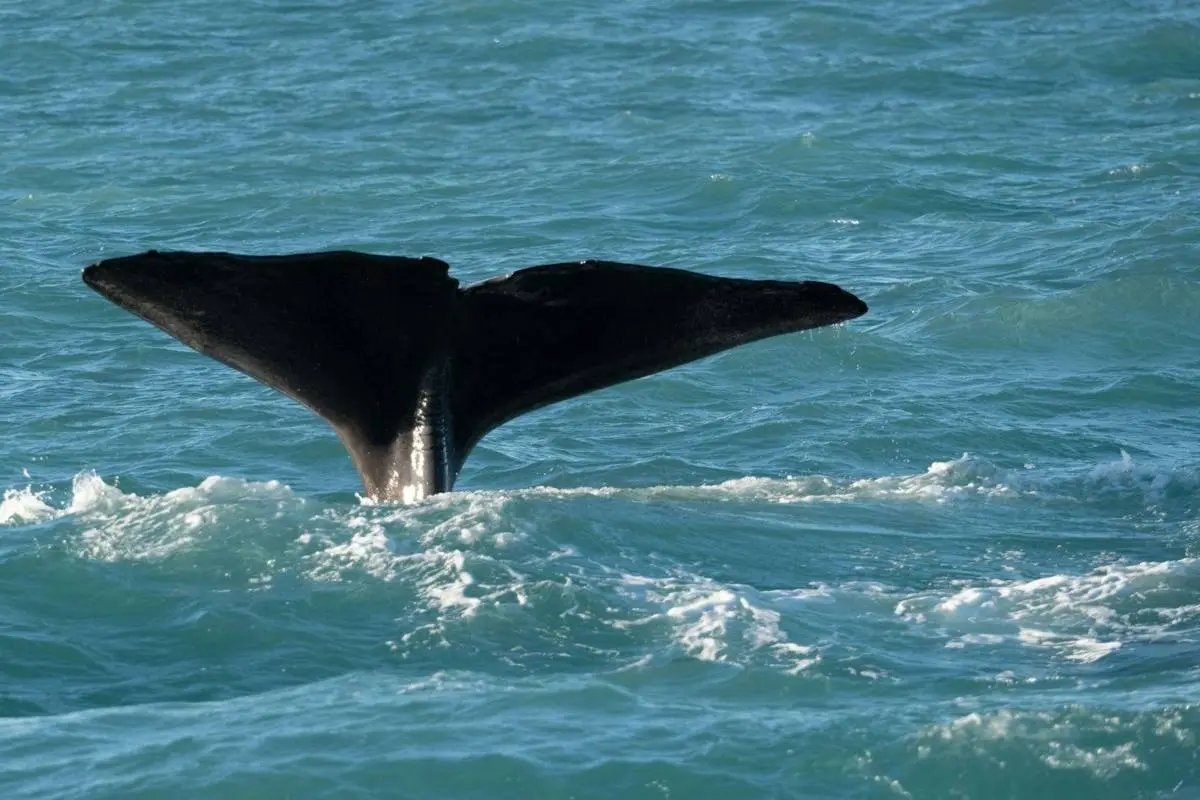
So what happens when a sperm whale disappears beneath the waves? It goes to work. On a typical feeding dive it goes down several hundred metres, finds its way by sound, hunts squid in the dark, and comes back about three quarters of an hour later. In a tagging study of 37 whales, the average dive lasted about 45 minutes, followed by about 9 minutes at the surface. Average maximum depths in different regions were between about 644 and 985 metres.
How does a sperm whale hunt in total darkness?
It listens. Sperm whales send out powerful clicks and listen to the echoes that come back from animals and objects around them. In the tag data, regular clicks filled about 81 percent of a dive. When a whale gets close to prey, the clicks speed up into rapid “buzzes”, sometimes called creaks. Scientists use these buzzes to detect attempts to catch prey. In that study, whales went down on average about 392 metres between their first click and their first buzz. The sound reached far ahead, long before the whale did.
I love thinking about how busy that darkness is. No light, no horizon, no clear map. And still the whale knows what is around it. The clicks are very loud, and a whale that cannot see its prey builds a picture of it from sound alone.
Scars, squid and stories we only half see
NOAA describes the sperm whale diet as mostly deep-water squid, with some octopus, sharks and other fish. And this is where sperm whale stories become almost hard to believe. Some whales carry round scars that look like the marks of squid suckers, and the biggest scars are larger than the suckers of any squid we know. The scars grow as the whale grows. So a big mark can be the memory of a meal that fought back when the whale was smaller. For centuries, whalers also found giant squid beaks in the stomachs of the whales they killed.
But we should be careful, because the real story is less neat than the legend. Some skin fungus can leave scars of a similar shape. And nobody really knows who usually wins a fight between a sperm whale and a giant squid. We have clues, not film.
Life at the surface: families that talk in clicks
After the dive, the whale comes back to a completely different world. At the surface, females and young live in close social units. They rest, look after calves and talk to each other with patterned sequences of clicks called codas.
Off the island of Dominica, researchers have followed these units for around twenty years, using photographs of individual whales. They describe clans of hundreds or thousands of whales that identify themselves with different coda patterns, a little like dialects. The Dominica clan uses its own set of 21 of the roughly 150 coda types found around the world.
In 2024, researchers reported what they called a sperm whale “phonetic alphabet”, built from the timing and other features of the clicks. It was presented as the first evidence that another species may use a combinatorial system of sounds. I want to be careful here. What codas mean is still mostly unknown. Ideas like “whales use names” or “the mother talks to the baby” are researchers’ interpretations, not translated sentences.
So the next time you see this huge animal fade into the blue, remember there may be a whole hunt happening far below you that you will never see. The surface is only the small part of a sperm whale’s life we are lucky enough to witness.
What happens when a sperm whale disappears: the conservation layer
Because so much of a sperm whale’s life is hidden, it is easy to forget how exposed it is. NOAA lists the species as endangered under the US Endangered Species Act and protected under the Marine Mammal Protection Act. Commercial whaling between about 1800 and 1987 nearly wiped out all sperm whale populations, and NOAA says populations are still recovering.
The IUCN lists the species as Vulnerable worldwide, and the Mediterranean subpopulation as Endangered, with an estimated fewer than 2,500 animals. Ship strikes and entanglement are named as continuing threats there, and noise is a further worry in busy areas such as the Hellenic Trench off Greece.
A whale that listens to find its food needs a sea that is not too loud. That is one more reason to choose quiet boats, slow speeds and operators who keep their distance. You can read about the body behind these dives in how sperm whales dive without crushing their lungs.
Meeting them with respect
Sperm whales are best watched from a boat, with a patient crew who keep their distance and never chase. Rules differ from place to place, so check the current rule before you travel. Our story on Azores sperm whales from a boat shows what a watch-only day can look like. Wildlife encounters are unpredictable. Whale watching should always follow local regulations and experienced professional guidance.
On a long day at sea I would carry a small action camera on a wrist strap. That way your eyes stay on the whale, and you still bring home a memory without leaning over the side. The sun on open water is strong, so a mineral sunscreen is worth packing.
If a quiet day on the water sounds like your kind of ocean, our Ocean Match can help you find the right place and pace. We never promise a sighting, we do not sell swims with sperm whales, and flying to see whales has a real carbon cost, so we prefer fewer, slower trips. If this made you curious to experience it yourself, you can explore our retreats, or meet the species in the Ocean Atlas.
Questions people ask
How do sperm whales find food in the dark?
They use echolocation. They make loud clicks and listen to the echoes, and the clicks speed up into buzzes when they get close to prey.
What are codas?
Codas are short, patterned sequences of clicks that sperm whales use to communicate. Different clans use different coda patterns. What each coda means is still mostly unknown.
What do sperm whales eat?
NOAA describes the diet as mostly deep-water squid, with some octopus, sharks and other fish.
Do sperm whales really fight giant squid?
Scars and squid beaks in whale stomachs show the two clearly meet. But scars can have other causes, and nobody has filmed enough to say who usually wins.
How long does a sperm whale stay down?
In a tagging study of 37 whales, an average dive lasted about 45 minutes, followed by about 9 minutes at the surface. Longer dives can happen.
Are sperm whales endangered?
NOAA lists the sperm whale as endangered under the US Endangered Species Act. The IUCN lists it as Vulnerable worldwide and the Mediterranean subpopulation as Endangered. Categories get updated, so check the current listing.
Wildlife encounters are never guaranteed and never forced. Ocean Calling works only with vetted, ethical local operators, and every animal is free to approach, or not, entirely on its own terms.
Sources & further reading
- Sperm whale species profile NOAA Fisheries, current page.
- Deep-diving foraging behaviour of sperm whales (Physeter macrocephalus) (Watwood et al.) Journal of Animal Ecology 75, 2006.
- Physeter macrocephalus (sperm whale) assessment IUCN Red List of Threatened Species, see current listing.
- Shipping routes through core habitat of endangered sperm whales along the Hellenic Trench, Greece: can we reduce collision risks? PLOS ONE, 2019.
- Could a newly discovered sperm whale ‘alphabet’ be deciphered by humans? Science, 2024.
- Groundbreaking effort launched to decode whale language National Geographic, 2020.
- Predicting mesoscale movement of sperm whale units in the Caribbean based on social dynamics PubMed Central, 2025.
Further reading on Ocean Calling: Sperm whale in the Ocean Atlas · How sperm whales dive without crushing their lungs · Azores sperm whales from a boat
Swim with humpback whales in Moʻorea: an ethical whale retreat
Whale encounter retreat · Moʻorea, French Polynesia
Time in the blue, on the whales’ terms. September 2027. If you love whales, this is our whale retreat: small group, slow pace, on the animals’ terms.
Explore in the Ocean Atlas
Animals in this article