
Ethical Ocean Wildlife on the Kenyan Coast: Diani, Watamu and Kisite
Is the Kenyan coast a good place for ethical wildlife watching? Yes for turtles, reefs and dolphins from the boat. Whales and whale sharks are seasonal and never certain, and some of the rules are softer than they look.
Read a few travel pages about this coast and it sounds as if everything is possible: dolphins, turtles, whales and whale sharks, all in one week. The real picture is quieter, and honestly I like it better. Turtles, reef fish and dolphins are the most dependable. Humpback whales and whale sharks come in short seasons and some years not at all.
So this is not a promise. It is what I could check, what I could not, and the questions I would ask before choosing a boat.
What the Kenyan coast offers, and when
Kenya has three coastal places that keep coming up for ocean travellers. Watamu, in the north, has an old marine park and a turtle project. Diani, on the south coast, has a long beach and reef diving. Shimoni and Kisite, near the Tanzanian border, are known for dolphins and snorkelling over coral.
The sea is often calmer and clearer from about October to March, which is the period our own research notes favour for reef time. That is a planning note, not an official season. Humpback whales pass the coast in the cooler months. The IWC Whale Watching Handbook says they migrate along the Kenyan coast between August and October, with small boats working from Watamu and Ngomeni. Other sources start the season in July, so I would say July to October and leave it there.
Whale sharks are the most uncertain animal of all. The East African Whale Shark Trust, which has researched them off Diani since 2005, reported in 2018 that its research expeditions normally run from the start of February to mid-March. That year the sharks arrived early. I could not find newer season reports, so I do not know how reliable the pattern is today. Our Kenya page in the Ocean Atlas lists the same windows, always with the word "never certain".
Dolphins at Kisite-Mpunguti: a code, not a certainty
Kisite-Mpunguti is the part of the coast where the rules matter most, because a small group of dolphins lives there all year. A Marine Mammal Protected Areas Task Force factsheet describes a small resident population of Indo-Pacific bottlenose dolphins that has long been the regular target of dolphin-watching tourism, with a mean estimate of about 62 animals from photo-identification surveys in 2006 to 2009. A small, resident group cannot simply move away from boats the way a passing whale can.
According to the IWC handbook, the Kenya Wildlife Service wrote a voluntary code in 2007 after dolphin tourism grew quickly. It recommends boats stay at least 100 m from dolphins, no more than two boats at a time, no more than 20 minutes with the same group, and no swimming with dolphins. The handbook adds that the code was adapted from codes for other dolphin populations because Kenya had little local data, and that studies suggest it helps reduce some impacts of tour boats.
Here I have to be honest about the gaps. A Kenyan research and ecotourism page gives different boat distances, 50 m and 100 m directly in front or behind. The KWS page for Kisite-Mpunguti lists swimming with dolphins as a highlight, while the code says it is prohibited. A Watamu lodge, citing the Watamu Marine Association, says never to chase dolphins to swim and that being in the water when they choose to approach is the only acceptable case. I did not find a current binding regulation for dolphin boats, and I could not read the original code. Please check the current rule before you travel.
Because of this, Ocean Calling watches Kenyan dolphins only from the boat, and we would not sell a swim. A voluntary code that its own authorities describe in two ways is not enough to build a retreat on. Our general guide to ethical swimming with dolphins explains the questions we ask, and this piece on chase warning signs shows what a bad trip looks like.
Marine park rules that are clearer
Some rules are written plainly. On its page about Kisite, KWS says the marine park is for non-consumptive use, that hook-and-line fishing is allowed in marine reserves but not in marine parks, and that spear guns are banned in both. Kisite itself is a fully protected no-take zone, while the neighbouring Mpunguti reserve allows controlled artisanal fishing alongside low-impact tourism.
For a traveller this means three simple things. Pay the park fee, because it supports the people who guard the reef. Do not stand on coral or touch it. Follow the park ranger and the boat captain, who are the ones who know the day's conditions. A good snorkel guide will brief you before you jump in, and will also tell you when to stay on board.
Turtles and the Watamu fishers: conservation with a catch
Watamu Turtle Watch, run by the Local Ocean Trust, is one of the most interesting community projects on this coast. It began in 1998, when many turtles were being eaten locally. Fishers call the team when a turtle is caught by accident in a net or on a line. The team checks the animal at the landing site, records data, tags it and releases it if it is healthy. The fisher receives a small payment. Sources disagree on the amount, from roughly US$3.50 to about US$5, so I will not quote a figure.
One programme profile reports more than 400 fishers taking part and more than 15,000 releases. I could not confirm those totals independently, so I read them as the project's own numbers. The authors of the profile also acknowledge that paying for releases has critics among turtle researchers, that the payment is far below the illegal market value of turtle meat, and that some fishers still hunt turtles. That is a fair, uncomfortable picture, and I trust it more than a perfect one.
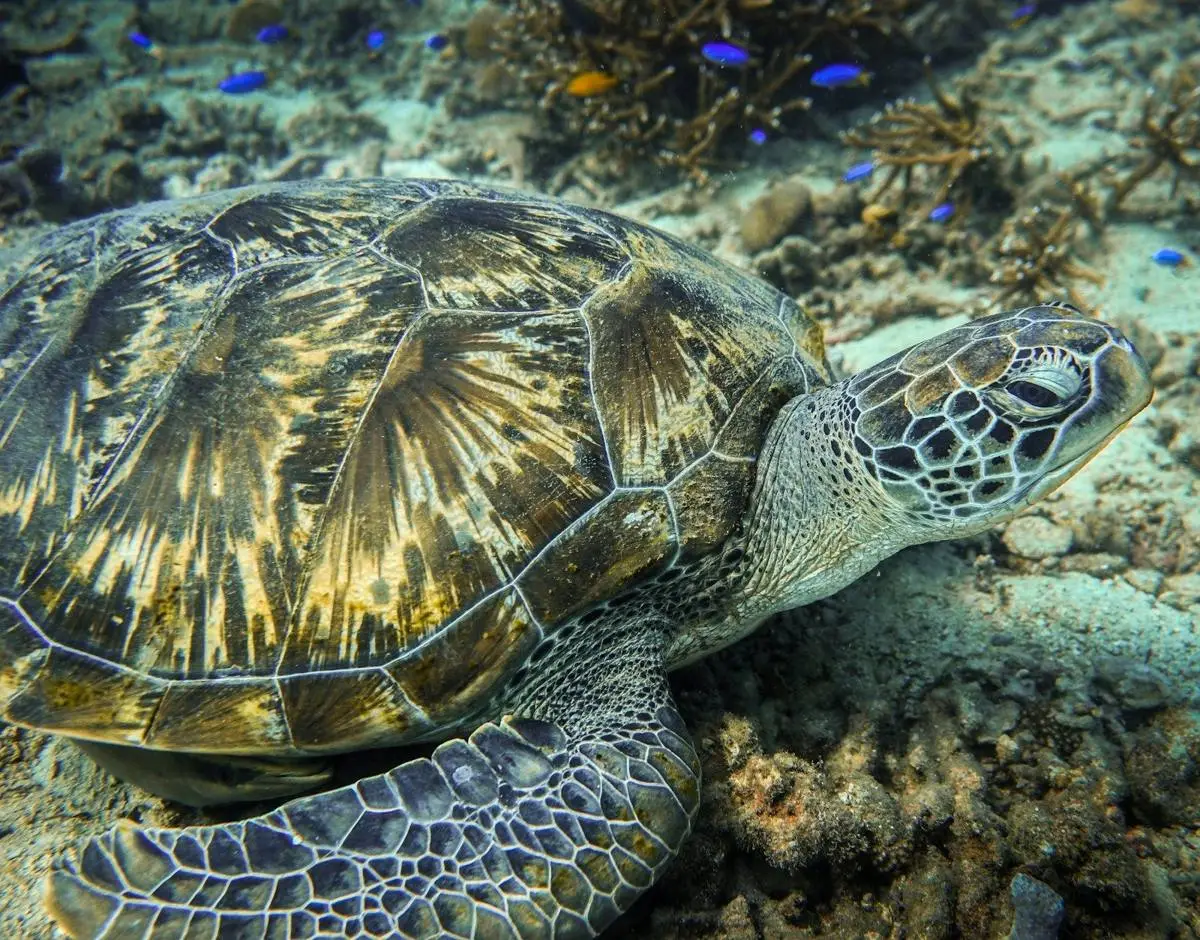
As a visitor, the lesson is simple. Watch turtles from the surface, never touch or ride them, and do not choose a place that keeps wild turtles in pools for visitors. We explain why in our piece on observing sea turtles respectfully while snorkelling. A low-volume mask and snorkel that fits properly also helps, because you stay calmer and can float quietly instead of kicking.
Whale sharks and humpbacks: why we wait
Whale sharks are listed as Endangered by the IUCN, after a 2016 assessment inferred a global decline of at least 50 percent, and a larger fall in the Indo-Pacific. That is as reported in secondary summaries, as I did not open the assessment itself. At Diani, visitors can join the Trust's tagging expeditions and snorkel near the sharks. I did not find a written Kenyan swim rule for whale sharks, so we do not sell a swim there. Our guide to five questions to ask before a whale shark tour applies in full.
For humpbacks, the same applies. I did not find a published Kenyan distance rule for whale boats. We would watch from a boat, at a distance, never in the water, and we would ask the operator what number they use and who checks it. Wildlife encounters are unpredictable. Watching dolphins, turtles, whales and whale sharks should always follow local regulations and experienced professional guidance.
Coral bleaching in 2024: reef health is part of the question
In 2024 corals on this coast were hit by a marine heatwave. A CORDIO scientist told Reuters that about 60 percent of the corals observed off Mombasa had bleached. A 2025 paper in the journal Environments reported bleaching from early March 2024 and surveyed 22 sites along about 600 km of coast, finding that severity varied by site and over time. A presentation reported in the press said coral cover in a studied Kenyan region rose from 27 to 40 percent within a year. That is encouraging, but it comes second-hand, so I would not treat it as settled.
Bleaching is not death, and reefs can recover when the water cools. But it is a reason to ask an operator how the reef looks now. Ask also about reef-friendly habits: a long-sleeved rash guard or a mineral sunscreen reduces what goes into the water, and a rash guard keeps the sun off your back while you float.
How we decide, and a soft invitation
Ocean Calling has no retreat in Kenya and we are still researching it. When we do research a place, our questions are the same: who wrote the rules, who enforces them, are animals ever fed or chased, are swimmers even contemplated, and can a guest skip anything. Groups are never larger than six, and the itinerary leaves room for a quiet day.
For Kenya, that means the reef, the turtles and the dolphins from the boat are the honest offer, and whales and whale sharks are bonuses, never the plan. If this made you curious about experiencing it yourself, you can explore our retreats. When wildlife rules are still taking shape, we wait.
Questions people ask
Can I swim with dolphins in Kenya?
The 2007 voluntary code described by the IWC handbook says no swimming with dolphins, but some pages describe it as an attraction. Sources disagree, so we only watch dolphins from the boat. Check the current rule before you travel.
When is the best time to see humpback whales in Kenya?
Humpbacks pass the coast roughly from July or August to October, with Watamu and Ngomeni named as viewing spots. The sea can be rough in that season, and sightings are never certain.
Are whale sharks reliable at Diani?
No. Expeditions have normally run from February to mid-March, but the sharks follow the ocean, not the calendar. I found no recent season data, so please do not plan around them.
Is the Kenyan coast good for turtles?
Green and hawksbill turtles are seen on the reefs, and Watamu has a long-running turtle project. Watch from the surface and never touch.
Did the 2024 bleaching ruin the reefs?
It damaged many corals, and researchers reported strong variation between sites. One report suggests partial recovery within a year, but this is second-hand. Ask your operator how the reef looks now.
Does Ocean Calling run retreats in Kenya?
Not yet. We are still researching the coast, and we do not announce places until our operator and safety checks are finished.
Wildlife encounters are never guaranteed and never forced. Ocean Calling works only with vetted, ethical local operators, and every animal is free to approach, or not, entirely on its own terms.
Sources & further reading
- International Whaling Commission, Whale Watching Handbook. Kenya country profile.
- International Whaling Commission, Whale Watching Handbook. Kenya case study: dolphin watching code of conduct.
- Kenya Wildlife Service. Home of the Dolphins (Kisite-Mpunguti).
- Kenya Wildlife Service. About Kisite Mpunguti Marine National Park.
- Kenya Marine Mammal Research and Ecotourism. Dolphin watching.
- Marine Mammal Protected Areas Task Force. Kisite-Shimoni IMMA factsheet.
- Ecology of the Indo-Pacific bottlenose dolphin around Kisite-Mpunguti Marine Protected Area, Kenya (thesis, ResearchGate).
- Lonno Lodge. Watamu dolphin guidance citing the Watamu Marine Association.
- People Not Poaching. Turtle Watch (Local Ocean Trust).
- Indian Ocean Turtle Newsletter, 2008. Local Ocean Trust: Watamu Turtle Watch by-catch net release programme.
- ATC News, 2018. The whale sharks are back in the waters off Diani beach.
- Mongabay, 2016. Whale sharks inch closer to extinction (IUCN Red List update).
- Reuters, 2024. Scientists observe mass bleaching of Kenya's coral reefs.
- Environments, 2025, vol. 12, 276. Coral bleaching along the Kenyan coast in 2024.
- Nation Africa, 2024. Panic as scientists issue alert over widespread coral bleaching.
- Drishti IAS summary of The Hindu report on Our Ocean Conference, Mombasa: coral recovery figures (secondary).
Further reading on Ocean Calling: Kenya in the Ocean Atlas · Green turtle · Whale shark · Mafia Island whale sharks
Find the retreat that fits you
Small groups of up to six guests, unhurried days and local experts. Tell us how you feel in the water and we will point you to the right trip.
Explore in the Ocean Atlas
Places in this article
Animals in this article
Green turtleChelonia mydas Humpback whaleMegaptera novaeangliae
 Whale sharkRhincodon typus
 Indo-Pacific bottlenose dolphinTursiops aduncus