
Ragged-tooth shark (sand tiger)
Carcharias taurus
A slow, calm shark hovering in a gully or under an overhang. Sightings follow the seasons and the sharks' own plans, and no sighting is ever a promise.
Critically Endangered (IUCN, assessed 2020, published 2021) means an extremely high risk of extinction in the wild. The South African subpopulation was reported as relatively stable in 2020.
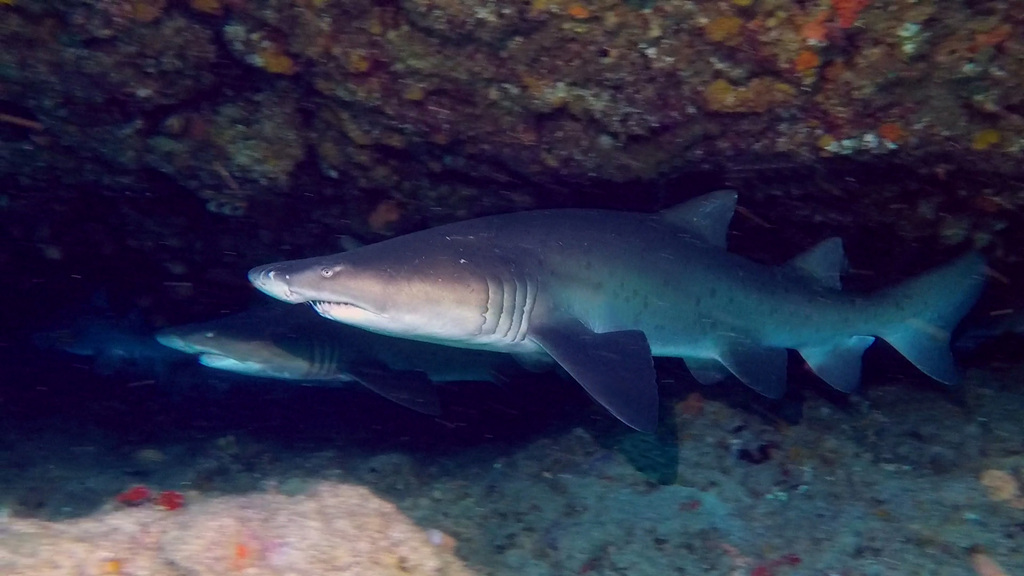
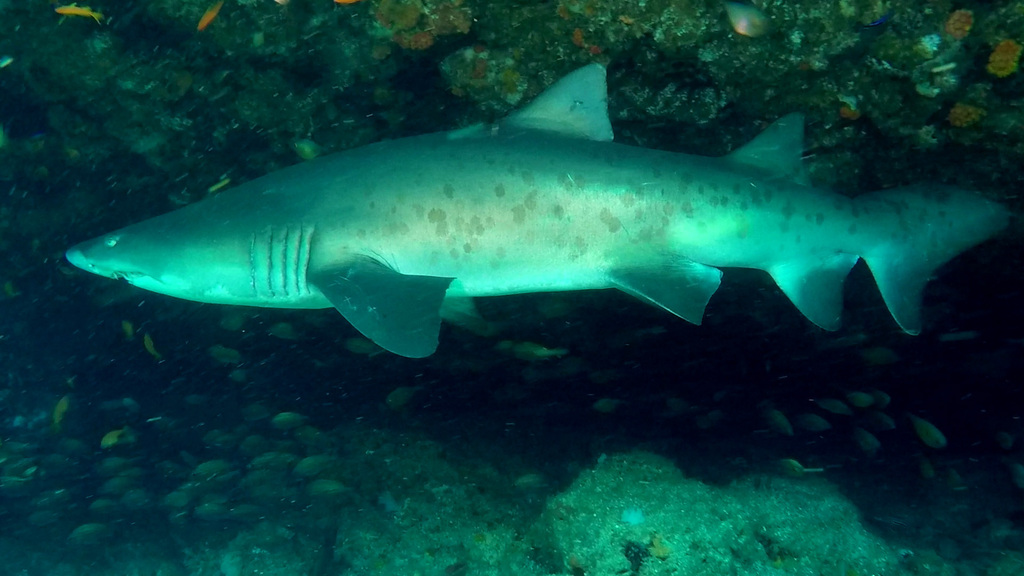
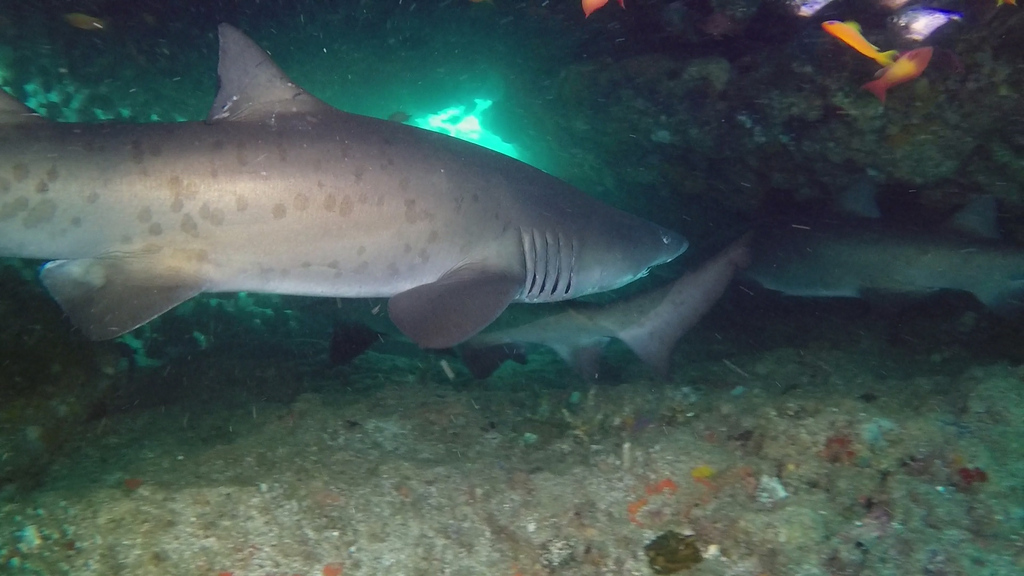
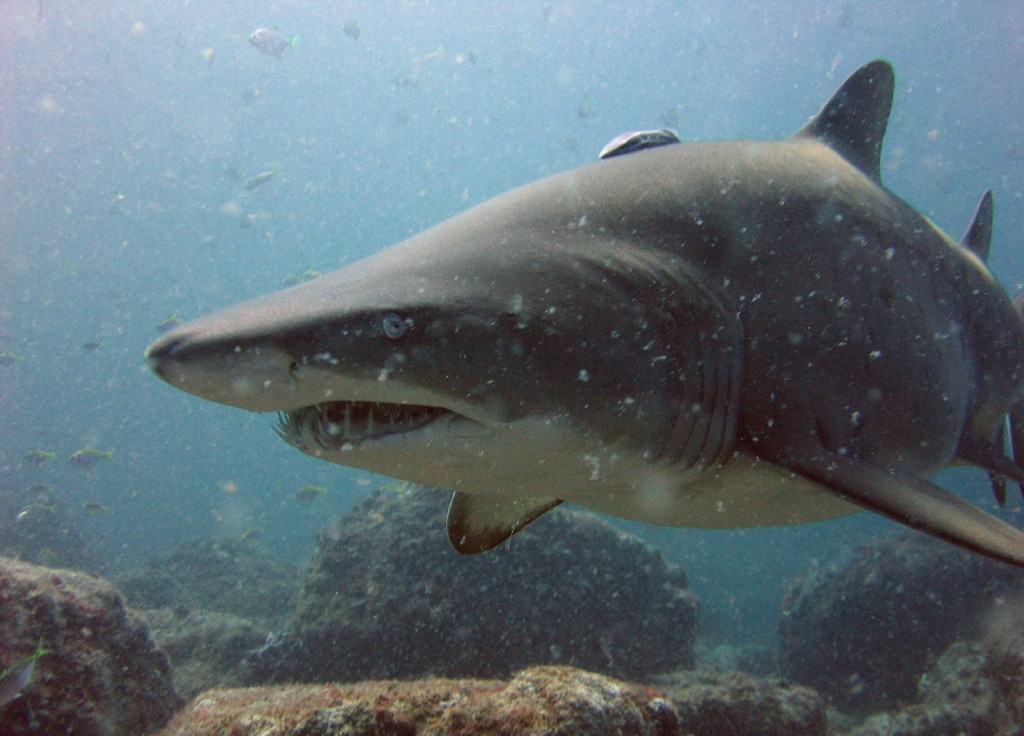
Photos show the species, not always the places on this page.
Length
Usually about 2.2 to 2.5 m (7.2 to 8.2 ft); the largest reported are about 3.2 to 3.3 m (10.5 to 10.8 ft)
Weight
Adults often about 91 to 159 kg (200 to 350 lb); the largest published weight is 158.8 kg (350 lb)
Next to a person
About 1.5 times as long as an adult is tall, and as heavy as one to two adults
What it eats
Mostly bony fish, which make up about 60% of the diet, plus small sharks, rays, squid, crabs and lobsters. It hunts mainly at night and shelters near rocks, caves and overhangs by day. It is the only shark known to gulp air at the surface and hold it in its stomach, which lets it hover almost motionless.
Around people
Calm, give space
How it lives
Lives from the surf zone and shallow bays down to about 191 m, often on or near the bottom around reefs, caves and overhangs, and usually at 15 to 25 m. It is found alone or in small to large groups. Females carry the young for about 9 to 12 months, and the biggest embryo in each of the two uteruses eats its siblings and the other eggs, so usually two pups are born. The reproductive cycle is generally two years, and some females seem to rest for a further two years. It is not aggressive when left alone: a global record counts 29 unprovoked bites on people, none fatal, and a handful of bites have involved spearfishers carrying speared fish.
Where it goes
In South Africa, adults of both sexes move north from the Eastern Cape into KwaZulu-Natal, where mating takes place in late October and November. Pregnant females continue north to northern KwaZulu-Natal and southern Mozambique, then return south around July and August. Pups are born at nursery sites in the Eastern Cape from September to November. Sand tigers off South Africa and Australia can make round trips of up to about 3,000 km. At Aliwal Shoal, sharks are reported mainly from about July to November, when they gather to mate. Timing varies from year to year.
We only draw a journey on the map when scientists have tracked it or clearly documented it. For this animal we have not found one yet.
Populations
Globally Critically Endangered (IUCN, assessed 2020, published 2021). CMS lists it on Appendices I and II since 2024. South Africa: the commercial sale of any part is prohibited. A mark-recapture estimate of about 16,700 adults was made more than a decade ago, and a 2020 study suggested this may be the last stable subpopulation in the world. Southwest Atlantic: an estimated decline of more than 80% over seven decades, with at least 70% lost in Brazil between 1970 and 2010. Australia: protected in New South Wales since 1984 and Queensland since 1997, but recovery has been slow. Mediterranean: last seen in 2003 and presumed gone.
Meet it respectfully
Stay calm and neutral in the water and let the shark choose the distance. Never chase, touch, feed or bait a ragged-tooth shark, and do not block its way out of a gully or cave. Keep clear of mothers resting at aggregation sites. Reported bites are rare and mostly linked to spearfishing with speared fish. Rules and protected zones differ by place, so follow your guide and local rules.
Fun fact
Tap the bulb to light it up.
It is the only shark known to gulp air at the surface and store it in its stomach, which helps it hang almost still in the water.
Pups feed on their unborn siblings inside the mother, so each uterus ends up with a single pup and usually two are born.
Round trips between birthing, mating and pregnancy waters can reach about 3,000 km off South Africa and Australia.
Ragged-tooth shark (sand tiger) in the Ocean Atlas
Places we have researched where this animal is recorded. It is never guaranteed, and some places are for watching from the boat only.
Travel with usComing soonTrusted referralExploringOn pause, story onlyEthics pass
Country colour: pink where we travel, blue where we are exploring or refer, grey for story only.
 Australia
 Brazil
 Cameroon
 Côte d'Ivoire
 Equatorial Guinea
 Gabon
Gabon Ghana
Ghana Guinea
 Guinea-Bissau
 Japan
Japan Liberia
 Nigeria
 Republic of the Congo
 Senegal
 Sierra Leone
 South Africa
 United States
Sources for this page
- FishBase, 2026
- Florida Museum of Natural History, 2026
- Wikipedia, Sand tiger shark, 2026
- IUCN Red List, Rigby et al., 2021
- PeerJ, iSimangaliso ragged-tooth study, 2024
- CMS, Carcharias taurus, 2024
- Southwest Atlantic sand tiger study, 2026
- Wikipedia, Aliwal Shoal, 2026
Facts checked 5 October 2026. Photos: Unsplash licence, or Creative Commons as shown on each photo.
Work in ocean travel?
We are always happy to hear from exceptional local operators, accommodation, conservation organisations and destination experts. If your work fits responsible, small-group ocean travel, we would love to learn more.
Partner with Ocean CallingNew: mobula rays in La Ventana, May 2027
CHF 2,720