
Blue-spotted ribbontail ray
Taeniura lymma
A neon-spotted reef ray that peeks from under ledges. Give it space, because it uses its venomous barb if it is stepped on or grabbed.
Least Concern (IUCN, 2020) means it is not at high risk of extinction worldwide today.


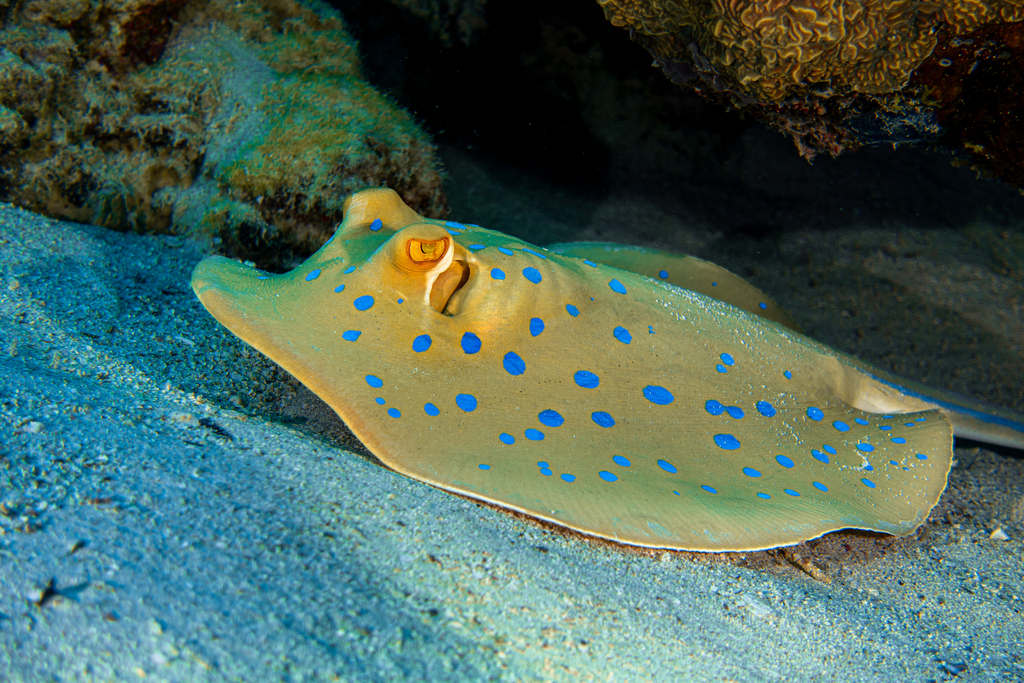
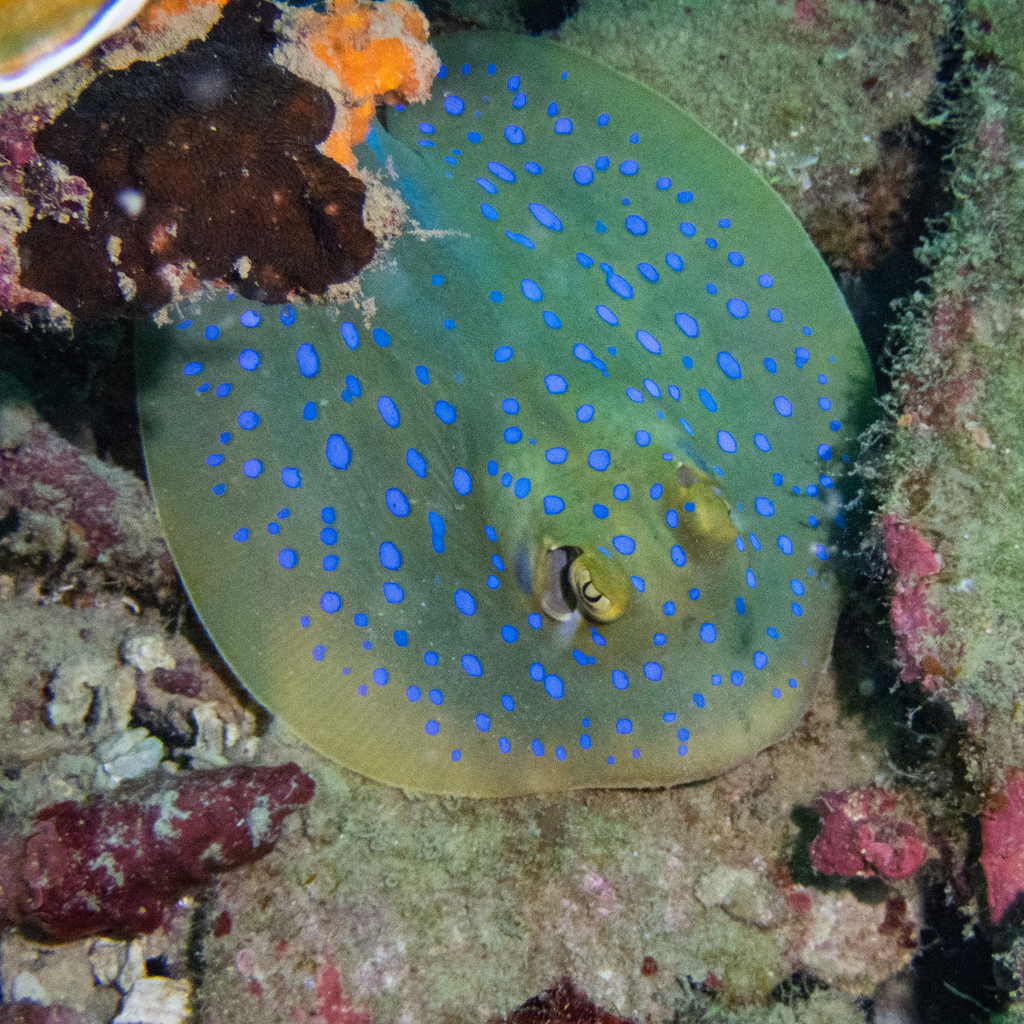
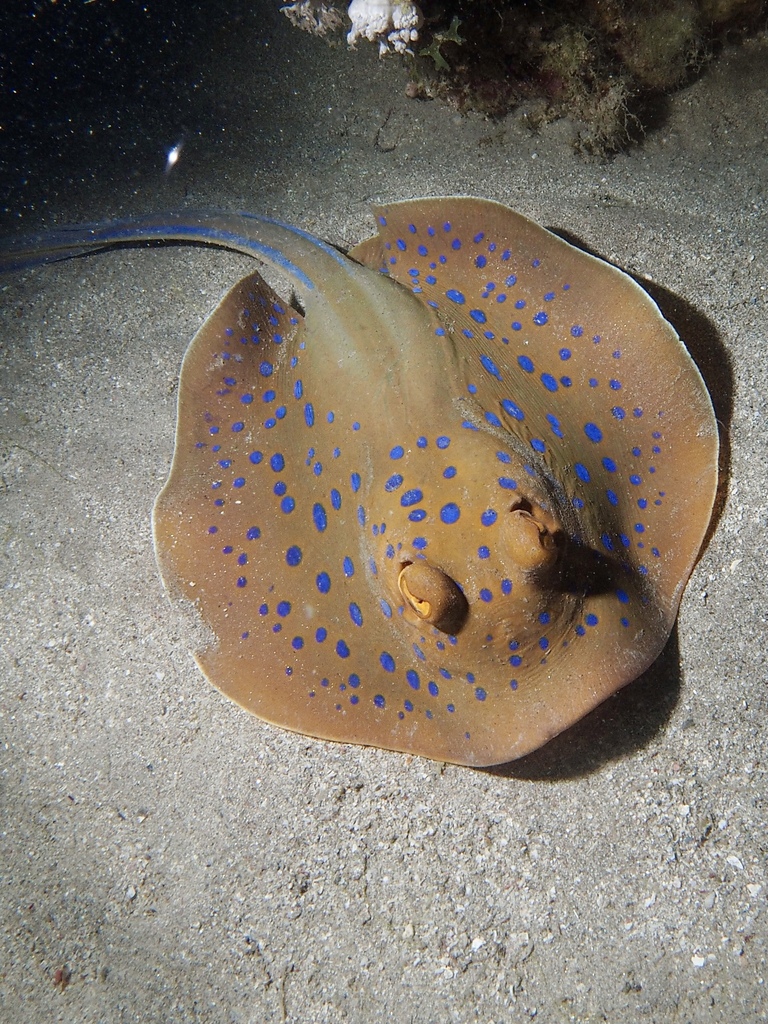
Photos show the species, not always the places on this page.
Length
Typical size not well measured; rays in one Red Sea study were about 22 cm (9 in) across. Largest reliably recorded disc about 35 cm (14 in) across, about 70 cm (2.3 ft) long including the tail
Weight
Not reliably measured
Next to a person
Disc about as wide as a dinner plate; with the tail, about knee to mid-thigh height on an adult
What it eats
Molluscs, worms, shrimps and crabs from sandy flats next to the reef, and sometimes small fishes.
Around people
Potentially dangerous, respect
How it lives
This small reef ray lives in shallow water, mostly in the top 20 m, and is sometimes found deeper. By day it often hides in caves and under ledges, and it is rarely buried in the sand. On the rising tide, small groups move onto shallow sand to feed. Females give birth to live young, up to 7 pups, already with blue spots.
Where it goes
Groups move into shallow sandy areas to feed as the tide rises, then spread out on the falling tide to shelter in caves and under ledges. No long-distance migration is known, only these local tidal moves.
We only draw a journey on the map when scientists have tracked it or clearly documented it. For this animal we have not found one yet.
Populations
Found widely on reefs and sand across the Indo-West Pacific. Along the coast of Tanzania there are small genetic differences between sites, but no regional colour forms or subspecies are known.
Meet it respectfully
It has a venomous spine on its tail. Never step on, touch, grab, chase or feed it, and do not reach under ledges or block its way out. Let it choose the distance. When you wade in sandy shallows, shuffle your feet.
Fun fact
Tap the bulb to light it up.
Each ray has its own spot pattern. In the Red Sea, researchers recognised about 90% of rays from photos for up to 496 days.
Mothers give birth to live pups, up to 7 at a time, and the babies already have blue spots.
Look for an oval disc and two blue stripes along the tail. It is a different animal from the blue-spotted stingray, which has an angular disc.
Its electric blue spots are not made by pigment. Tiny crystals inside special skin cells, held at just the right spacing by a scaffold of filaments, reflect blue light.
Blue-spotted ribbontail ray in the Ocean Atlas
Places we have researched where this animal is recorded. It is never guaranteed, and some places are for watching from the boat only.
Travel with usComing soonTrusted referralExploringOn pause, story onlyEthics pass
Country colour: pink where we travel, blue where we are exploring or refer, grey for story only.
 Australia
 Djibouti
 Egypt
Egypt Fiji
Fiji Indonesia
 Israel
 Kenya
Kenya Madagascar
 Malaysia
 Mayotte
 Mozambique
 Oman
Oman Papua New Guinea
 Philippines
 Saudi Arabia
 Singapore
 South Africa
 Sudan
Sudan Tanzania
 Thailand
 Timor-Leste
 Yemen
YemenSources for this page
- FishBase, 2020
- Reef Check, 2019
- Rumisha et al., 2024
- Scientific Reports, 2024
- iNaturalist research-grade records, Taeniura lymma, checked 25 Sep 2026
- IUCN Red List, Sherman et al., 2021
- Florida Museum, Discover Fishes
Facts checked 26 September 2026. Photos: Unsplash licence, or Creative Commons as shown on each photo.
Work in ocean travel?
We are always happy to hear from exceptional local operators, accommodation, conservation organisations and destination experts. If your work fits responsible, small-group ocean travel, we would love to learn more.
Partner with Ocean CallingSwim with humpback whales in Moʻorea, September 2027
from CHF 4,500