
Great shearwater
Ardenna gravis
A dark cap and a white collar on a long ocean journey. Seabirds follow the wind and the fish, and every sighting is a privilege, never a promise.
Least Concern (IUCN, 2018) means it is not close to being threatened at present. Its population is suspected to be stable, although bycatch and chick harvesting are noted.
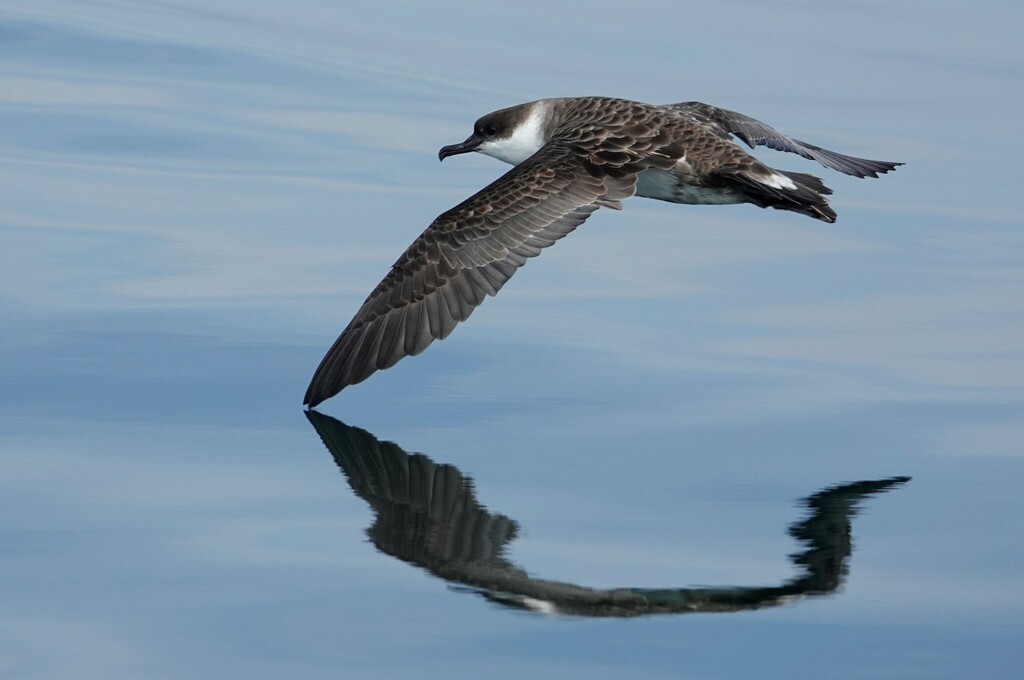
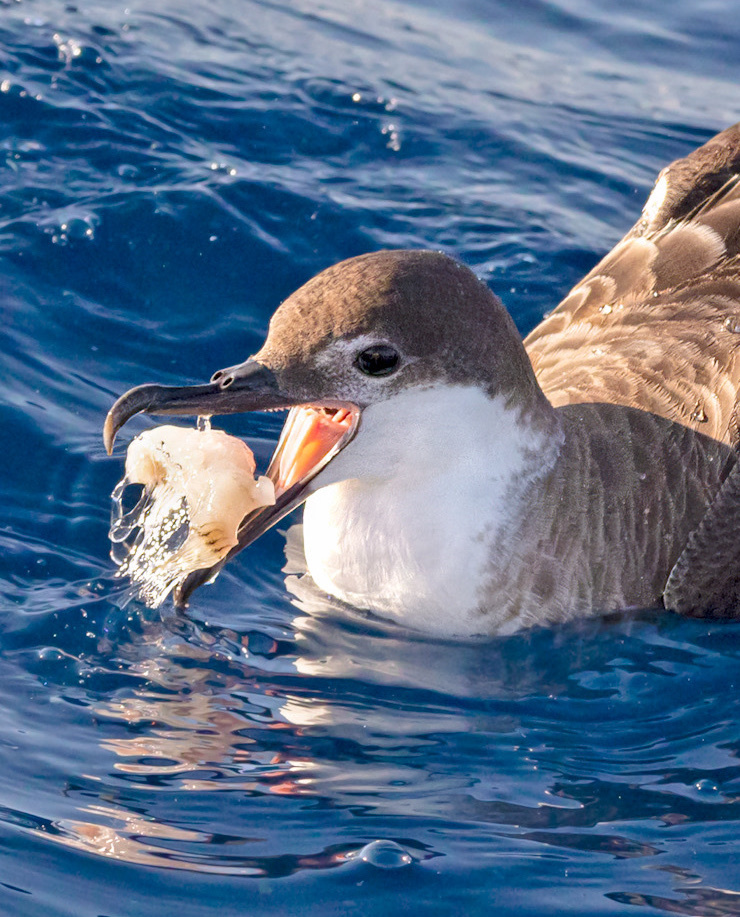
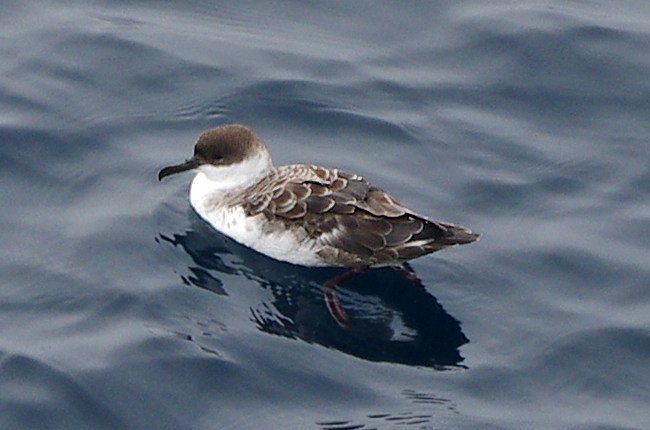
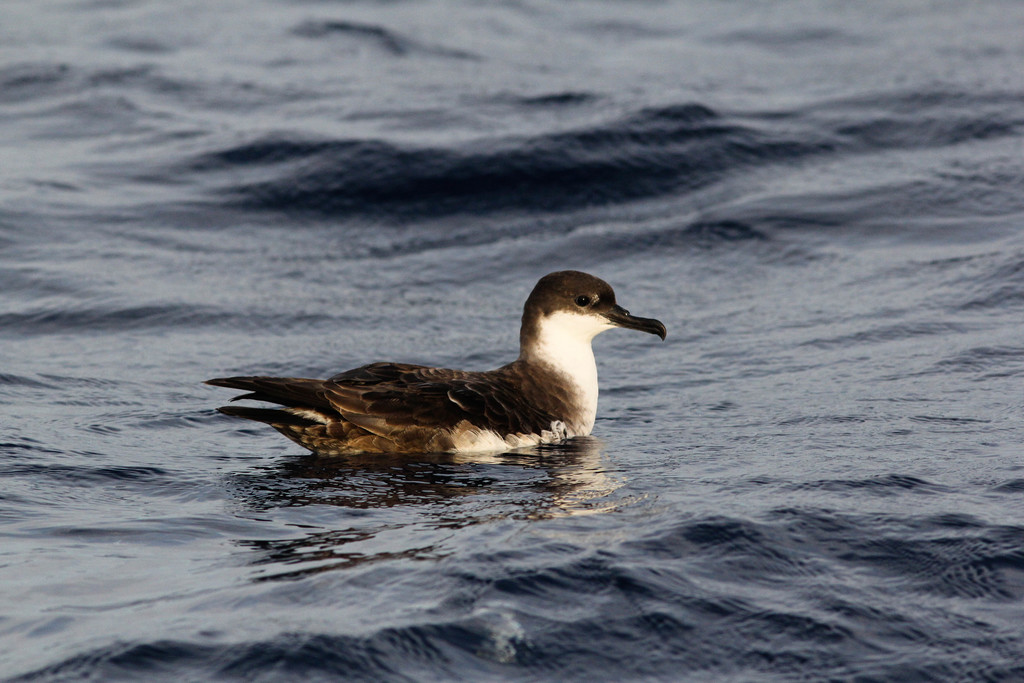
Photos show the species, not always the places on this page.
Length
About 43 to 51 cm (17 to 20 in) long, with a wingspan of about 105 to 122 cm (41 to 48 in)
Weight
BTO lists about 830 g (1.8 lb); a Tristan da Cunha source says up to 1.1 kg (2.4 lb)
Next to a person
Wingspan roughly two-thirds of an adult's arm span, and a little lighter than a bag of sugar
What it eats
Fish and squid, caught from the surface or by plunge-diving, plus crustaceans and fish offal. It readily follows fishing boats, sometimes in large numbers.
Around people
Calm, give space
How it lives
Great shearwaters breed in large colonies, in burrows or in open grass, and visit the nests only at night. They lay one white egg. At Tristan da Cunha birds return to the colonies in late August, lay in November, hatch chicks in January and fledge them in May. Great shearwaters are gregarious and make a piercing cry when resting in groups on the water.
Where it goes
A full migrant that breeds in the South Atlantic and spends the northern summer in the North Atlantic. Adults begin the journey in April, moving north-west to South America, then on to Canada, past Greenland and into the north-east Atlantic, before returning south in November. Most birds reach waters off Newfoundland and Greenland in June and July. Off Britain and Ireland they are seen mostly in August and September, with most records from the south-west of England.
We only draw a journey on the map when scientists have tracked it or clearly documented it. For this animal we have not found one yet.
Populations
IUCN (2018): Least Concern, with the population suspected to be stable. A 2004 estimate gave at least 15 million individuals. IUCN cites at least 5 million pairs at Tristan da Cunha and 600,000 to 3 million pairs at Gough. A 2015 survey of Nightingale Island estimated about 1.82 million pairs (95% range 1.67 to 1.97 million), and a Tristan da Cunha page gives 2 to 3 million pairs there, 2 million on Inaccessible and 1 million on Gough. IUCN notes high bycatch in Atlantic fisheries. Several thousand adults and about 50,000 chicks are harvested each year from Nightingale Island by islanders, and IUCN says sustainable levels are not known. Plastic ingestion is also reported. It is Green listed in the UK.
Meet it respectfully
Great shearwaters pass through in late summer, and you meet them at sea, often resting on the water. Keep boats slow and steady, give resting groups room, and never chase them. Never throw fish or bait to draw them in, because they already follow fishing boats and can be caught on hooks. Take your litter home, as plastic is a known problem for the species. No sighting can be promised.
Fun fact
Tap the bulb to light it up.
It is one of the few birds that breed in the Southern Hemisphere and then migrate north for the northern summer.
A 2015 survey estimated about 1.82 million breeding pairs on Nightingale Island alone.
It has a black cap and a white horseshoe at the base of its tail.
Great shearwater in the Ocean Atlas
Places we have researched where this animal is recorded. It is never guaranteed, and some places are for watching from the boat only.
Travel with usComing soonTrusted referralExploringOn pause, story onlyEthics pass
Country colour: pink where we travel, blue where we are exploring or refer, grey for story only.
 Antarctica
 Argentina
 Australia
 The Bahamas
 Bermuda
 Brazil
 Cabo Verde
 Canada
 Chile
Chile Denmark
 Falkland Islands
 Faroe Islands
 France
 French Guiana
 Greenland
 Guadeloupe
 Iceland
 Ireland
 Morocco
 Netherlands
 Norway
 Portugal
 Saint Helena
 Senegal
 South Africa
 Spain
Spain Suriname
 Sweden
 United Kingdom
 United States
 Uruguay
 Western Sahara
Sources for this page
- IUCN Red List (BirdLife International), 2018
- Wikipedia, 2026
- BTO BirdFacts, 2026
- Tristan da Cunha website, Great Shearwaters
- Dilley et al., 2019, Marine Ornithology
Facts checked 5 October 2026. Photos: Unsplash licence, or Creative Commons as shown on each photo.
Work in ocean travel?
We are always happy to hear from exceptional local operators, accommodation, conservation organisations and destination experts. If your work fits responsible, small-group ocean travel, we would love to learn more.
Partner with Ocean CallingNot sure where to go? Get your Ocean Match
from CHF 19