
Grey reef shark
Carcharhinus amblyrhynchos
Grey reef sharks are built for current. They can hold position or surf rising water along reef slopes, saving energy while staying close to rich reef channels.
Endangered (IUCN, 2020) means it is at very high risk of extinction in the wild.


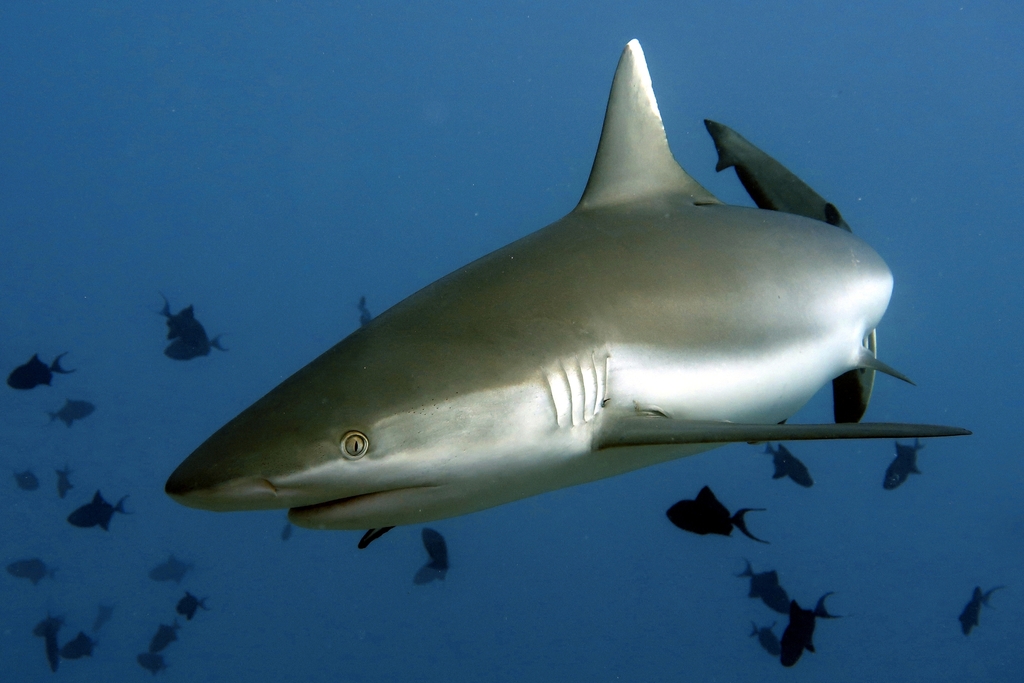
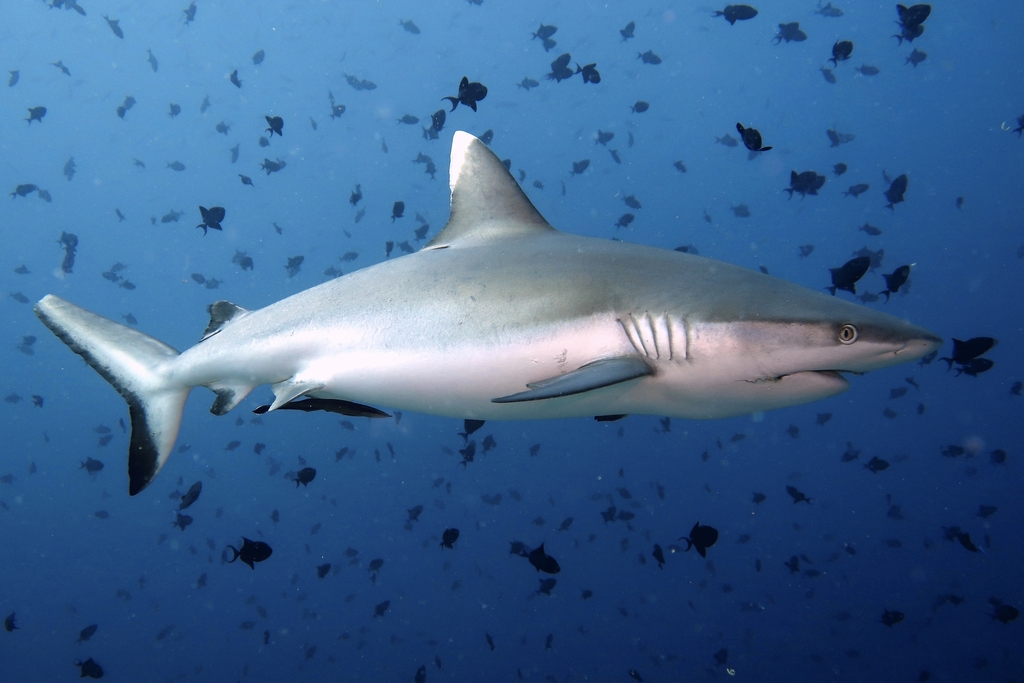
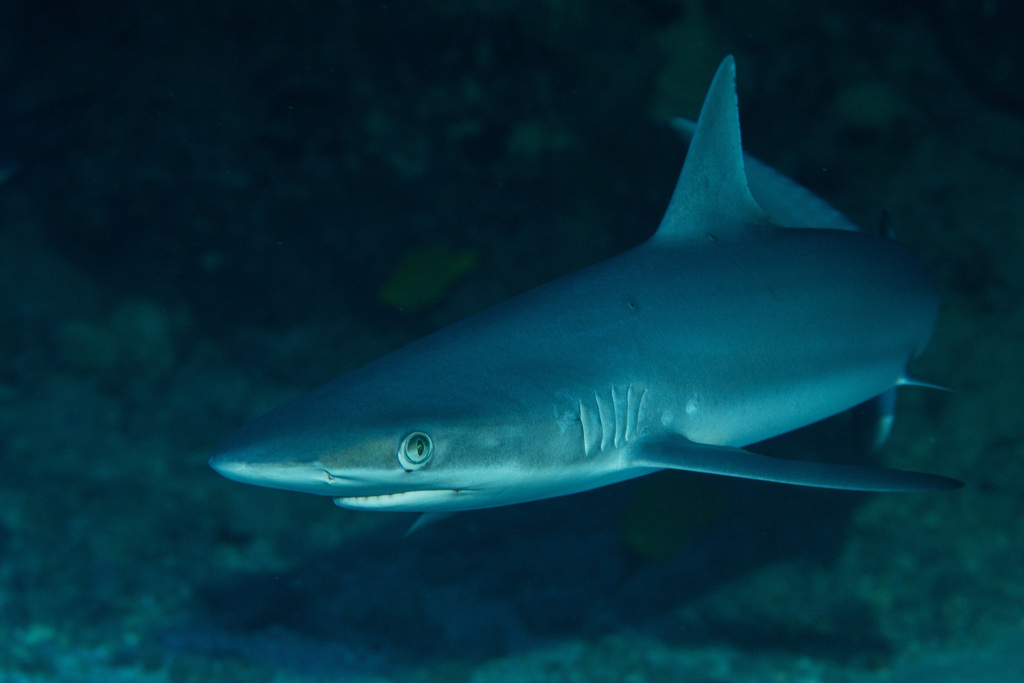
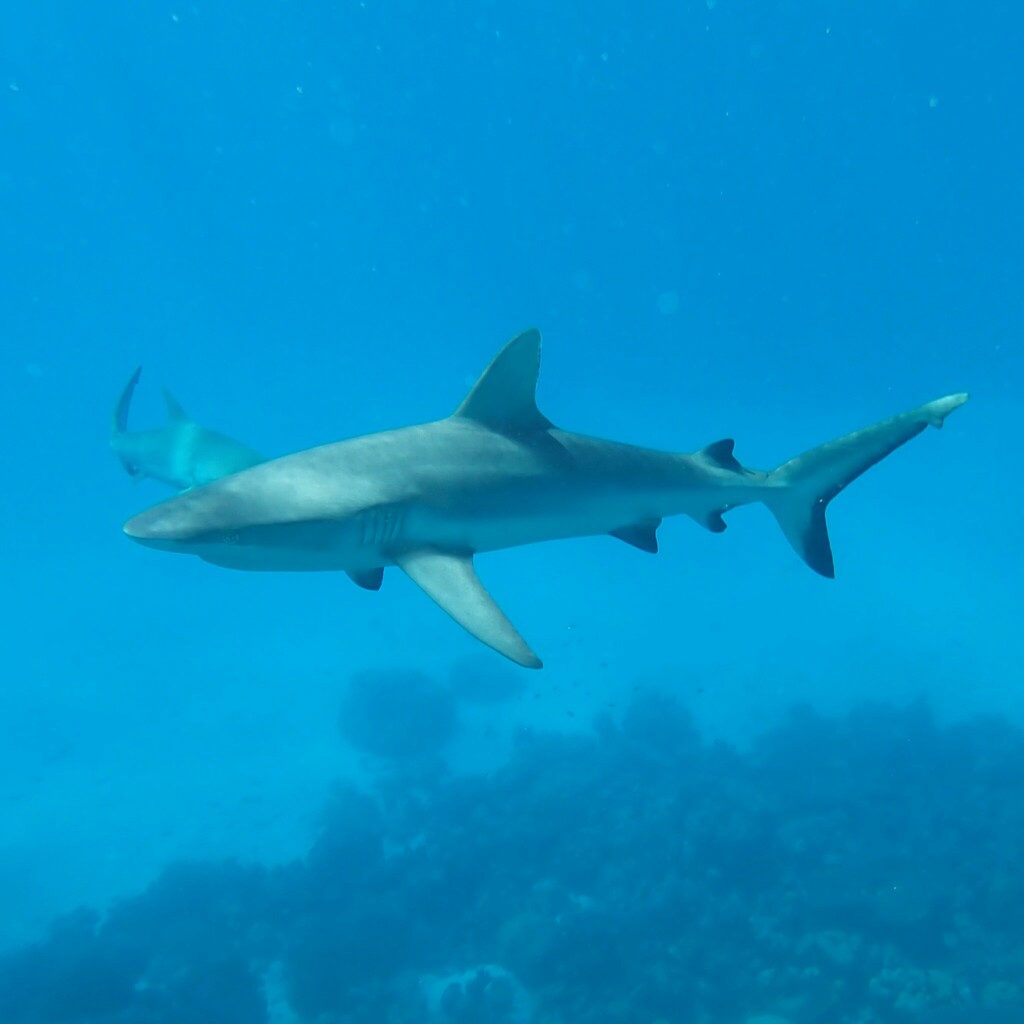
Photos show the species, not always the places on this page.
Length
Usually 1.8 to 2.1 m (6 to 7 ft); largest recorded 2.55 m (8.4 ft)
Weight
Typical adult weight not reliably measured; heaviest published about 33.7 kg (74 lb)
Next to a person
About as long as an adult person or a little longer, but about half the weight or less
What it eats
Mainly reef fish, plus smaller amounts of squid, octopus, crabs, lobsters and shrimp.
Around people
Defensive if pressured
How it lives
Grey reef sharks gather in groups near reef drop-offs by day and hunt mostly alone at night, mainly for reef fish. When one feels threatened, it gives a clear warning: it arches its back, raises its snout, pushes its fins down and swims stiffly. Females give birth to 1 to 6 live pups after about 12 months.
Where it goes
Young grey reef sharks stay close to their home reef, and larger sharks roam more between reefs. In 2008 in the Coral Sea, a 122 cm male swam about 134 km from Osprey Reef to the Ribbon Reefs of the Great Barrier Reef in less than 48 hours. This is a single tracked trip, not a yearly migration.
Populations
Grey reef sharks are closely tied to their reefs. Open-ocean gaps limit mixing, so the Indo-Pacific holds regional groups rather than one population, and local reef populations can behave almost as separate units. There are no subspecies. In the south pass of Fakarava Atoll, French Polynesia, counts in 2014 found between 251 and 705 grey reef sharks in one resting school.
Meet it respectfully
Watch for the hunched warning display: arched back, raised snout, lowered fins and stiff swimming. If you see it, stop approaching and calmly move away. Never chase, corner, touch, bait or feed grey reef sharks, and never carry speared fish near them. Give them space and let them choose how close they come.
Fun fact
Tap the bulb to light it up.
Grey reef sharks can surf rising currents along reef slopes to save energy.
Young sharks stay close to their home reef, while larger sharks roam more between reefs.
When it feels pressured, a grey reef shark shows a clear hunched warning display. This is a warning, not an attack.
At Fakarava Atoll in French Polynesia, grey reef sharks ride rising currents along the slope, like birds on updrafts. Surfing this way cuts their energy use by at least 15 percent.
Source: Papastamatiou et al., 2021, Journal of Animal Ecology, via British Ecological Society
In the south pass of Fakarava, French Polynesia, divers counted up to 705 grey reef sharks in one school in 2014. Groupers that gather there to spawn help to feed them.
Follow its journey
Watch it travel. Every line comes from satellite tracking or documented research, and the source is named.
StartEndJourney (the line joins documented areas; real paths vary)
Grey reef shark in the Ocean Atlas
Places we have researched where this animal is recorded. It is never guaranteed, and some places are for watching from the boat only.
Travel with usComing soonTrusted referralExploringOn pause, story onlyEthics pass
Country colour: pink where we travel, blue where we are exploring or refer, grey for story only.
 American Samoa
 Australia
 Chagos (British Indian Ocean Territory)
 Cocos (Keeling) Islands
 Cook Islands
 Egypt
 Faroe Islands
 Fiji
 French Polynesia
 India
 Indonesia
 Kiribati
 Madagascar
 Malaysia
 Maldives
 Marshall Islands
 Micronesia (FSM)
 Mozambique
 Myanmar
 New Caledonia
 Northern Mariana Islands
 Oman
 Palau
 Papua New Guinea
 Philippines
 Saudi Arabia
 Seychelles
 Solomon Islands
 South Africa
 Sudan
 Thailand
 Tuvalu
 United States
Sources for this page
- Florida Museum of Natural History, 2026
- FishBase, 2020
- AnAge, 2026
- Scientific Reports
- Heupel et al., 2010, PLOS ONE
- Mourier et al., 2016, Current Biology
Facts checked 26 September 2026. Photos: Unsplash licence, or Creative Commons as shown on each photo.
Work in ocean travel?
We are always happy to hear from exceptional local operators, accommodation, conservation organisations and destination experts. If your work fits responsible, small-group ocean travel, we would love to learn more.
Partner with Ocean Calling