
Robber crab (coconut crab)
Birgus latro
The largest land-living arthropod, usually met at night and on its own terms. Every sighting is chance, never a promise.
Vulnerable (IUCN) means it is at high risk of extinction in the wild. The assessment is cited as 2020 and replaced an earlier Data Deficient listing.
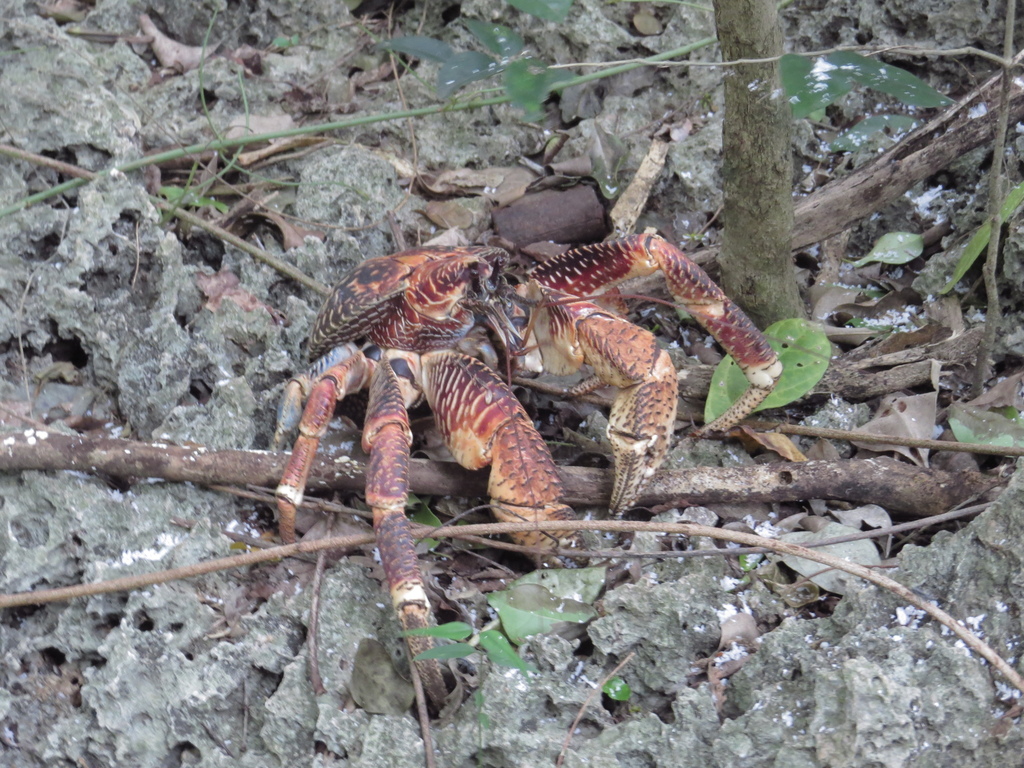
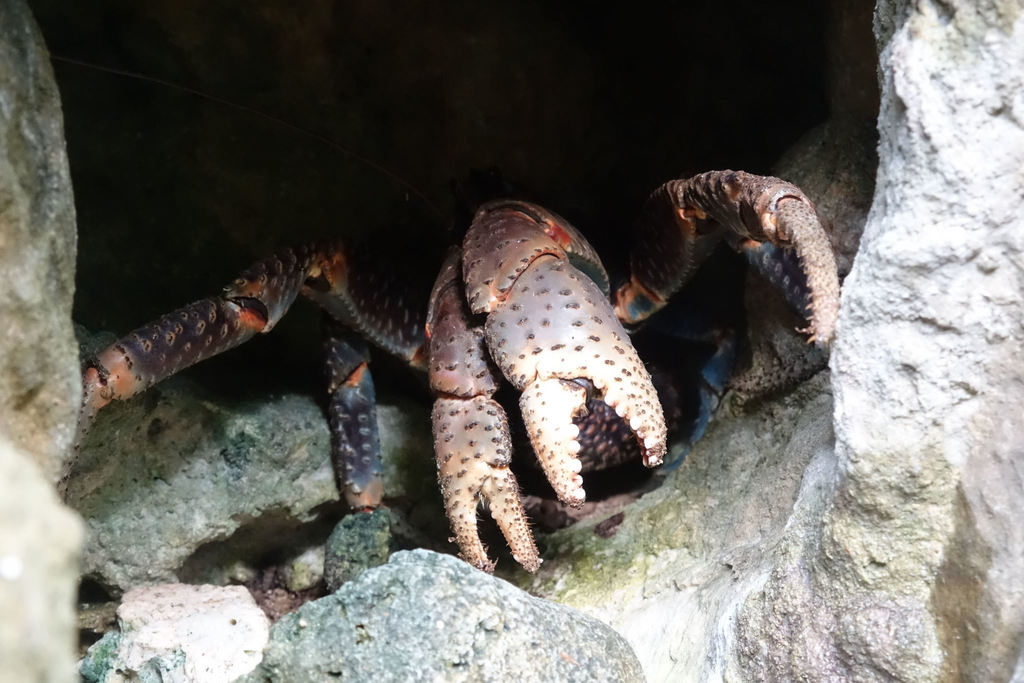
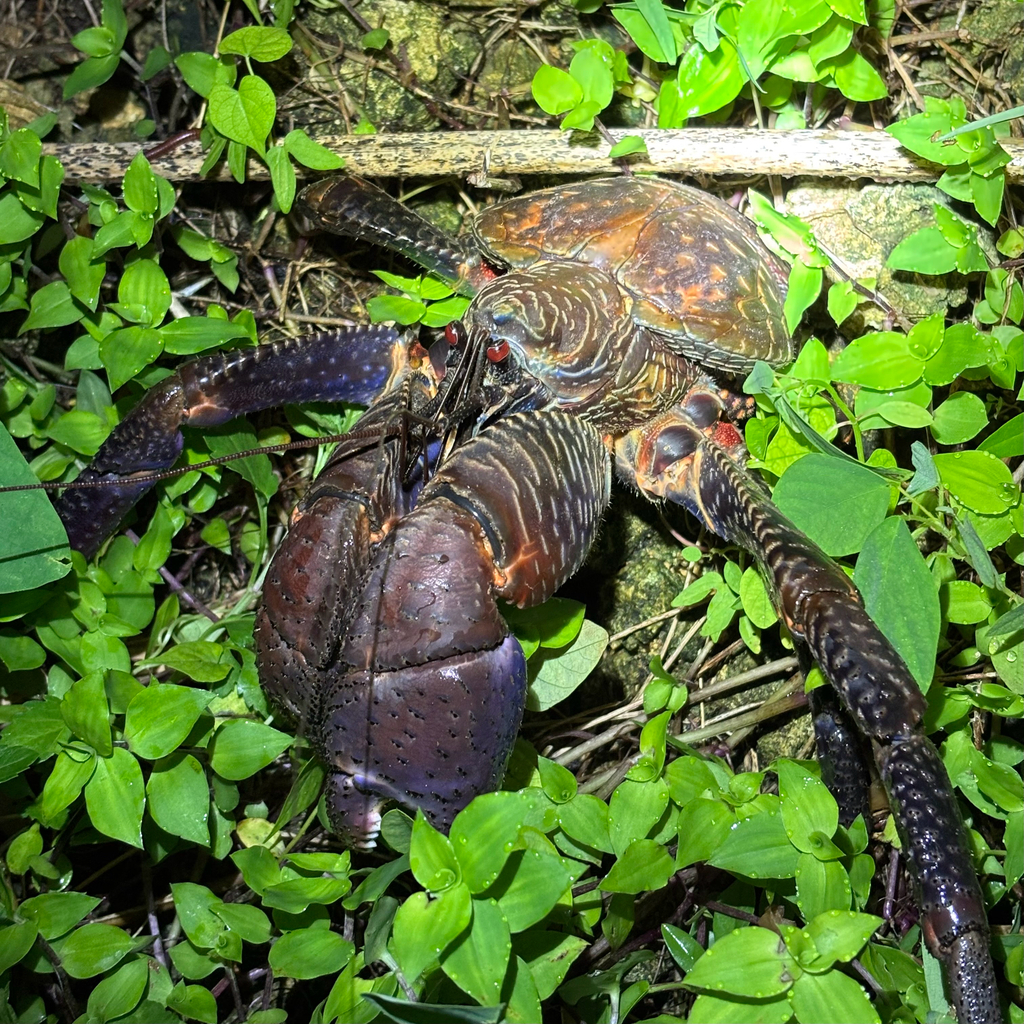
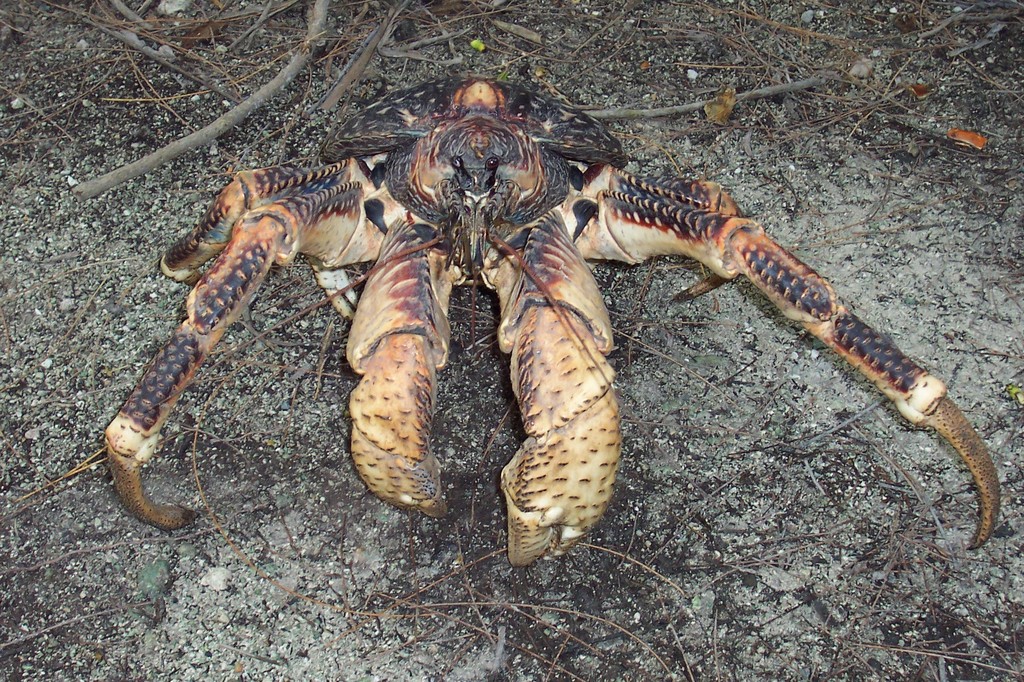
Photos show the species, not always the places on this page.
Length
Body length up to about 40 cm (16 in), with a leg span of more than 90 cm (35 in) (Wikipedia). Parks Australia says up to a metre across.
Weight
Up to about 4.1 kg (9 lb) (Wikipedia). In a GPS study of 55 male crabs on Christmas Island, tagged crabs weighed 600 to 2,940 g (1.3 to 6.5 lb), average about 1,668 g (3.7 lb).
Next to a person
A leg span close to a metre is about as wide as a small child's outstretched arms, and the heaviest crabs weigh about as much as a large cat.
What it eats
Mainly fruits, seeds and the pith of fallen trees, especially Arenga palms. They also scavenge dead animals, including other crabs, and may eat turtle hatchlings (Parks Australia). Despite the name, coconuts are not a main food, although the crabs can crack them.
Around people
Calm, give space
How it lives
A robber crab is a land hermit crab. It breathes air with special lung-like tissue and can drown if kept under water for long. It is mostly active at night or in overcast weather and climbs well. Mating happens on land. The female releases larvae into the sea, where they drift for about 3 to 4 weeks, and the young then settle into snail shells until their abdomen hardens. Sexual maturity comes at about 5 years, the largest size after 40 to 60 years, and Parks Australia says they can live more than 50 years.
Where it goes
A GPS study on Christmas Island (2008 to 2011, 55 males) found two patterns. Some crabs stayed in place with short trips of about 25 m, while others made long trips of 0.7 to 4.2 km between the coast and the inland forest, mainly in the wet season, at up to about 150 m per hour. A crab's core area was about 0.2 ha.
We only draw a journey on the map when scientists have tracked it or clearly documented it. For this animal we have not found one yet.
Populations
Global: Vulnerable on the IUCN Red List. It was listed Data Deficient from 1996 and moved to Vulnerable in an assessment cited as 2020 (one source text says 2018). Hunting and habitat loss are the main threats. Christmas Island has the largest and densest population in the world according to Wikipedia, outnumbered there by more than 50 times by the red crab. Parks Australia calls it the world's largest and best protected population. Many crabs are killed by vehicles on the island every year, and road mortality monitoring began in January 2010 after traffic rose in late 2009.
Meet it respectfully
Drive carefully on Christmas Island and give way to crabs on the road. Do not pick up, feed or bait a robber crab, and keep your distance from a crab sheltering in a burrow or cave. Secure food and shiny items when camping or swimming, as Parks Australia advises. Sightings depend on night, weather and luck, and no one can promise one.
Fun fact
Tap the bulb to light it up.
Parks Australia notes that robber crabs steal shiny objects such as pots and silverware from campsites.
The GPS study was described as the first large-scale GPS tracking of any arthropod.
Young robber crabs use empty snail shells for protection, like hermit crabs, until the abdomen hardens.
Robber crab (coconut crab) in the Ocean Atlas
Places we have researched where this animal is recorded. It is never guaranteed, and some places are for watching from the boat only.
Travel with usComing soonTrusted referralExploringOn pause, story onlyEthics pass
Country colour: pink where we travel, blue where we are exploring or refer, grey for story only.
 Australia
 Chagos (British Indian Ocean Territory)
 Christmas Island
 French Polynesia
 Guam
Guam Indonesia
 Japan
Japan Marshall Islands
 New Caledonia
 Niue
Niue Northern Mariana Islands
 Philippines
 Seychelles
 Solomon Islands
 Taiwan
 Tanzania
 Vanuatu
Sources for this page
- Parks Australia, Robber crab
- Wikipedia, Coconut crab
- Krieger et al., 2012, PLoS ONE, Giant robber crabs monitored from space
- GBIF Backbone Taxonomy, Birgus latro
- GBIF, IUCN Red List category record
- Atlas of Living Australia, Christmas Island robber crab road kill monitoring
Facts checked 5 October 2026. Photos: Unsplash licence, or Creative Commons as shown on each photo.
Work in ocean travel?
We are always happy to hear from exceptional local operators, accommodation, conservation organisations and destination experts. If your work fits responsible, small-group ocean travel, we would love to learn more.
Partner with Ocean Calling5-day freediving course in Bali
CHF 1,180