
Caribbean spiny lobster
Panulirus argus
Two long antennae and a pair of eyes at the edge of a reef crevice. Spiny lobsters hide by day and come out at night, and no sighting is ever a promise.
Data Deficient (IUCN, 2009) means there was not enough information to judge extinction risk. It is not a sign the species is safe, and some fished stocks are under pressure.
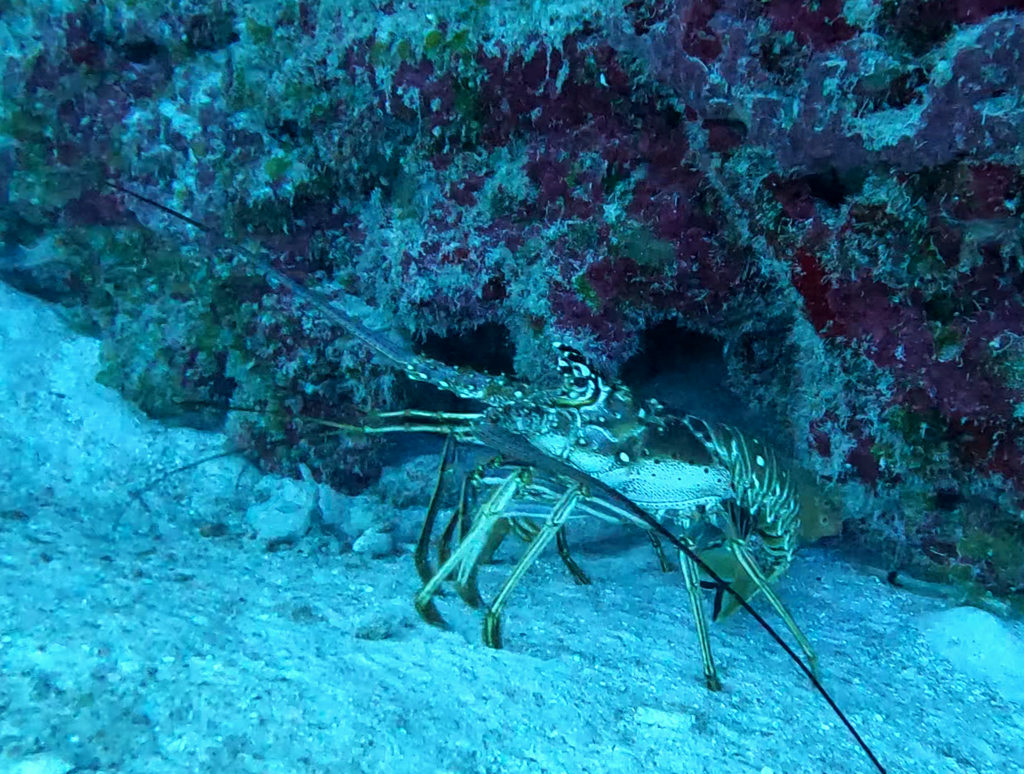
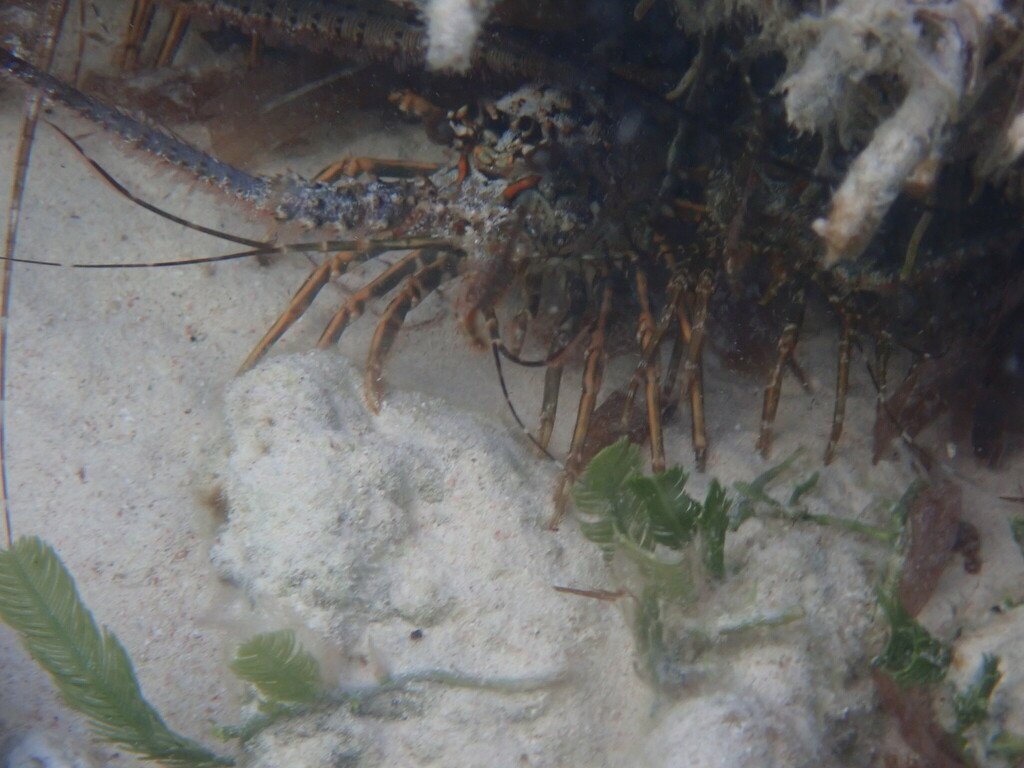
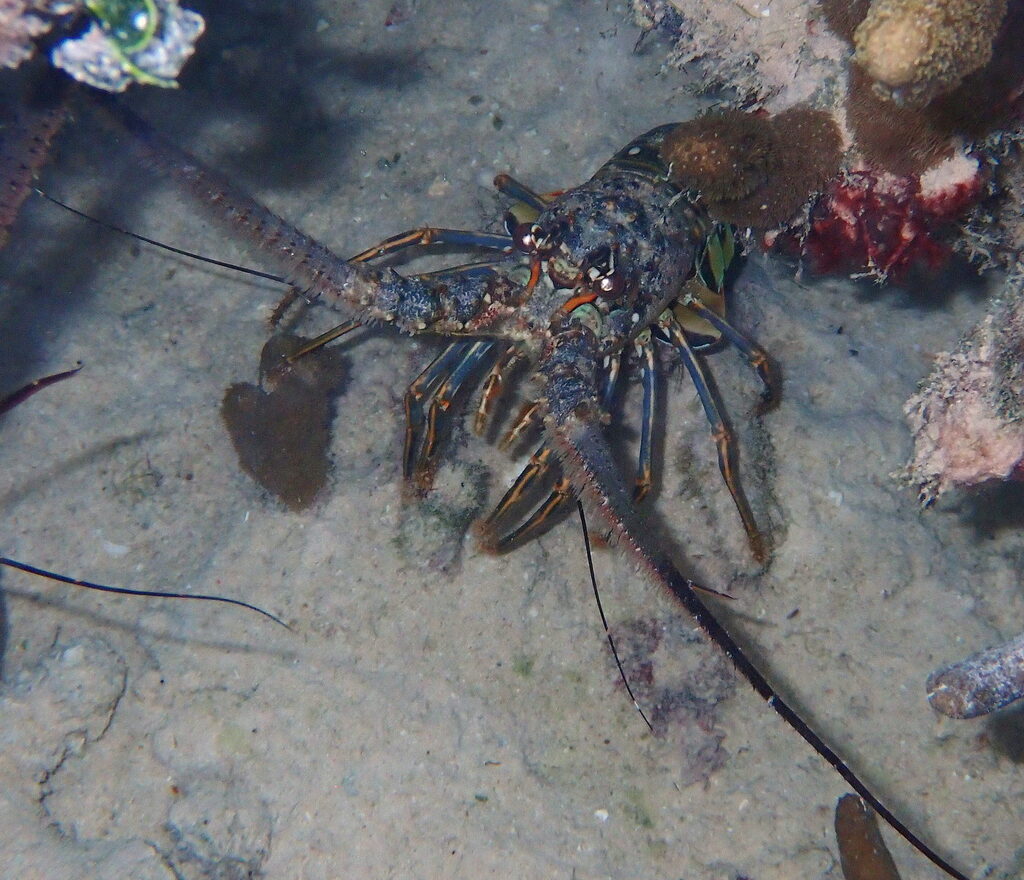
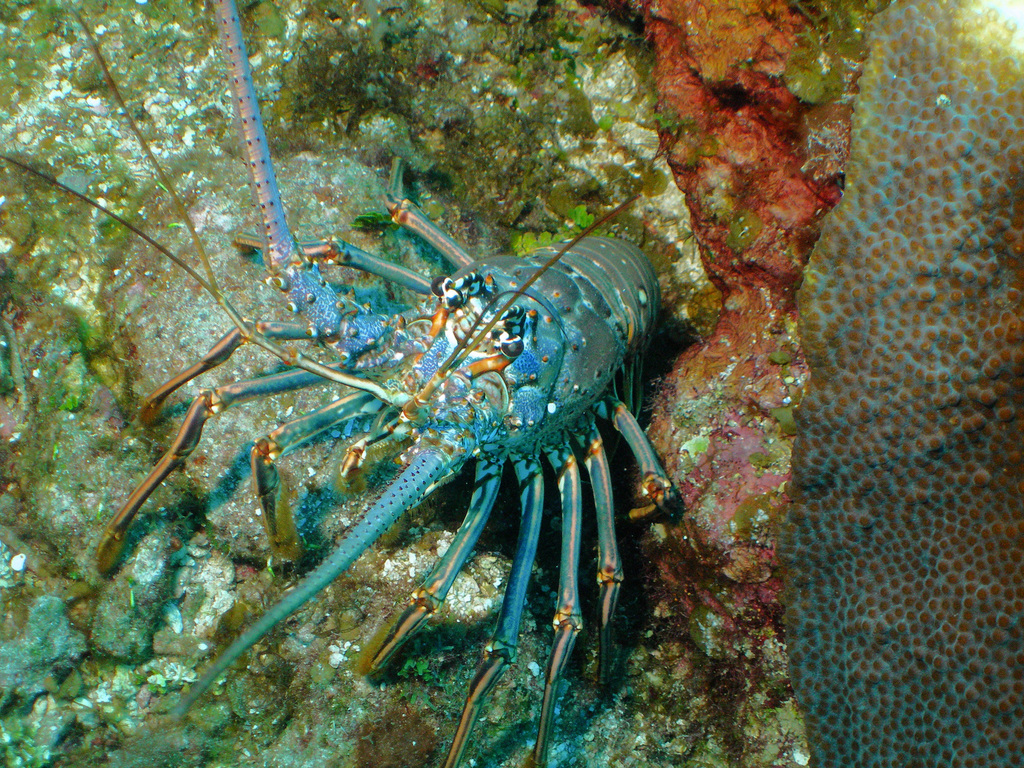
Photos show the species, not always the places on this page.
Length
Typically about 20 cm (8 in); up to about 45 cm (18 in) in SeaLifeBase and up to about 60 cm (24 in) in other accounts
Weight
Usually well under a few kilograms; sources give maximum weights from about 4.5 kg (10 lb) to 6.8 kg (15 lb)
Next to a person
A typical adult is about as long as a person's forearm and hand, and the largest are longer than a person's arm.
What it eats
Snails, clams, other bivalves, chitons, crabs and sea urchins, plus carrion. They hunt at night and may also eat some algae. Young lobsters feed on soft-bodied plankton.
Around people
Calm, hands off
How it lives
Females carry the fertilised eggs under the tail, and the eggs hatch in about three weeks. The larvae, called phyllosoma, drift in the plankton and go through several stages before settling in seagrass, algae or mangrove roots as young lobsters. Juveniles later move to reef crevices. Spawning is from March to August in the Florida Keys and takes place through the year elsewhere in the Caribbean. Lobsters may live 15 years or more, but ageing them is difficult. By day they shelter in crevices and under ledges.
Where it goes
Caribbean spiny lobsters live in the western Atlantic from about Rio de Janeiro to North Carolina, including the Caribbean, the Bahamas and Bermuda. Females move to deeper water to spawn. In autumn, groups sometimes walk in single-file lines across the seabed near Florida and the Bahamas. The reason is not fully known.
We only draw a journey on the map when scientists have tracked it or clearly documented it. For this animal we have not found one yet.
Populations
IUCN (2009): Data Deficient, meaning there is not enough information to judge extinction risk across its range. Stock status varies by place. NOAA Fisheries reported in 2022 that the Puerto Rico stock was subject to overfishing, while the St. John/St. Thomas and St. Croix stocks were not. In Venezuela, most of the catch comes from Los Roques Archipelago National Park (created 1972), where a 1998 to 1999 study estimated a catch of about 139 tonnes.
Meet it respectfully
Look from a distance and never reach into crevices, pull lobsters out or block their shelter. Do not touch the coral around them. Fishing rules and seasons are set by authorities and have been described differently across sources, so follow current local rules and your guide. Spearfishing has been prohibited in Los Roques since 1972, and part of the park is closed to fishing and tourism.
Fun fact
Tap the bulb to light it up.
Young lobsters drift as plankton larvae before they settle and turn into the lobsters we know.
In autumn, groups sometimes march in single file across the seabed near Florida and the Bahamas.
When alarmed it can make a rasping sound by rubbing parts of its antennae.
Caribbean spiny lobster in the Ocean Atlas
Places we have researched where this animal is recorded. It is never guaranteed, and some places are for watching from the boat only.
Travel with usComing soonTrusted referralExploringOn pause, story onlyEthics pass
Country colour: pink where we travel, blue where we are exploring or refer, grey for story only.
 Anguilla
 Antigua and Barbuda
 The Bahamas
 Belize
 Bermuda
 Brazil
 British Virgin Islands
 Caribbean Netherlands
 Cayman Islands
 Colombia
 Costa Rica
 Cuba
 Curaçao
 Dominican Republic
 Guadeloupe
 Honduras
 Jamaica
 Martinique
 Mexico
 Panama
 Puerto Rico
 Saint Kitts and Nevis
 Saint Martin
 Saint Vincent and the Grenadines
 Sint Maarten
 Trinidad and Tobago
 Turks and Caicos Islands
 United States
 US Virgin Islands
 Venezuela
Sources for this page
- Wikipedia, Caribbean spiny lobster
- SeaLifeBase, Panulirus argus
- Animal Diversity Web, Panulirus argus
- NOAA Fisheries, Caribbean spiny lobster
- GBIF, IUCN Red List category for Panulirus argus
- Yallonardo et al., 2002, Marine and Freshwater Research, spiny lobster fishery in Los Roques
- Sea Around Us, Los Roques National Park
- Wikipedia, Los Roques Archipelago
Facts checked 5 October 2026. Photos: Unsplash licence, or Creative Commons as shown on each photo.
Work in ocean travel?
We are always happy to hear from exceptional local operators, accommodation, conservation organisations and destination experts. If your work fits responsible, small-group ocean travel, we would love to learn more.
Partner with Ocean Calling7-day freediving course in Coron, Palawan
CHF 1,480