
Common octopus
Octopus vulgaris
A shy, den-living octopus of Mediterranean and north-east Atlantic rocky shores. Look for a quiet den and a pile of empty shells, and give it space.
Least Concern (IUCN, 2016) means it is not at high risk of extinction worldwide today.
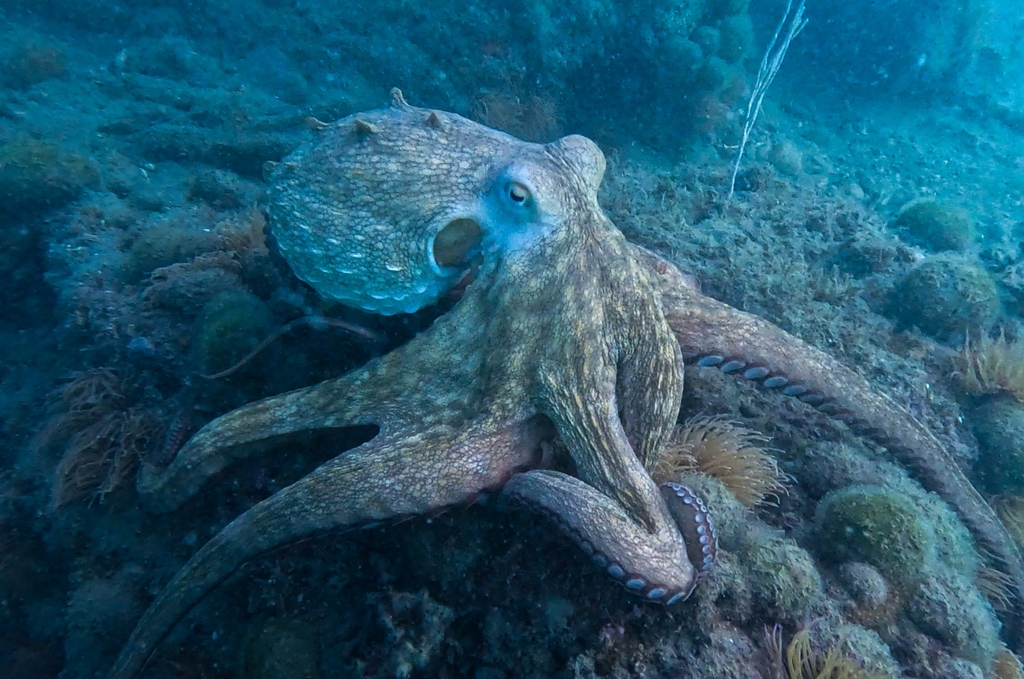
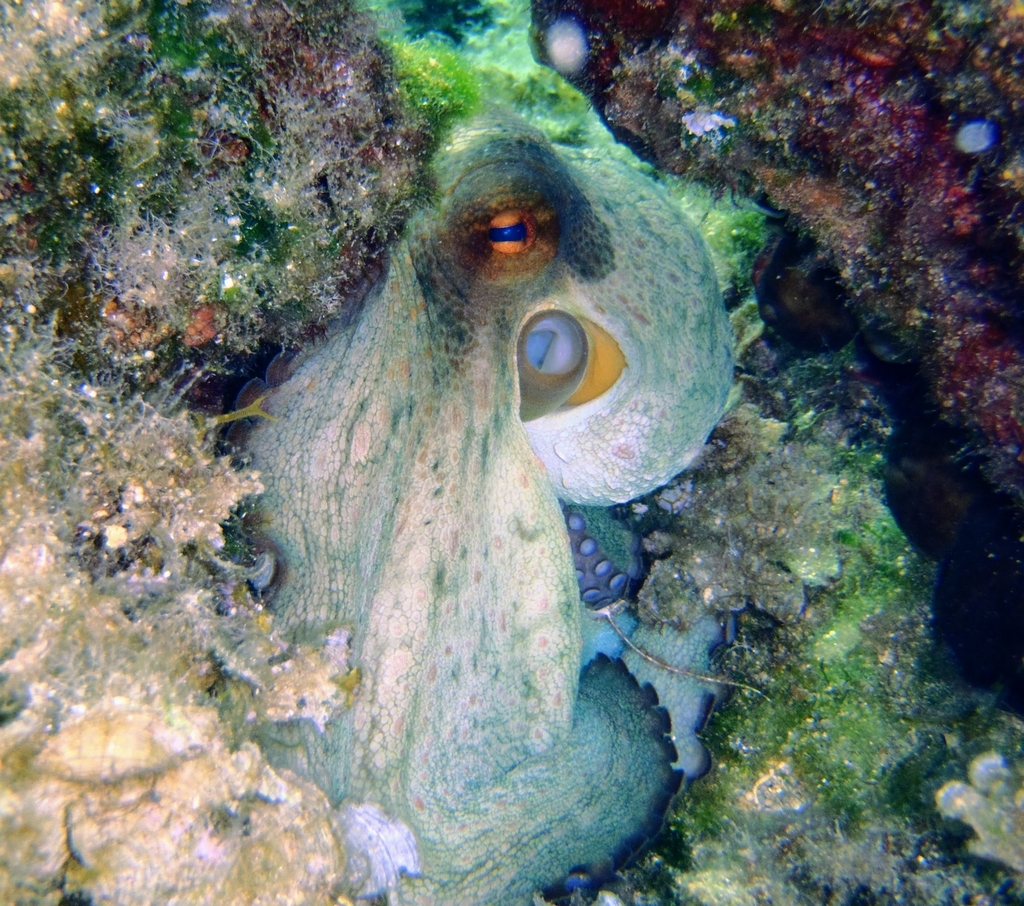
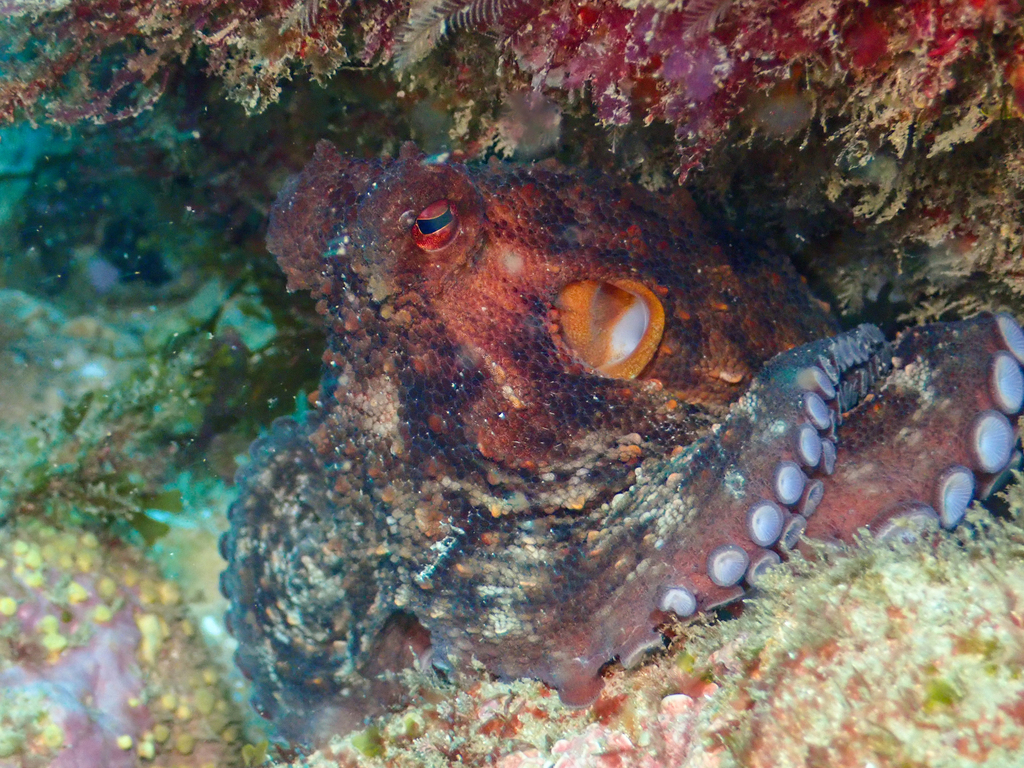
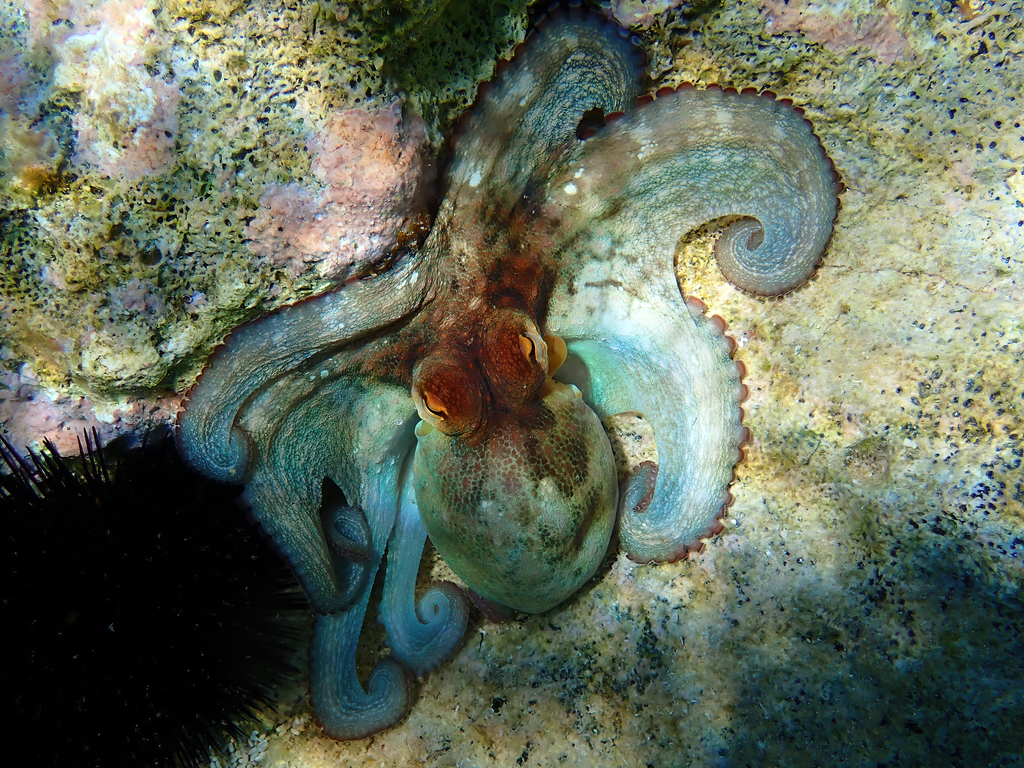
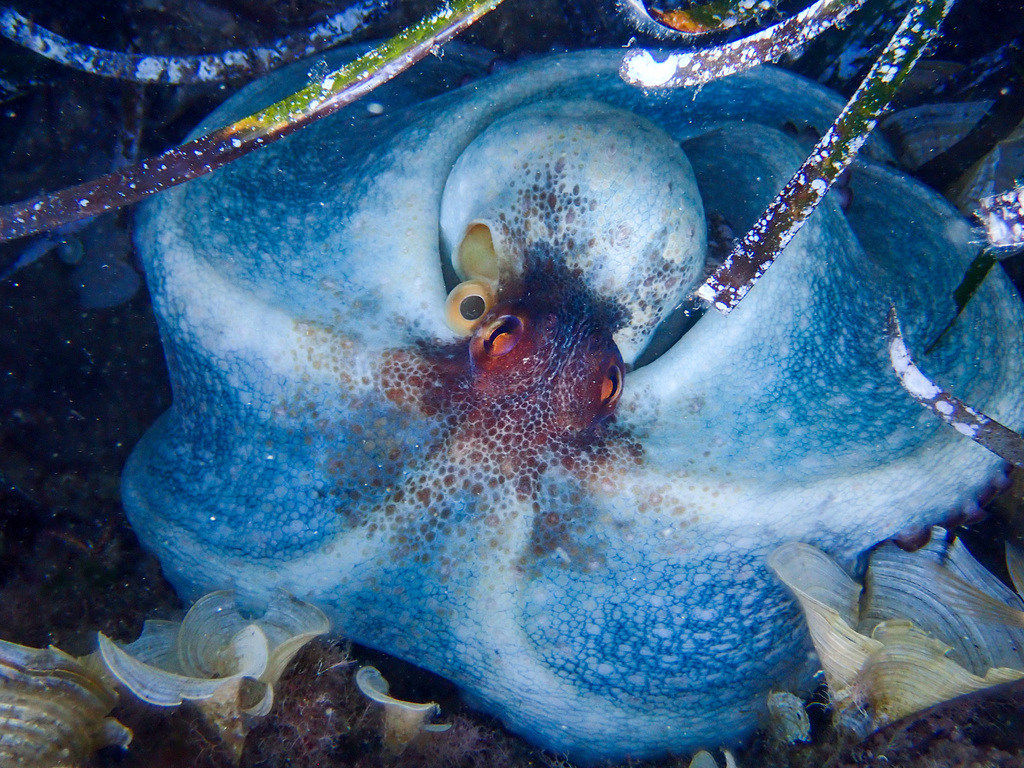
Photos show the species, not always the places on this page.
Length
Most are much smaller than the maximum. With arms, largest recorded about 1.2 m (3.9 ft) for females and 1.8 m (5.9 ft) for males
Weight
Typical weight not reliably measured; largest recorded about 10 kg (22 lb)
Next to a person
A very large one, arms spread, can be as long as an adult is tall; most are much smaller
What it eats
Mostly shellfish such as clams and abalone, plus crabs.
Around people
Calm, give space
How it lives
The common octopus lives on rocky, sandy and muddy seabeds from the shore to the edge of the continental shelf. It hunts from a den and leaves the empty shells of its prey outside. Off France, molluscs made up about 80% of its diet. Adults usually die soon after breeding; the female guards her eggs, and the young drift in the plankton before they settle.
Where it goes
The common octopus does not migrate. In Port d'Andratx, Mallorca, most recaptured octopuses had moved less than 30 m, and the furthest only 169 m in 106 days. In the Atlantic Islands of Galicia National Park, Spain, 24 tagged octopuses were most active at dawn and dusk, made short trips from their dens, and some changed dens.
We only draw a journey on the map when scientists have tracked it or clearly documented it. For this animal we have not found one yet.
Populations
The name Octopus vulgaris once covered look-alike octopuses around the world. Genetic studies now treat the true common octopus as a species of the Mediterranean and north-east Atlantic. Octopuses in East Asia (Octopus sinensis), the western Atlantic (Octopus americanus), Australia and a southern lineage in South Africa are separate. In Port d'Andratx, numbers fell from about 337 in autumn to 105 by late winter.
Meet it respectfully
Look into cracks and holes, but never touch, poke or pull an octopus out, and do not move rocks or its shell pile. Never feed it or tempt it out with food, and never chase it. If it changes colour fast, jets away or inks, give it more space.
Fun fact
Tap the bulb to light it up.
Young common octopuses clean their dens with jets of water and block the entrance with rocks and shells.
The day octopus of tropical reefs is a different species.
It is not dangerously venomous to people, but it can bite if it is handled.
Off the French Mediterranean coast, scientists counted at least 22 kinds of shellfish and several crabs in the shell piles outside octopus dens. Shellfish made up about 80% of the diet.
Source: Ambrose & Nelson, 1983, Marine Ecology, Predation by Octopus vulgaris in the Mediterranean
In a busy harbour bay in Mallorca, octopuses lived in areas of about 4.6 ha. One was caught again 106 days later only 169 m from where it was first found.
Source: Arechavala-Lopez et al., 2019, ICES Journal of Marine Science
In 2022, 24 wild common octopuses in a Spanish national park were the first of their species tracked with acoustic tags. Tagged males were detected on about ten times as many days as females.
Source: Papadopoulo et al., 2024, Animal Biotelemetry, first acoustic tracking of wild Octopus vulgaris
Common octopus in the Ocean Atlas
Places we have researched where this animal is recorded. It is never guaranteed, and some places are for watching from the boat only.
Travel with usComing soonTrusted referralExploringOn pause, story onlyEthics pass
Country colour: pink where we travel, blue where we are exploring or refer, grey for story only.
 Albania
 Angola
 The Bahamas
 Brazil
 Canada
 Caribbean Netherlands
 Chile
Chile China
China Croatia
 Cyprus
 Egypt
Egypt France
 Greece
 Guadeloupe
 Indonesia
 Israel
 Italy
Italy Japan
Japan Madagascar
 Malta
Malta Martinique
 Montenegro
 Morocco
 Netherlands
 Panama
 Portugal
 South Africa
 South Korea
 Spain
Spain Türkiye
 United Kingdom
 United States
Sources for this page
- SeaLifeBase, Octopus vulgaris
- Arechavala-Lopez et al., 2019, ICES Journal of Marine Science
- Papadopoulo et al., 2024, Animal Biotelemetry
- Ambrose & Nelson, 1983, Marine Ecology
- Fee et al., 2023, Molecular Biology Reports
- Emami-Khoyi et al., 2026, Ecology and Evolution
- Avendaño et al., 2020, Aquatic Ecology
- Allcock, Headlam & Allen, 2018, IUCN Red List
Facts checked 26 September 2026. Photos: Unsplash licence, or Creative Commons as shown on each photo.
Work in ocean travel?
We are always happy to hear from exceptional local operators, accommodation, conservation organisations and destination experts. If your work fits responsible, small-group ocean travel, we would love to learn more.
Partner with Ocean CallingSwim with humpback whales in Moʻorea, September 2027
from CHF 4,500