
Giant trevally
Caranx ignobilis
A heavy, silver shape that cruises the reef edge on its own schedule. No sighting is ever promised, and a quiet moment with a giant trevally is a gift.
Least Concern (IUCN, assessed 2015) means it is not at high risk of extinction worldwide, although local groups such as those in the main Hawaiian Islands have declined.


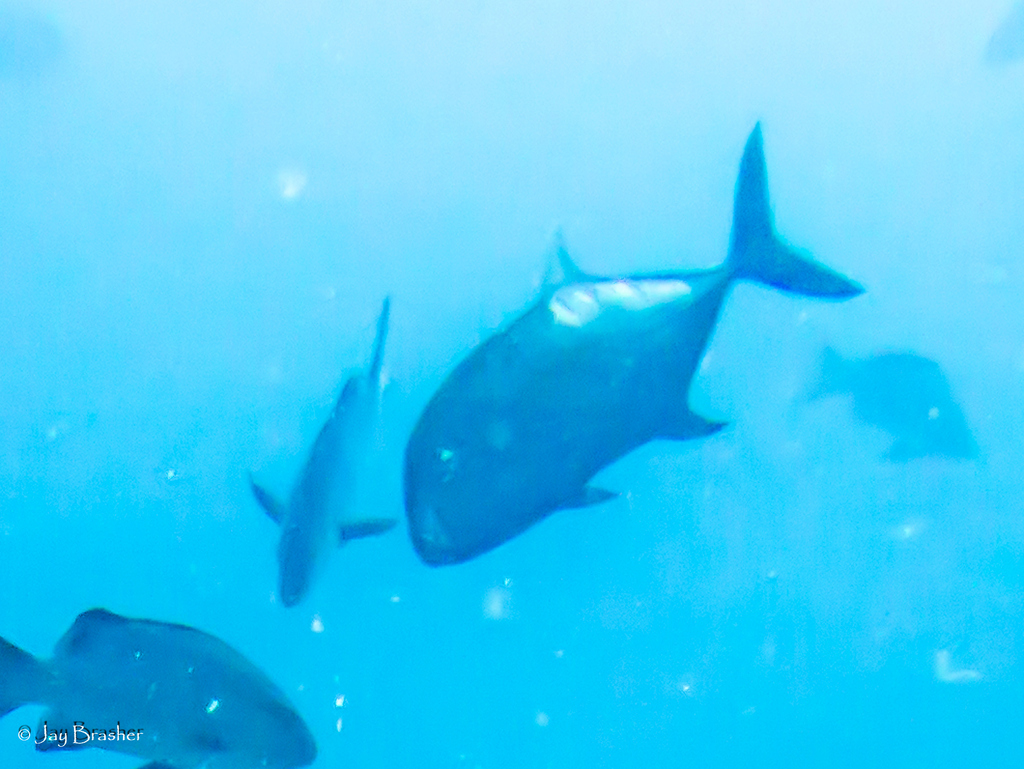
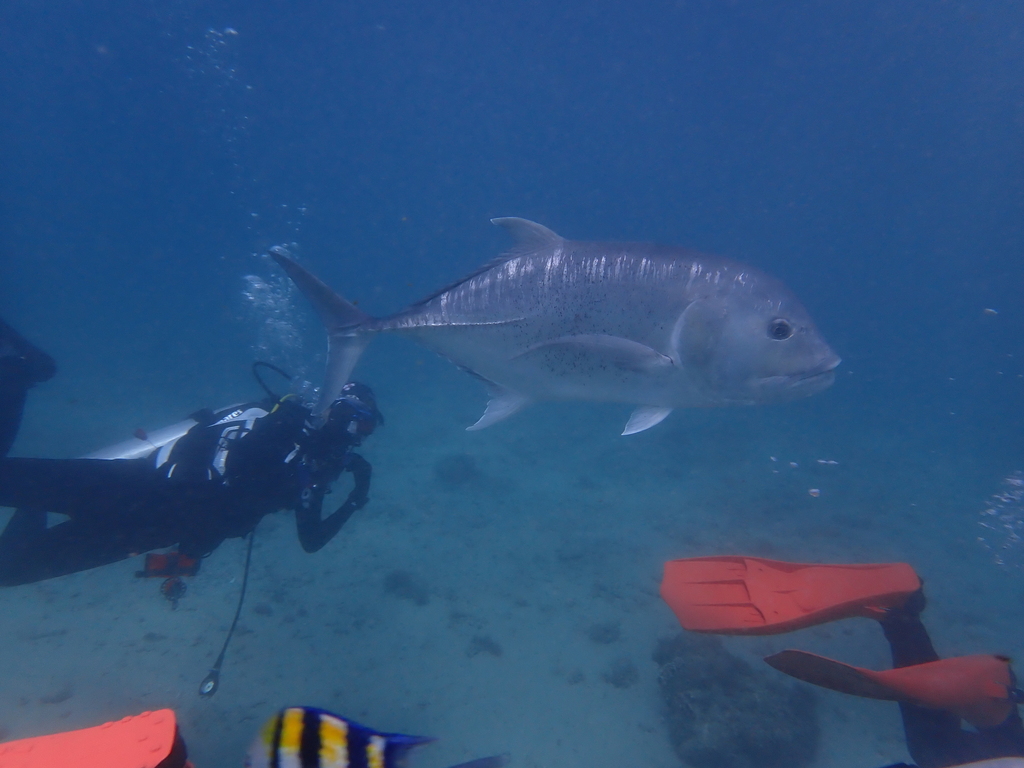
Photos show the species, not always the places on this page.
Length
Up to about 170 cm (67 in) total length; common length about 100 cm (39 in) (FishBase)
Weight
Up to about 80 kg (176 lb) recorded (FishBase). Most fish seen on a reef are far smaller than this maximum.
Next to a person
A common adult, about 1 m long, reaches roughly to an adult's waist when held upright. The largest on record, about 1.7 m, is about as long as a tall adult is tall.
What it eats
Fishes and crustaceans such as crabs and spiny lobsters, hunted mostly at night according to FishBase. Other sources add squid, octopus and molluscs. Giant trevally are known to follow monk seals to pick off escaping prey, and to leap from the water to catch seabirds.
Around people
Calm, give space
How it lives
Juveniles use estuaries and murky coastal water. Adults live on clear lagoon and outer reefs, down to about 188 m. Mature fish are mostly solitary, but they form groups to feed and to spawn. They mature at about 60 cm and around 3 years of age. Growth curves suggest a 1 m fish is about 8 years old and a 1.7 m fish about 24 years old. Spawning takes place on shallow outer reefs and offshore banks in the warmer months, timed to the moon.
Where it goes
Adults tend to stay in a home range of up to about 9 km, while juveniles can travel about 70 km to outer reefs. Larger seasonal trips seem to be made to gather at spawning sites. No migration route is described in the sources read for the Cook Islands.
We only draw a journey on the map when scientists have tracked it or clearly documented it. For this animal we have not found one yet.
Populations
Global: Least Concern on the IUCN Red List, assessed in 2015. Large fish are heavily targeted by small-scale and recreational fisheries across the range, and big adults can carry ciguatera toxin (FishBase). Hawaii: giant trevally are described as severely depleted in the main islands, where they make up under 0.03 percent of apex predator biomass in fished areas, against 71 percent in undisturbed ecosystems. Cook Islands: no local population count was found. Marae Moana, created by law in 2017, covers the whole 1.9 million square kilometre ocean zone, with protected areas covering 16 percent of it, plus traditional ra'ui harvest bans decided by each community.
Meet it respectfully
Giant trevally are curious and may swim in to look at you. Stay calm, keep your hands to yourself and let it decide how close to come. Never chase, touch, feed or bait one, and never block its path to open water. In the Cook Islands, some lagoon areas are under a traditional ra'ui harvest ban, so ask your host which areas are closed. Follow the local guide, who knows the lagoon.
Fun fact
Tap the bulb to light it up.
Adults hunt alone most of the time but gather in groups to spawn, timed to the lunar cycle.
Giant trevally have been seen shadowing monk seals to catch prey the seal startles.
Young fish use estuaries, and the species is unusually tolerant of fresh water.
Giant trevally in the Ocean Atlas
Places we have researched where this animal is recorded. It is never guaranteed, and some places are for watching from the boat only.
Travel with usComing soonTrusted referralExploringOn pause, story onlyEthics pass
Country colour: pink where we travel, blue where we are exploring or refer, grey for story only.
 American Samoa
 Australia
 Christmas Island
 Cocos (Keeling) Islands
 Cook Islands
 Egypt
Egypt Fiji
Fiji French Polynesia
 Guam
Guam India
India Indonesia
 Japan
Japan Kiribati
 Madagascar
 Malaysia
 Maldives
 Marshall Islands
 Mayotte
 Mozambique
 Myanmar
 New Caledonia
 Northern Mariana Islands
 Palau
Palau Papua New Guinea
 Philippines
 Saudi Arabia
 Seychelles
 South Africa
 Sri Lanka
 Taiwan
 Tanzania
 Thailand
 United States
Sources for this page
- FishBase, accessed 2026
- Wikipedia, Giant trevally
- GBIF Backbone Taxonomy, Caranx ignobilis
- GBIF, IUCN Red List category record
- Pickett et al., 2022, GigaByte, The genome of a giant (trevally)
- Cook Islands Government, Marae Moana, 2017
Facts checked 5 October 2026. Photos: Unsplash licence, or Creative Commons as shown on each photo.
Work in ocean travel?
We are always happy to hear from exceptional local operators, accommodation, conservation organisations and destination experts. If your work fits responsible, small-group ocean travel, we would love to learn more.
Partner with Ocean Calling7-day freediving course in Coron, Palawan
CHF 1,480