
Manx shearwater
Puffinus puffinus
A cross-shaped glider tilting from wave to wave. Seabirds follow the wind and the fish, and every sighting is a privilege, never a promise.
Least Concern (IUCN, 2018) means it is not close to being threatened at present. The overall trend is unknown, and the population is decreasing in North America.
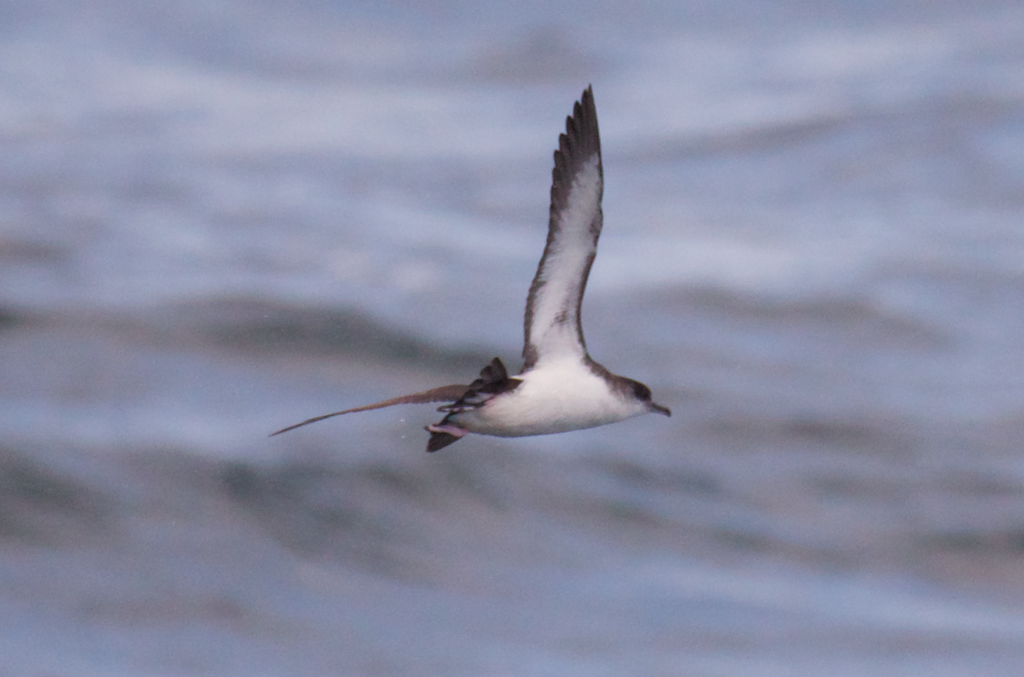
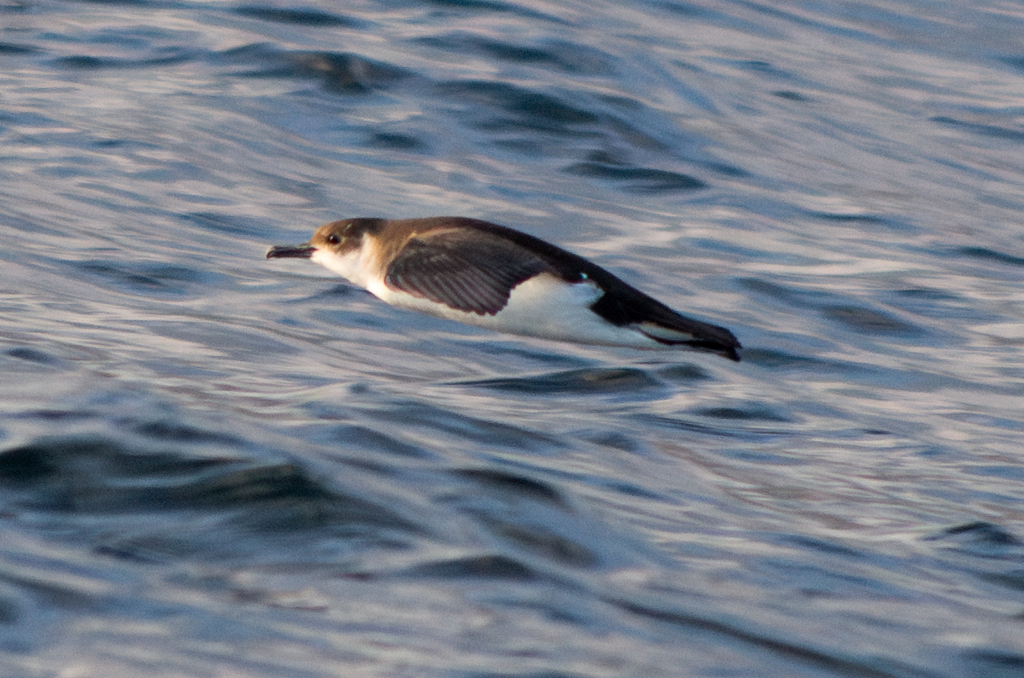
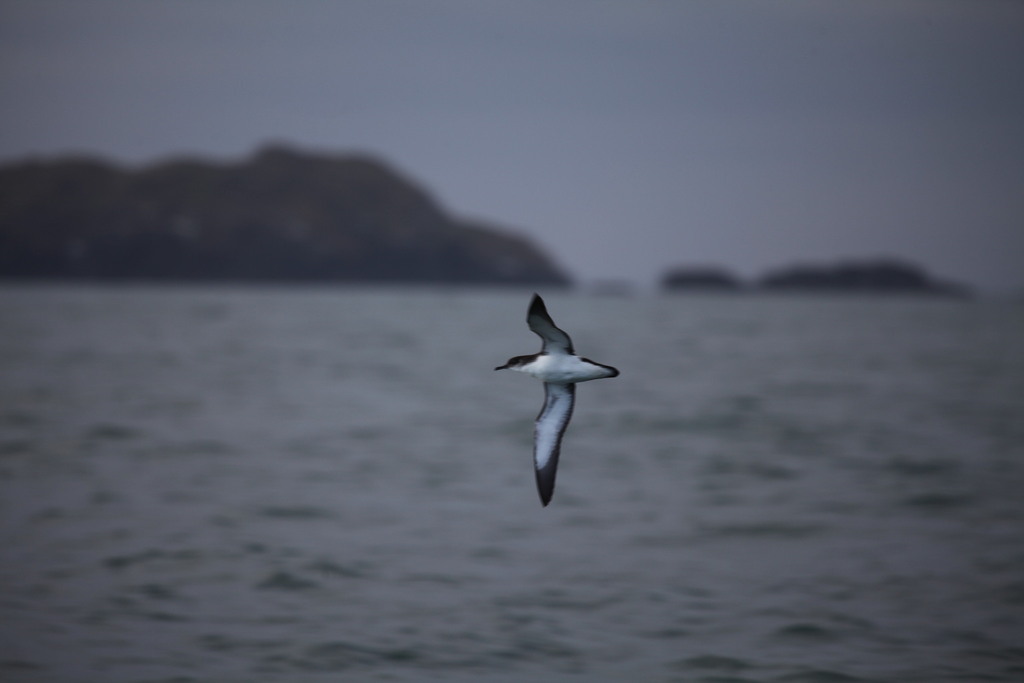
Photos show the species, not always the places on this page.
Length
About 30 to 38 cm (12 to 15 in) long, with a wingspan of about 76 to 89 cm (30 to 35 in)
Weight
About 350 to 575 g (12.3 to 20.3 oz); UK adults weighed on average 383 g (13.5 oz), range 330 to 455 g (11.6 to 16 oz)
Next to a person
Wingspan about half an adult's arm span, and about as heavy as a tin of baked beans
What it eats
Small shoaling fish such as herring, sprat and sandeel, plus squid, crustaceans and fish offal. It catches prey by plunging and diving, alone or in small flocks, and can use smell to find food from a distance.
Around people
Calm, give space
How it lives
Manx shearwaters nest in burrows on islands and visit them only at night, when colonies fill with croons, howls and screams. Breeding starts in March. During the breeding season birds commute to feeding grounds up to 1,500 km away. They live very long lives: the British and Irish ringing record is 50 years, 11 months and 21 days.
Where it goes
A full migrant. Colonies are largely empty from July to March. Birds from Skomer Island, Wales, travelled south along the west coast of Africa, crossed to Brazil, and spent the winter on the Patagonian Shelf off Argentina, near 40 degrees south. All 12 tracked birds wintered in that same small area. Southbound trips took 14 to 44 days. Smaller numbers winter off south-west South Africa.
We only draw a journey on the map when scientists have tracked it or clearly documented it. For this animal we have not found one yet.
Populations
IUCN (2018): Least Concern, with an unknown overall trend. It is decreasing in North America and unknown in Europe. Europe holds more than 95% of the breeding range, with 342,000 to 393,000 breeding pairs (684,000 to 785,000 mature individuals) in the assessment cited by IUCN (2015). About three-quarters of British and Irish birds breed on Skomer, Skokholm and Rum. The UK had about 300 thousand pairs in 1998 to 2002, and BTO notes that recent surveys suggest a rise of up to 50% since the 2000 census. It is Amber listed in the UK. Threats named by IUCN include rats and feral cats on breeding islands, chick harvesting in the Faroes (1,000 to 5,000 chicks a year) and artificial light.
Meet it respectfully
Watch from a boat or headland at a distance, with binoculars. Keep boats slow and steady and never steer through a raft of birds resting on the water. Never chase them or throw fish or bait. Fledglings can be drawn to artificial light, so keep lights off near colonies at night, and keep out of nesting areas. No sighting can be promised.
Fun fact
Tap the bulb to light it up.
The British and Irish ringing record for a Manx shearwater is 50 years, 11 months and 21 days, set in 2008.
Birds tracked from Skomer Island wintered off Argentina, and one covered about 7,750 km in 6.5 days.
It visits its nesting burrows only at night, when the colony is full of croons, howls and screams.
Manx shearwater in the Ocean Atlas
Places we have researched where this animal is recorded. It is never guaranteed, and some places are for watching from the boat only.
Travel with usComing soonTrusted referralExploringOn pause, story onlyEthics pass
Country colour: pink where we travel, blue where we are exploring or refer, grey for story only.
 Argentina
 Australia
 Belgium
 Bermuda
 Brazil
 Cabo Verde
 Canada
 Chile
Chile Costa Rica
 Denmark
 Falkland Islands
 Faroe Islands
 France
 French Guiana
 Germany
 Greenland
 Guadeloupe
 Iceland
 Ireland
 Israel
 Mexico
 Morocco
 Netherlands
 Norway
 Panama
 Portugal
 Saint Vincent and the Grenadines
 Senegal
 South Africa
 Spain
Spain Sweden
 United Kingdom
 United States
 Uruguay
Sources for this page
- IUCN Red List (BirdLife International), 2018
- Wikipedia, 2026
- BTO BirdFacts, 2026
- Guilford et al., 2009, Proceedings of the Royal Society B
Facts checked 5 October 2026. Photos: Unsplash licence, or Creative Commons as shown on each photo.
Work in ocean travel?
We are always happy to hear from exceptional local operators, accommodation, conservation organisations and destination experts. If your work fits responsible, small-group ocean travel, we would love to learn more.
Partner with Ocean Calling7-day freediving course in Coron, Palawan
CHF 1,480