
Moon jellyfish
Aurelia aurita and other Aurelia species
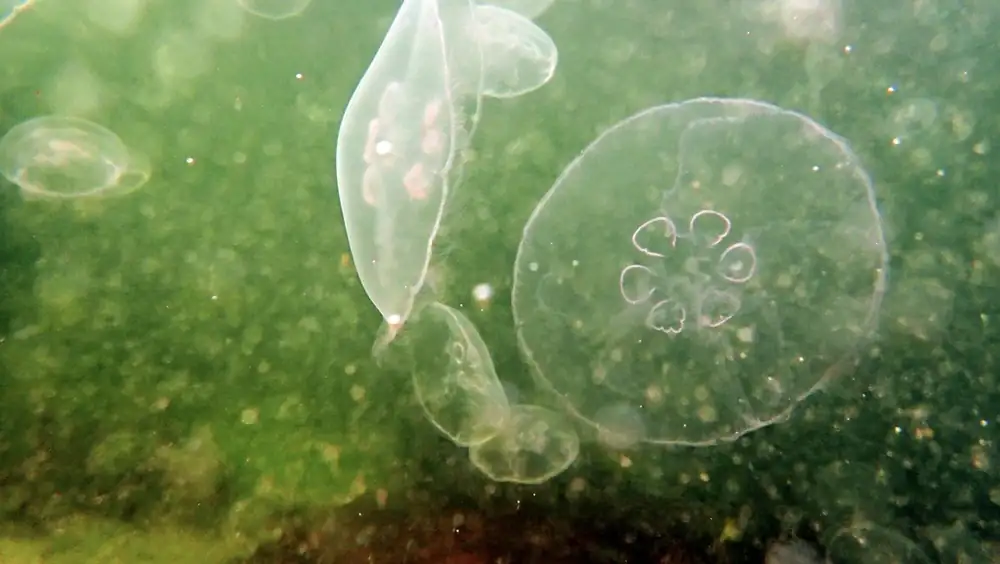
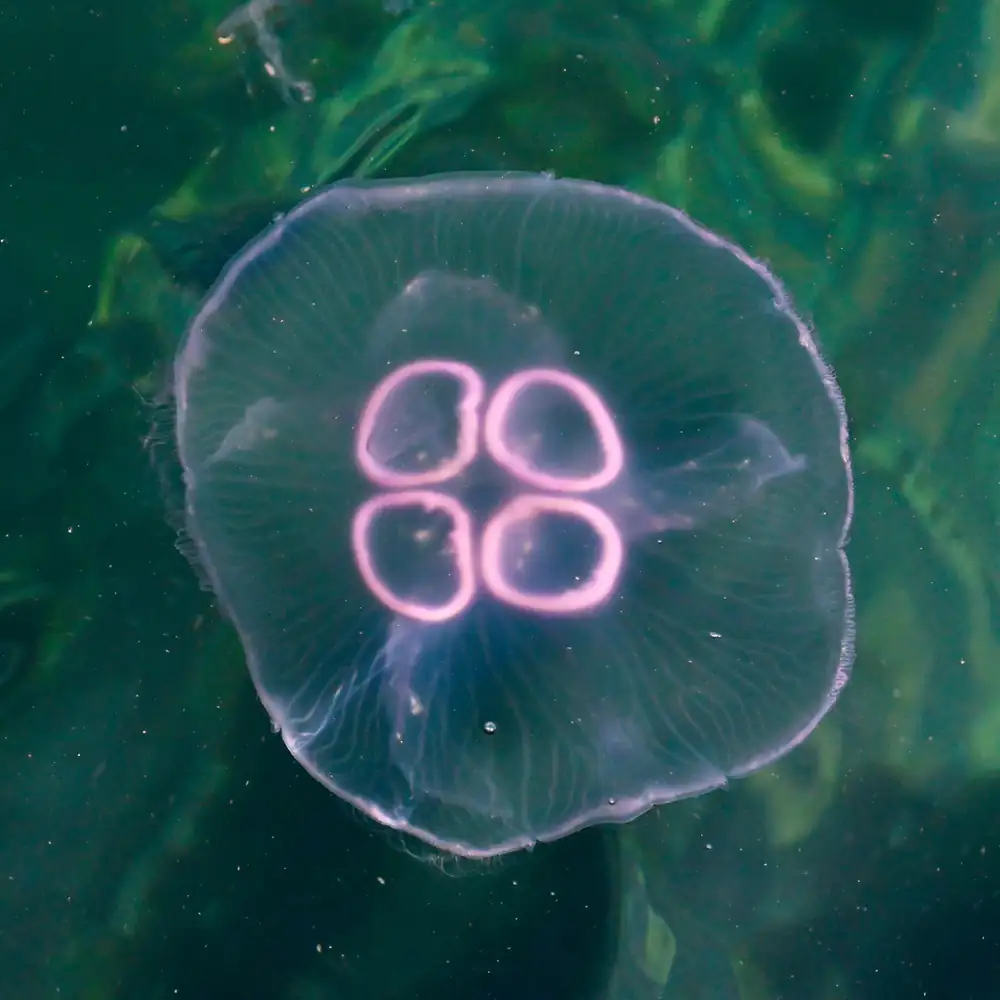
A clear, saucer-shaped jelly with four violet horseshoe rings. Lovely to watch as it pulses by, and never to touch.
Not Evaluated means IUCN has never assessed moon jellyfish.
Photos show the species, not always the places on this page.
Length
Bell usually about 25 cm (10 in) across, up to about 40 cm (16 in)
Weight
Not reliably measured
Next to a person
Bell about the size of a dinner plate, with only a short fringe of tentacles
What it eats
Mostly zooplankton, the tiny animals drifting in the water.
Around people
Calm, give space
How it lives
Moon jellyfish have a clear, saucer-shaped bell with four horseshoe-shaped rings in the middle, often violet, pink or yellowish, and a fringe of short tentacles with stinging cells. What was once called one species, Aurelia aurita, is really a group of about 28 lookalike Aurelia species around the world. Aurelia aurita itself belongs mainly to the cool North Atlantic, where it is the most common jellyfish in Britain and Ireland, including estuaries, harbours and sea lochs. Other Aurelia species live elsewhere, including Palau's marine lakes.
Where it goes
Not a migrant. It pulses gently and drifts with the water. Its larvae settle on hard surfaces and grow into tiny polyps, which bud off baby jellies. These usually become adults in about 3 months, and some take up to about 2 years.
We only draw a journey on the map when scientists have tracked it or clearly documented it. For this animal we have not found one yet.
Populations
Numbers change a lot: huge local swarms in some years and none in others, sometimes so dense they slow small boats. Jellyfish blooms often match warm water and fewer small fish, and human changes to coasts may help jellies, but direct proof is still limited.
Meet it respectfully
Moon jellies have stinging cells. For most people the sting is mild, but it is not harmless to everyone, and jellies stranded on the beach can still sting. We watch without touching, in the water and on the beach, and never collect them.
Fun fact
Tap the bulb to light it up.
The four horseshoe shapes and four arms under the bell give the moon jelly its classic look.
Dense swarms can tint the water and even slow small boats.
Scientists now recognise about 28 Aurelia species that look much alike.
In June 1991 the Space Shuttle Columbia carried thousands of tiny moon jellyfish on the SLS-1 life science mission, together with seven astronauts and 30 rodents.
Source: NASA, STS-40 mission page
Baby jellies that formed in space looked normal, but 18.3 percent had problems pulsing, compared with 2.9 percent of those raised on Earth.
Source: Spangenberg et al., 1994, Advances in Space Research
Scientists found that the moon jelly is not one species but many lookalike species, and one of them has been carried around the world by people.
Jellyfish are about 95 percent water, and they have no brain, heart or blood. One opening works as both mouth and anus.
Source: NOAA National Ocean Service, What are jellyfish made of?
Jellyfish fossils about 505 million years old, with tentacles still visible, were found in Utah.
Moon jellyfish in the Ocean Atlas
Places we have researched where this animal is recorded. It is never guaranteed, and some places are for watching from the boat only.
Travel with usComing soonTrusted referralExploringOn pause, story onlyEthics pass
Country colour: pink where we travel, blue where we are exploring or refer, grey for story only.
 Australia
 Belgium
 Bulgaria
 Canada
 Denmark
 Egypt
Egypt Estonia
 Finland
 France
 French Guiana
 Georgia
 Germany
 Greece
 Iceland
 Ireland
 Israel
 Japan
Japan Latvia
 Lebanon
 Lithuania
 Netherlands
 Norway
 Palau
Palau Poland
 Romania
 Russia
 South Korea
 Spain
Spain Sweden
 Türkiye
 Ukraine
 United Kingdom
 United States
Sources for this page
- MarLIN (Marine Biological Association), Moon jellyfish, Aurelia aurita
- Dawson & Jacobs, 2001, Biological Bulletin
- Dawson, Sen Gupta & England, 2005, PNAS
- Lawley et al., 2021, PeerJ, Aurelia species diversity
- Purcell, 2012, Annual Review of Marine Science
- NASA, STS-40 mission page
- Spangenberg et al., 1994, Advances in Space Research
- NOAA National Ocean Service, What are jellyfish made of?
Facts checked 26 September 2026. Photos: Unsplash licence, or Creative Commons as shown on each photo.
Work in ocean travel?
We are always happy to hear from exceptional local operators, accommodation, conservation organisations and destination experts. If your work fits responsible, small-group ocean travel, we would love to learn more.
Partner with Ocean CallingNew: tiger sharks in Fuvahmulah, January or March 2027
from CHF 2,900