
Smooth hammerhead
Sphyrna zygaena
The smooth hammerhead is the hammerhead of cooler seas. A wide-ranging shark with a smooth head edge, coastal nurseries for its young, and adults able to travel across oceans.
Vulnerable (IUCN, 2018) means it is at high risk of extinction in the wild.
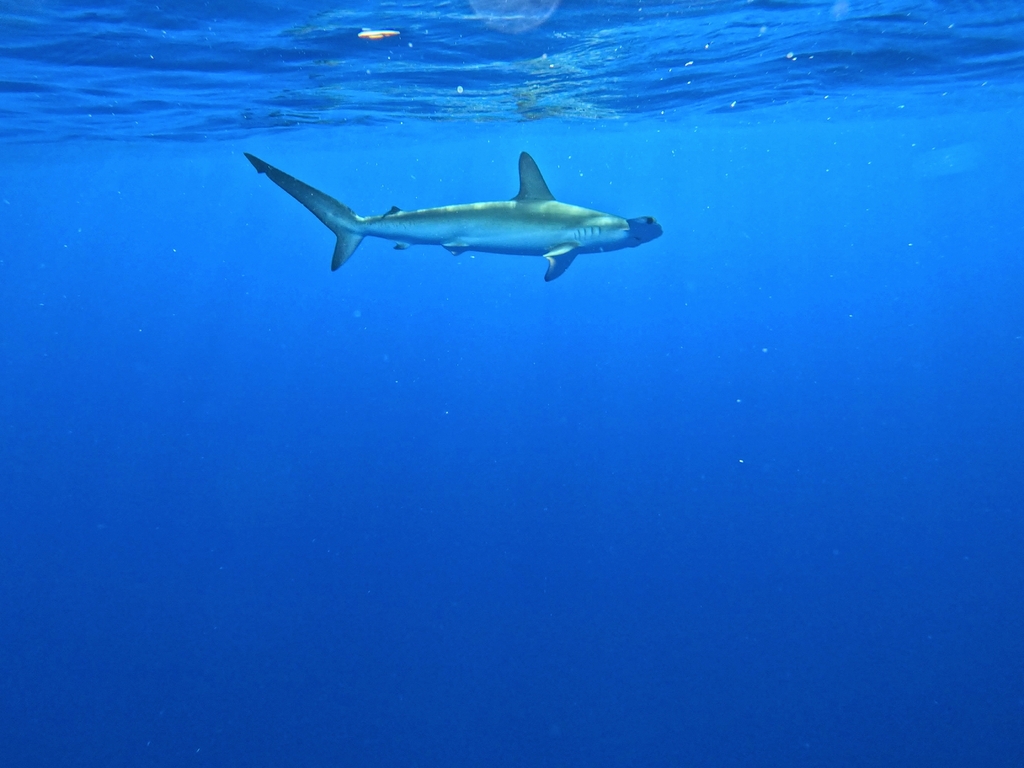

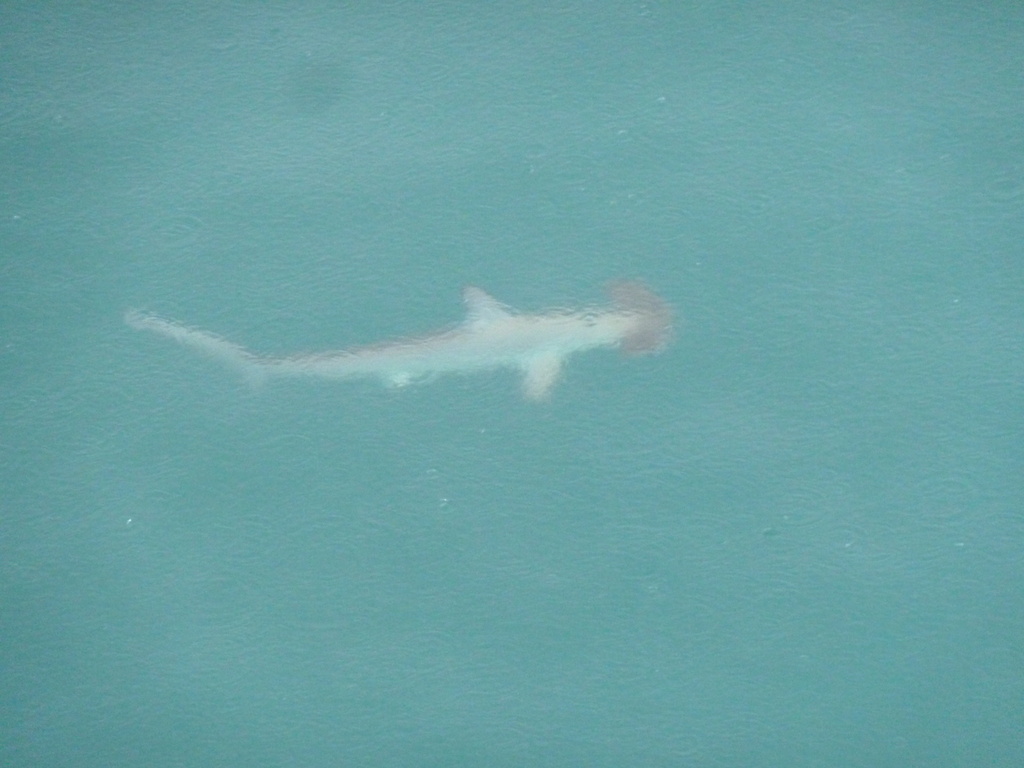
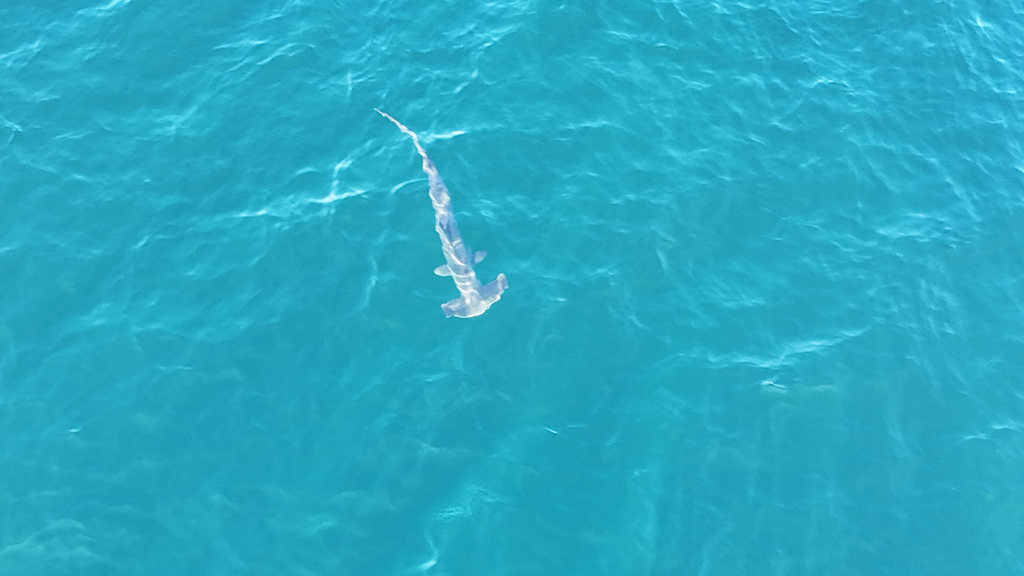
Photos show the species, not always the places on this page.
Length
Commonly about 3.35 m (11 ft); the largest reported up to about 5 m (16.4 ft)
Weight
The largest adults up to about 400 kg (880 lb)
Next to a person
A large adult is about two to three times as long as a person
What it eats
Small sharks, skates and stingrays, plus bony fish, shrimps, crabs and squid.
Around people
Calm, give space
How it lives
The smooth hammerhead has a curved head with no notch in the middle, which helps tell it from the scalloped hammerhead. It lives from tropical to temperate seas, near the coast and far offshore. Young ones can gather in large groups in some places. Females give birth to live young, and in New Zealand newborns first appear near the coast in summer at about 60 cm.
Where it goes
Young smooth hammerheads can stay for years in one coastal nursery. In the Azores, 18 tagged juveniles off Faial and Pico were followed for up to 4.26 years, most of all in summer. Adults travel far: one female tagged in the tropical north-east Atlantic swam 6,610 km across the equator in 150 days. Off South Africa, tagged sharks moved up to 384 km.
We only draw a journey on the map when scientists have tracked it or clearly documented it. For this animal we have not found one yet.
Populations
Found worldwide in tropical to temperate seas. Known nurseries include the Azores, northern New Zealand (Firth of Thames, Hauraki Gulf, eastern Bay of Plenty), the Transkei coast of South Africa and northern Peru. In 2024 a group of juveniles was found in the Galápagos, the first records there in over 20 years. South African sharks show high gene flow along the coast.
Meet it respectfully
Smooth hammerheads are shy. Watch calmly and never chase, surround, block, feed or bait them. Give young sharks and nursery bays extra space, because repeated close approaches can disturb them. Never try to touch them; the shark chooses how close it comes.
Fun fact
Tap the bulb to light it up.
One adult female swam 6,610 km in 150 days, from the northern to the southern hemisphere, the longest trip known for the species.
In the Azores, young smooth hammerheads stayed near the shore of Faial by day and moved further offshore at night.
One adult female smooth hammerhead swam 6,610 km in 150 days, from the northern to the southern hemisphere. It is the longest trip known for the species.
Source: Santos & Coelho, 2018, PLOS ONE, Migrations of the smooth hammerhead in the Atlantic
At De Hoop in South Africa, 20 tagged young smooth hammerheads spent 95% of their detected days just outside the eastern edge of the protected area, where shark longline boats worked.
Source: Albano et al., 2023, Frontiers in Marine Science, juvenile smooth hammerheads at De Hoop MPA
In the Azores, young smooth hammerheads kept coming back to the north shore of Faial Island. By day they stayed near shore, and at night they moved further offshore.
Source: Afonso et al., 2022, Frontiers in Marine Science, juvenile smooth hammerheads in an island nursery
Smooth hammerhead in the Ocean Atlas
Places we have researched where this animal is recorded. It is never guaranteed, and some places are for watching from the boat only.
Travel with usComing soonTrusted referralExploringOn pause, story onlyEthics pass
Country colour: pink where we travel, blue where we are exploring or refer, grey for story only.
 Australia
 Brazil
 Chile
 China
 Côte d'Ivoire
 Ecuador
 Faroe Islands
 France
 Germany
 India
 Indonesia
 Italy
 Japan
 Mexico
 Mozambique
 New Zealand
 Oman
 Peru
 Portugal
 South Africa
 South Korea
 Spain
 Sri Lanka
 Taiwan
 United States
 Uruguay
Sources for this page
- FishBase, Sphyrna zygaena
- Afonso et al., 2022, Frontiers in Marine Science
- Santos & Coelho, 2018, PLOS ONE
- Diemer et al., 2011, African Journal of Marine Science
- Albano et al., 2023, Frontiers in Marine Science
- Fisheries New Zealand, Smooth hammerhead shark (HHS), 2015
- Texas A&M University, 28 Jul 2026, smooth hammerheads in the Galápagos
- Grobler et al., 2024, Ecology and Evolution
Facts checked 26 September 2026. Photos: Unsplash licence, or Creative Commons as shown on each photo.
Work in ocean travel?
We are always happy to hear from exceptional local operators, accommodation, conservation organisations and destination experts. If your work fits responsible, small-group ocean travel, we would love to learn more.
Partner with Ocean Calling7-day freediving course in Coron, Palawan
CHF 1,480