
Common (estuary) seahorse
Hippocampus kuda
A seahorse holds a blade of seagrass with its tail and barely moves. You find it by looking slowly, and a sighting is never promised.
Vulnerable (IUCN, 2012) means it is at high risk of extinction in the wild.
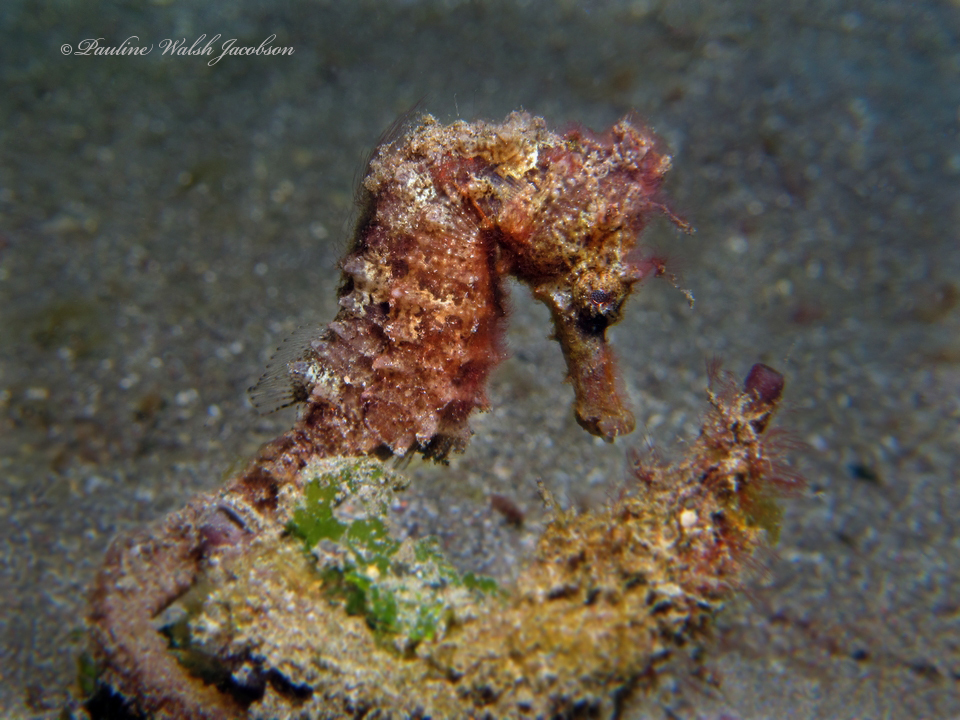
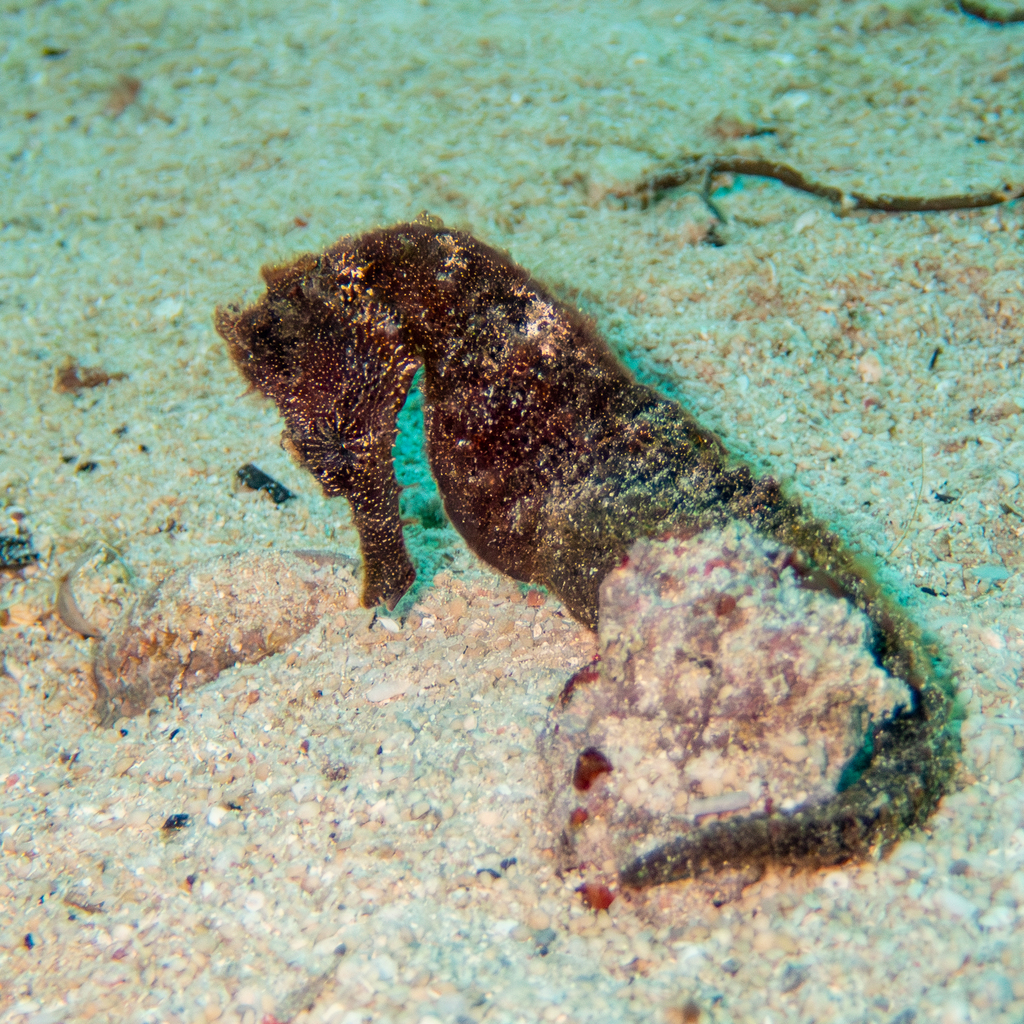
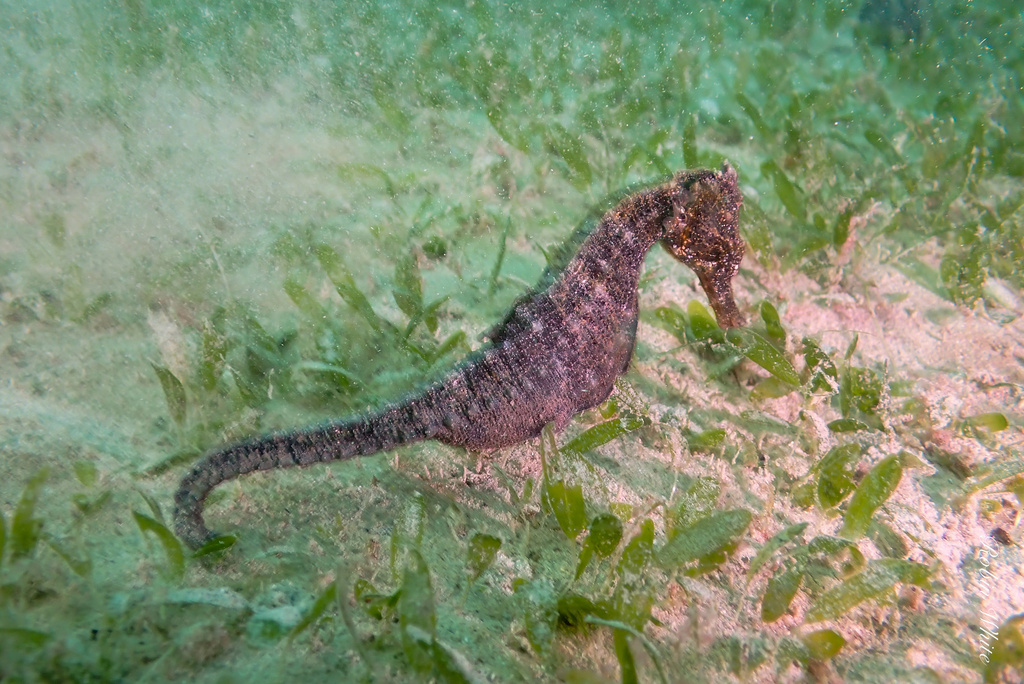
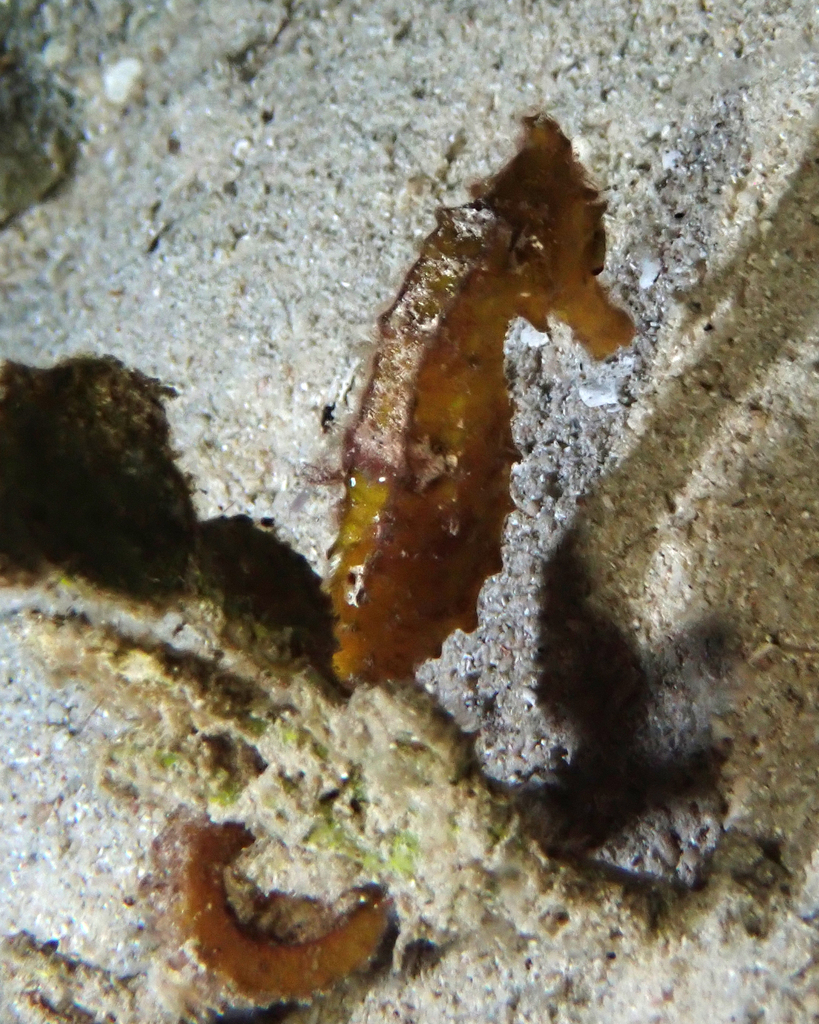
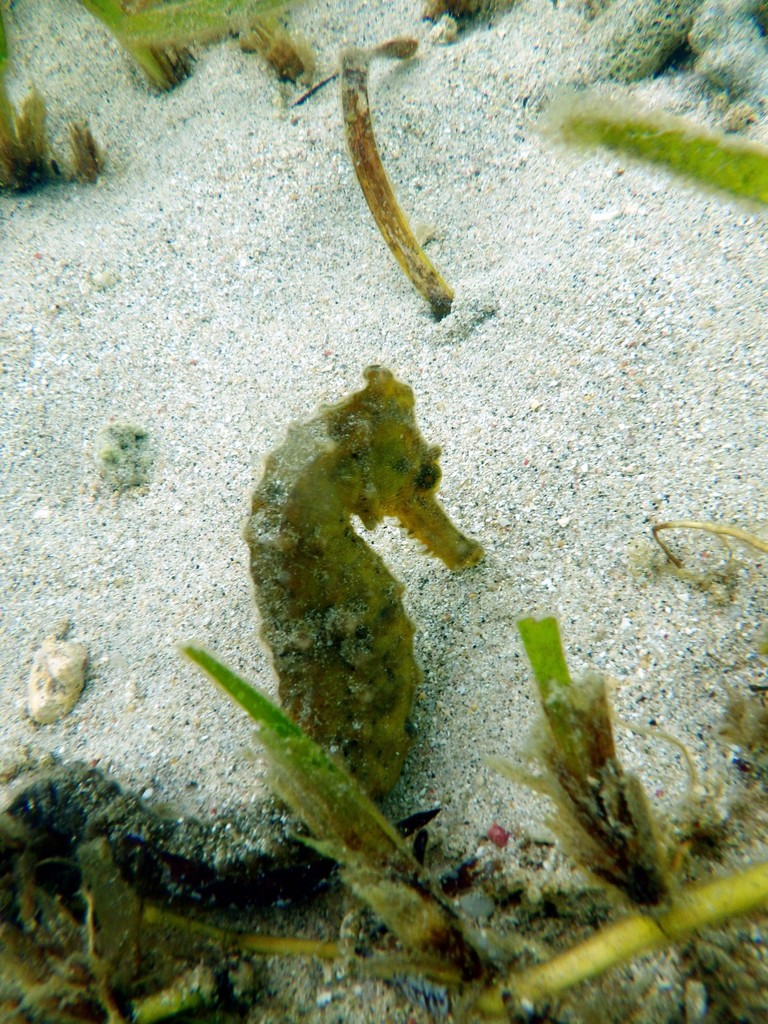
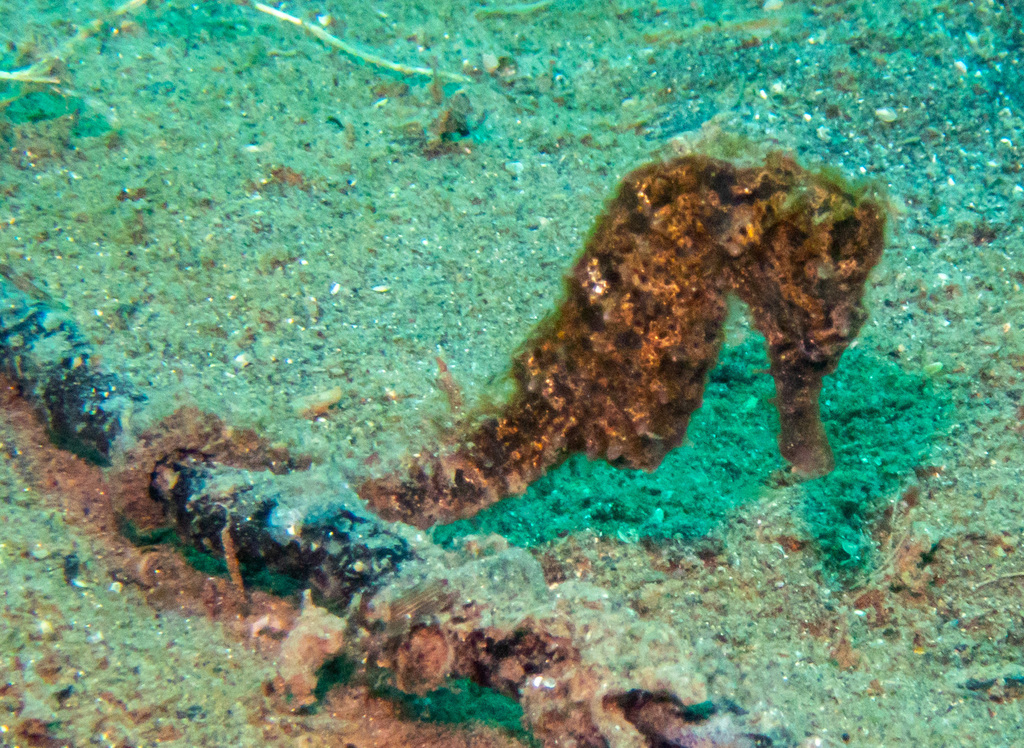
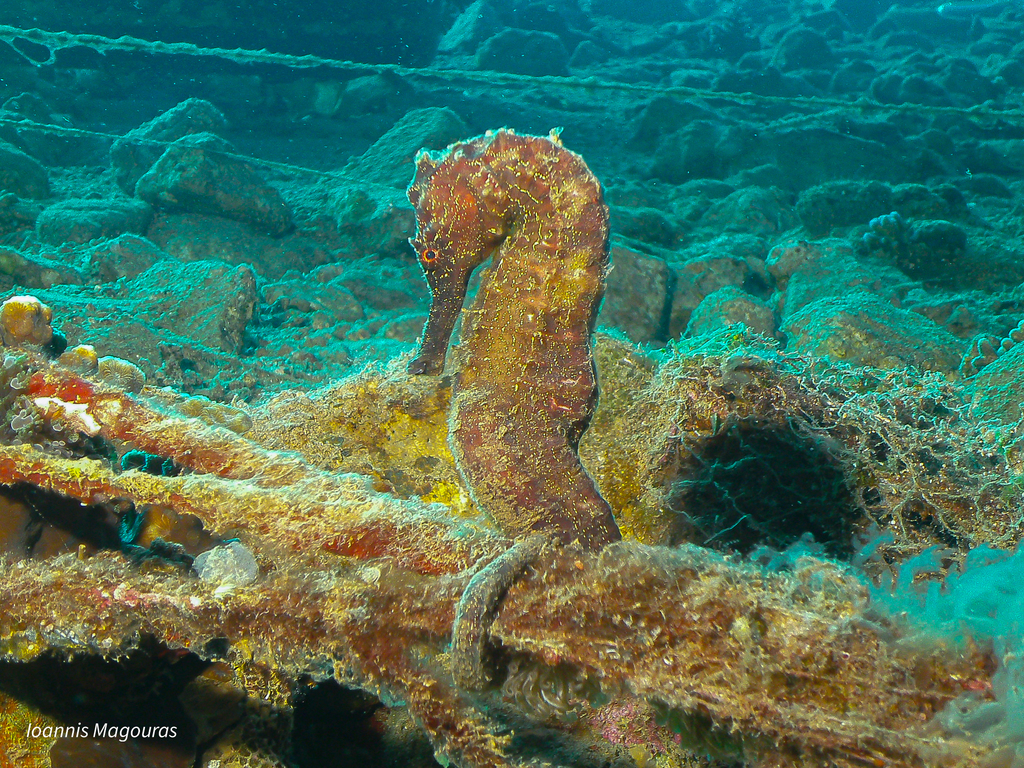
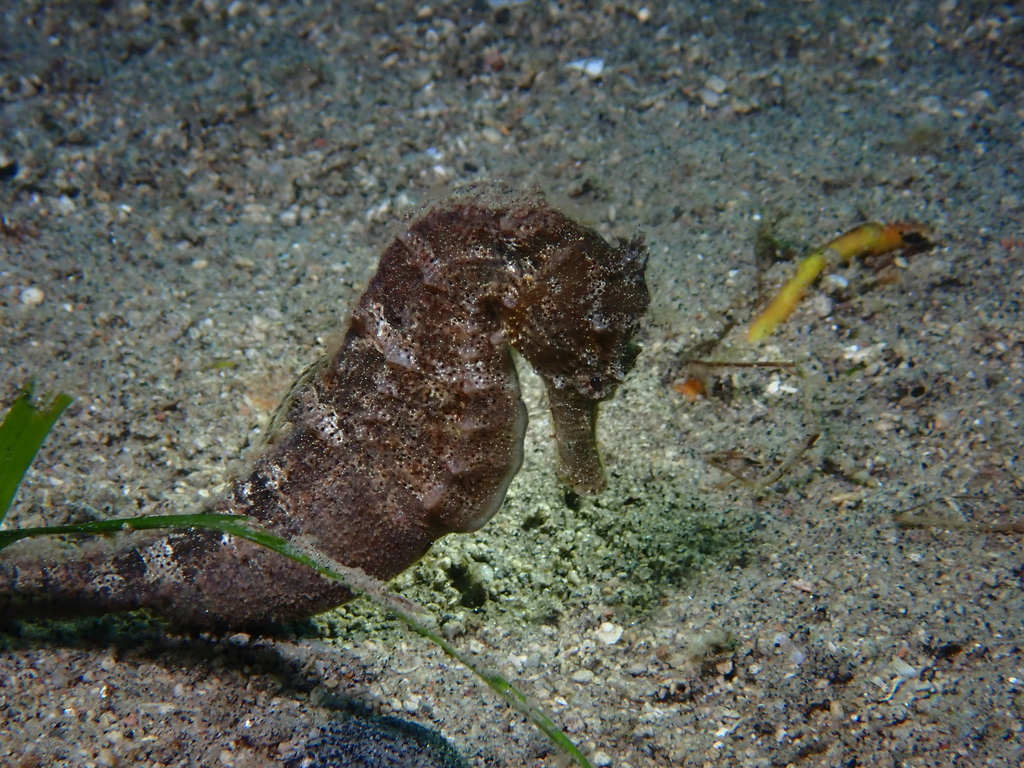
Photos show the species, not always the places on this page.
Length
Usually about 7 to 17 cm (3 to 7 in) tall; measured stretched out, the largest recorded is about 30 cm (12 in)
Weight
Only a few grams; adults in one Indian study weighed about 5 to 19 g (0.2 to 0.7 oz)
Next to a person
Palm-sized, about as big as a closed adult fist
What it eats
Small crustaceans and other tiny plankton, sucked in through its tube-shaped snout. It does not eat seagrass.
Around people
Harmless
How it lives
This seahorse holds on to seagrass, mangrove roots or debris with its tail. It is a poor swimmer and relies on camouflage to stay safe, and its colour can change to match its surroundings. It sucks up small crustaceans and plankton through its tube-shaped snout. The male carries the eggs in a pouch for about 20 to 28 days before the young swim out.
Where it goes
It does not migrate. It usually lives in shallow water from 0 to 8 m, but has been recorded deeper than 50 m. Adults are often seen in pairs.
We only draw a journey on the map when scientists have tracked it or clearly documented it. For this animal we have not found one yet.
Populations
It lives across the Indo-Pacific, from southern Africa and the Red Sea to Hawaii and French Polynesia. It is listed as Vulnerable because numbers are believed to have fallen by 30% or more, from fishing for trade, bycatch and habitat loss. A 2001 study recorded this species in Lombok, alongside another seahorse, Hippocampus barbouri.
Meet it respectfully
Look only. Never touch a seahorse or lift it off whatever it is holding, never chase it, and keep good buoyancy so you do not damage the seagrass. Keep bright lights and flash to a minimum and follow your guide. Never take one as a souvenir: international trade in seahorses is controlled under CITES, and Indonesia restricts wild export.
Fun fact
Tap the bulb to light it up.
The male gets pregnant: eggs grow in his pouch for about 20 to 28 days.
Its colour is not fixed; it can be black, yellow with spots, or sandy to blend in.
It is one of the few seahorses that often lives in estuaries and brackish water.
This seahorse does not only live in quiet estuaries. It has been found holding on to drifting Sargassum seaweed up to 20 km out to sea.
Each of its eyes can move on its own. This lets the seahorse search a wider area for tiny prey, looking two ways at once.
Common (estuary) seahorse in the Ocean Atlas
Places we have researched where this animal is recorded. It is never guaranteed, and some places are for watching from the boat only.
Travel with usComing soonTrusted referralExploringOn pause, story onlyEthics pass
Country colour: pink where we travel, blue where we are exploring or refer, grey for story only.
 Australia
 Cambodia
 China
 Egypt
 Fiji
 Hong Kong
 India
 Indonesia
 Israel
 Japan
 Kenya
 Malaysia
 Mozambique
 New Caledonia
 Papua New Guinea
 Philippines
 Saudi Arabia
 Singapore
 South Africa
 Taiwan
 Tanzania
 Thailand
 Timor-Leste
 United States
 Vietnam
Sources for this page
- FishBase, 2012
- Animal Diversity Web
- Pawar et al., 2019
- Lourie et al., 2004, Project Seahorse ID guide
- WoRMS
- IUCN SSC Seahorse, Pipefish and Seadragon Specialist Group, CITES toolkit
- Ignatius and Joseph, CMFRI, 2017
Facts checked 26 September 2026. Photos: Unsplash licence, or Creative Commons as shown on each photo.
Work in ocean travel?
We are always happy to hear from exceptional local operators, accommodation, conservation organisations and destination experts. If your work fits responsible, small-group ocean travel, we would love to learn more.
Partner with Ocean CallingNew: mobula rays in La Ventana, May 2027
CHF 2,720