
Day octopus
Octopus cyanea
A reef octopus that hunts by day on Indo-Pacific coral. Watch its colour change near its den, give it space, and never touch or feed it.
Least Concern (IUCN, 2018) means it is not at high risk of extinction worldwide today.
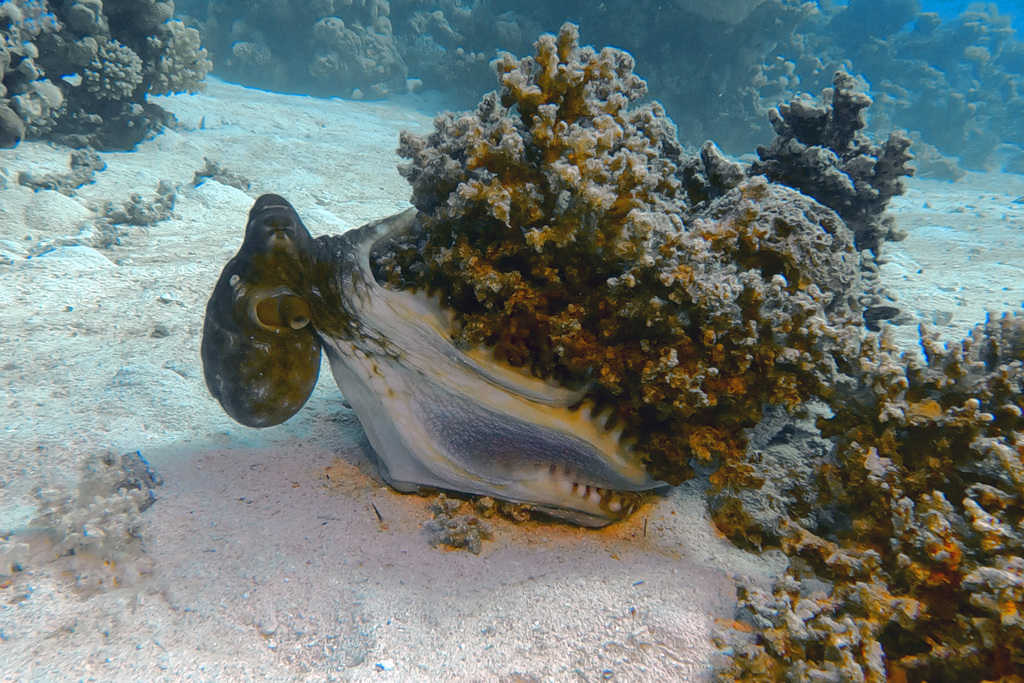
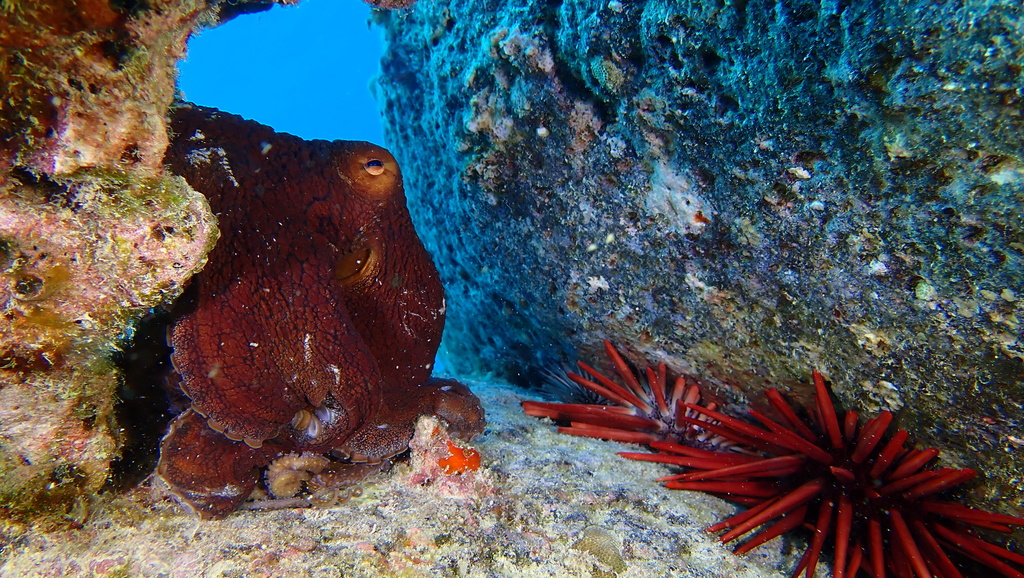
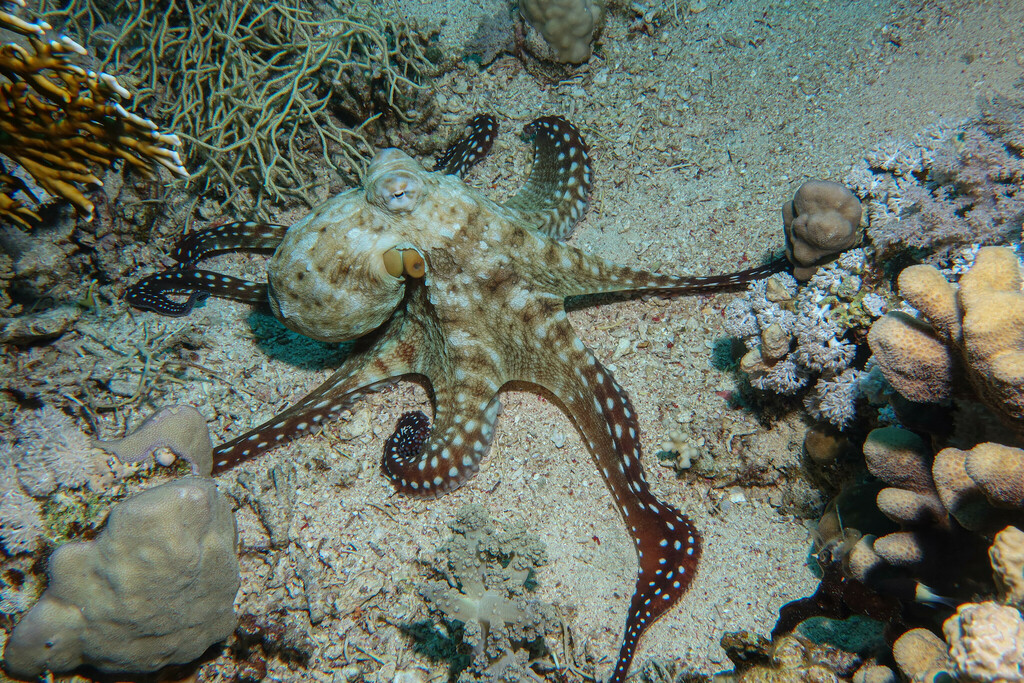
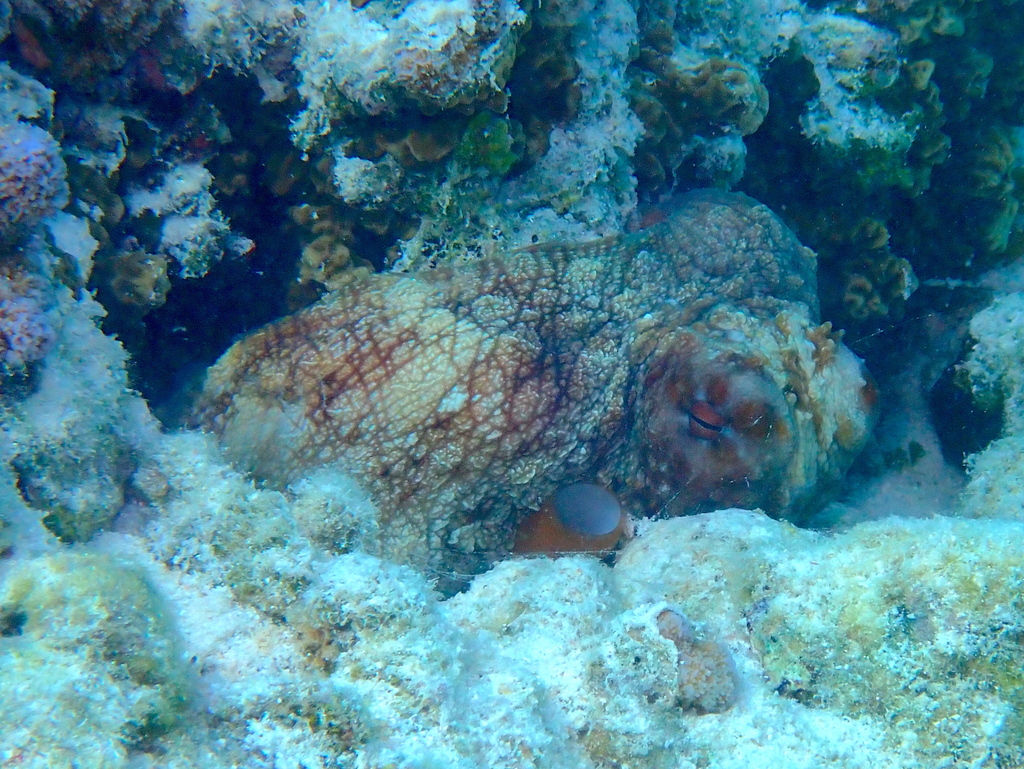
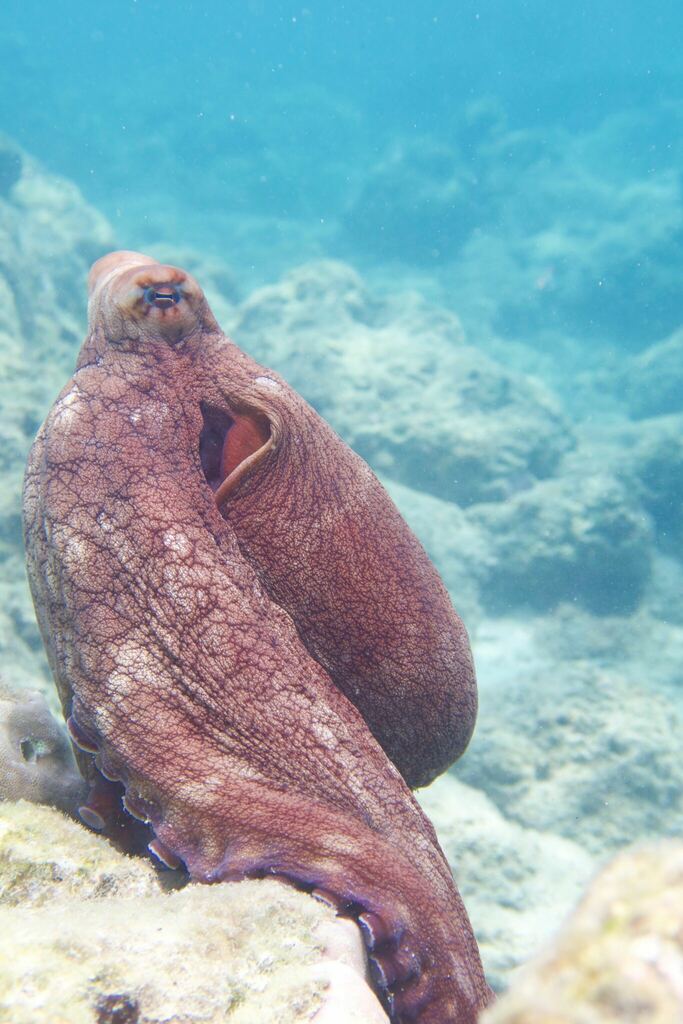
Photos show the species, not always the places on this page.
Length
Body (mantle) up to about 22 cm (8.7 in); with arms, large animals may reach about 1 m (3 ft) across. Most are smaller
Weight
Typical weight not reliably measured, and most seen on reefs are much smaller; largest recorded about 6 kg (13 lb)
Next to a person
The body alone is up to about the length of an adult's forearm; most are smaller
What it eats
Mainly crabs, plus clams, snails, mantis shrimps, shrimps and sometimes small fish.
Around people
Calm, give space
How it lives
The day octopus lives alone in a den in coral or rock and hunts mostly by day, with peaks at dawn and dusk. It pounces on crabs, or spreads the web between its arms over a coral head and feels inside with its arm tips. Goatfish and groupers sometimes hunt with it. Like other octopuses, adults usually die soon after breeding, and the female guards her eggs.
Where it goes
The day octopus does not migrate. Adults are sedentary and keep to dens in a small patch of reef. Across the south-west Indian Ocean, from Kenya to Madagascar and the Seychelles, the genes are well mixed, probably because the tiny young drift in the plankton before they settle.
We only draw a journey on the map when scientists have tracked it or clearly documented it. For this animal we have not found one yet.
Populations
The day octopus lives on tropical reefs from eastern Africa and the Red Sea to Hawaiʻi, mostly in shallow water but recorded down to about 150 m. Samples from 20 sites in Kenya, Tanzania, Mozambique, Madagascar, Mauritius, Rodrigues and the Seychelles form one connected population. It is Least Concern, but it is still fished on many reefs. In Hawaiʻi it is called heʻe.
Meet it respectfully
Watch calmly from a little distance and let the octopus stay in or near its den. Never touch, poke, pick up or pull an octopus from its hole, and do not move the shell pile outside its den. Never feed or chase it, even for a photo. If it flashes colour, jets away or inks, you are too close.
Fun fact
Tap the bulb to light it up.
Unlike many octopuses, it hunts in daylight, most of all at dawn and dusk.
It can change the colour and texture of its skin in moments as it crosses the reef.
It brings prey back to its den, and the empty shells pile up outside.
It is not dangerously venomous to people like the blue-ringed octopus.
In the Red Sea off Eilat, day octopuses hunt in groups with goatfish and groupers. The fish lead the search, but the octopus decides if and when the group moves, and it sometimes punches a fish partner.
Source: Sampaio et al., 2024, Nature Ecology & Evolution, octopus-fish hunting groups
In south-west Madagascar, villages close their day octopus fishing grounds for several weeks to months each year. A 2023 model suggests these closures have helped the fishery last since 2006.
Source: Wulfing et al., 2023, bioRxiv preprint, temporary closures for a small-scale octopus fishery
In Hawaiʻi, a heʻe (day octopus) must weigh at least 1 pound, about 450 g, before anyone may take it.
Source: Hawaiʻi Division of Aquatic Resources, Fishing Regulations, February 2025
Day octopus in the Ocean Atlas
Places we have researched where this animal is recorded. It is never guaranteed, and some places are for watching from the boat only.
Travel with usComing soonTrusted referralExploringOn pause, story onlyEthics pass
Country colour: pink where we travel, blue where we are exploring or refer, grey for story only.
 Australia
 Egypt
Egypt Fiji
Fiji French Polynesia
 Guam
Guam India
India Indonesia
 Israel
 Japan
Japan Kenya
Kenya Kiribati
 Madagascar
 Malaysia
 Maldives
 Marshall Islands
 Mauritius
 Mayotte
 Micronesia (FSM)
 Mozambique
 New Caledonia
 Northern Mariana Islands
 Oman
Oman Palau
Palau Papua New Guinea
 Philippines
 Réunion
 Saudi Arabia
 Seychelles
 Solomon Islands
 South Africa
 Taiwan
 Tanzania
 Thailand
 United States
 Vanuatu
Sources for this page
- SeaLifeBase, Octopus cyanea
- Treleven et al., 2024, Ecology and Evolution
- Sampaio et al., 2024, Nature Ecology & Evolution
- Scheel et al., 2016, Journal of Natural History
- Hawaiʻi Division of Aquatic Resources, Fishing Regulations, Feb 2025
- Wulfing et al., 2023, bioRxiv preprint
- Forsythe & Hanlon, 1997, Journal of Experimental Marine Biology and Ecology
- Allcock et al., 2018, IUCN Red List
Facts checked 26 September 2026. Photos: Unsplash licence, or Creative Commons as shown on each photo.
Work in ocean travel?
We are always happy to hear from exceptional local operators, accommodation, conservation organisations and destination experts. If your work fits responsible, small-group ocean travel, we would love to learn more.
Partner with Ocean CallingNot sure where to go? Get your Ocean Match
from CHF 19