
Leach's storm-petrel
Hydrobates leucorhous
A small dark flicker over open ocean. These birds live far from land, and every sighting is a privilege, never a promise.
Vulnerable (IUCN, 2018) means it faces a high risk of extinction in the wild. The rating comes from a fall of at least 30% over three generations, for reasons that are not yet known.
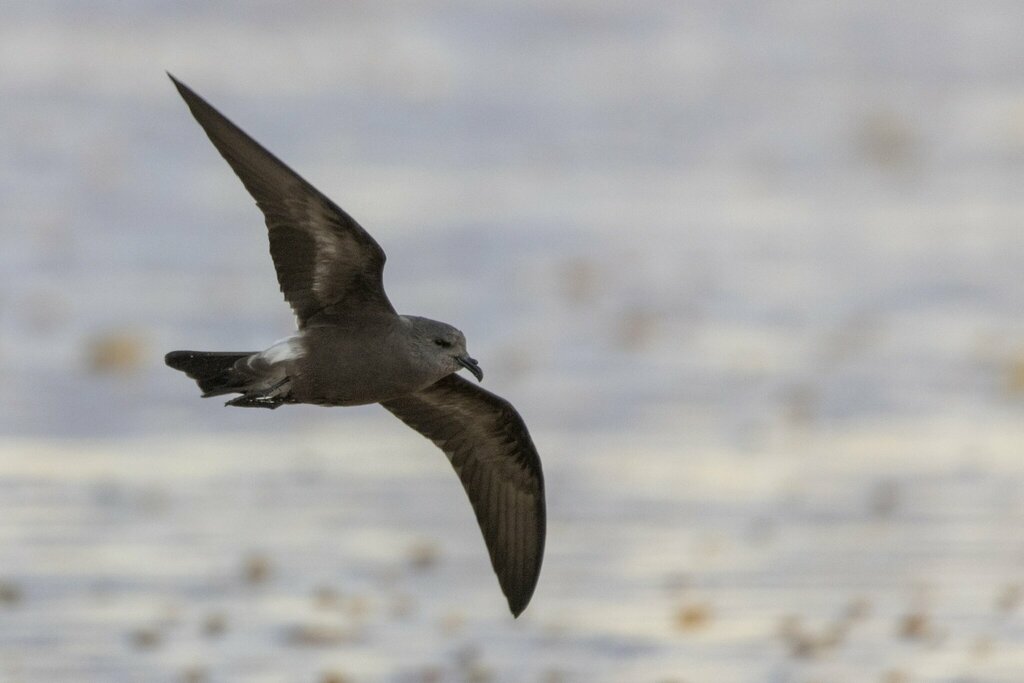
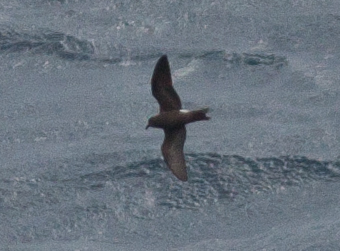
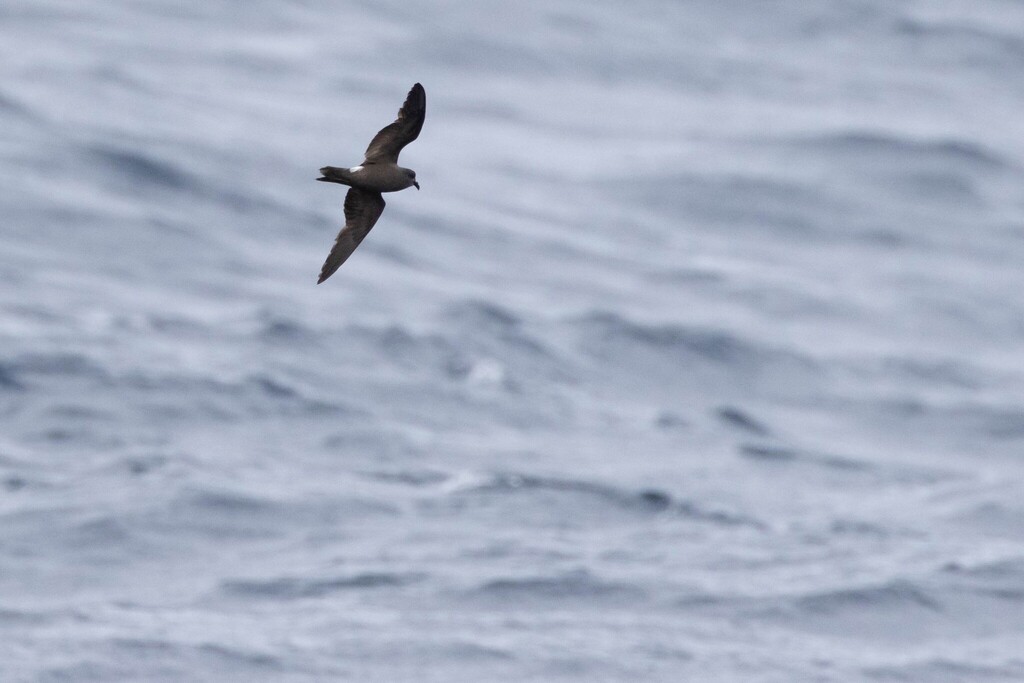
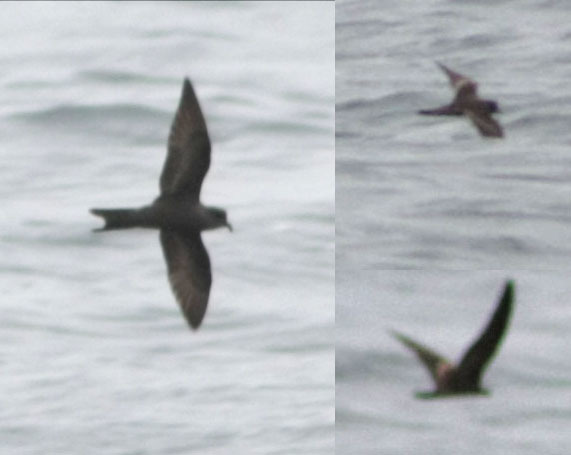
Photos show the species, not always the places on this page.
Length
About 18 to 21 cm (7.1 to 8.3 in) long, with a wingspan of about 43 to 48 cm (17 to 19 in)
Weight
Adults caught in Britain and Ireland averaged about 44 g (1.5 oz); females averaged a little more, about 49 g (1.7 oz)
Next to a person
About as long as an adult's hand, and lighter than a hen's egg
What it eats
Small fish such as lanternfish, plus krill and other small crustaceans, squid and jellyfish. It hovers and picks prey from the surface, and also takes fish offal. Birds from the western Atlantic forage on average 400 to 830 km from their colonies.
Around people
Calm, give space
How it lives
Leach's storm-petrels nest in colonies on offshore islands, in burrows or rock crevices. They visit nests only at night, which helps them avoid gulls and skuas. A pair raises one chick a year. The egg is incubated for 37 to 50 days and the chick stays in the burrow for 56 to 79 days. While one partner incubates, the other makes foraging trips that usually last about four days. They live long for their size: about 13 years on average, and at least 36 years in ringing records.
Where it goes
A full migrant. It breeds on islands in the North Atlantic and North Pacific, including Canada, the United States, Iceland, the Faroe Islands, Norway and the UK. The only Southern Hemisphere colony is on Dassen Island, South Africa. After breeding, birds move to tropical waters, near the North Equatorial and Benguela Currents. Away from colonies it rarely comes near land, although storm-blown birds are seen on coasts, mostly in autumn.
We only draw a journey on the map when scientists have tracked it or clearly documented it. For this animal we have not found one yet.
Populations
IUCN (2018): Vulnerable, with a decreasing population. Data from 1977 to 2016 covering 75 to 80% of the world population point to a fall of at least 30% over three generations. The cause is unknown and probably has several parts. IUCN gives a world figure of 6.7 to 8.3 million, described as breeding pairs in its text, and an earlier estimate (2004) was more than 20 million individuals. In Atlantic Canada the population was rated Threatened by COSEWIC in 2020, at about 5.28 million mature individuals, down 53.8% from 1974 to 2018. The largest colony, Baccalieu Island, Newfoundland, had about 1.95 million pairs in 2013. The UK has about 48,000 pairs (1998 to 2002) and the species is Red listed there. The biggest UK colony, Dun in St Kilda, has fallen by 54%.
Meet it respectfully
Leach's storm-petrels live far offshore and are rarely seen from land. On a boat, keep a steady course and speed, and never chase them or throw fish or bait to draw them in. At breeding islands they come and go at night to avoid predators, and artificial light is listed as a threat, so keep away from colonies and do not shine lights at them. If a storm-blown bird lands on a coast, give it space. No sighting can be promised.
Fun fact
Tap the bulb to light it up.
Males and females look the same, but males have slightly higher-pitched calls.
The oldest known Leach's storm-petrel, banded on Kent Island, New Brunswick, was at least 36 years old.
While one partner incubates, the other makes foraging trips that usually last about four days and cover more than 1,400 km.
Leach's storm-petrel in the Ocean Atlas
Places we have researched where this animal is recorded. It is never guaranteed, and some places are for watching from the boat only.
Travel with usComing soonTrusted referralExploringOn pause, story onlyEthics pass
Country colour: pink where we travel, blue where we are exploring or refer, grey for story only.
 Belgium
 Bermuda
 Brazil
 Cabo Verde
 Canada
 Costa Rica
 Denmark
 Ecuador
 El Salvador
 Faroe Islands
 France
 French Guiana
 Germany
 Greenland
 Guadeloupe
 Iceland
 Ireland
 Israel
 Japan
Japan Mexico
 Morocco
 Namibia
 Netherlands
 Norway
 Portugal
 Russia
 Saint Helena
 South Africa
 Spain
Spain Suriname
 Sweden
 Taiwan
 Trinidad and Tobago
 United Kingdom
 United States
Sources for this page
- IUCN Red List (BirdLife International), 2018
- Wikipedia, 2026
- Cornell Lab, All About Birds, 2026
- BTO BirdFacts, 2026
- COSEWIC, Government of Canada, 2020
Facts checked 5 October 2026. Photos: Unsplash licence, or Creative Commons as shown on each photo.
Work in ocean travel?
We are always happy to hear from exceptional local operators, accommodation, conservation organisations and destination experts. If your work fits responsible, small-group ocean travel, we would love to learn more.
Partner with Ocean CallingNew: mobula rays in La Ventana, May 2027
CHF 2,720