
Longsnout seahorse
Hippocampus reidi
A seahorse the size of a hand, holding on with its tail in the seagrass and sea rods. It is easy to miss, and no sighting is a promise.
Near Threatened (IUCN, 2017) means it is close to qualifying as threatened, mainly because of collection for trade. The population trend is unknown.
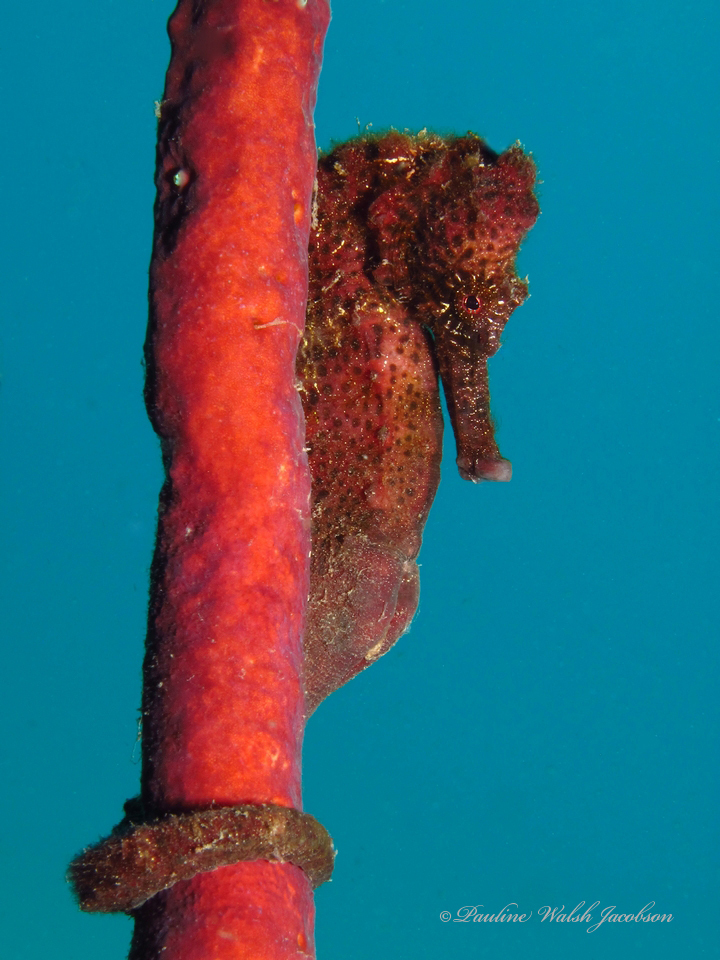
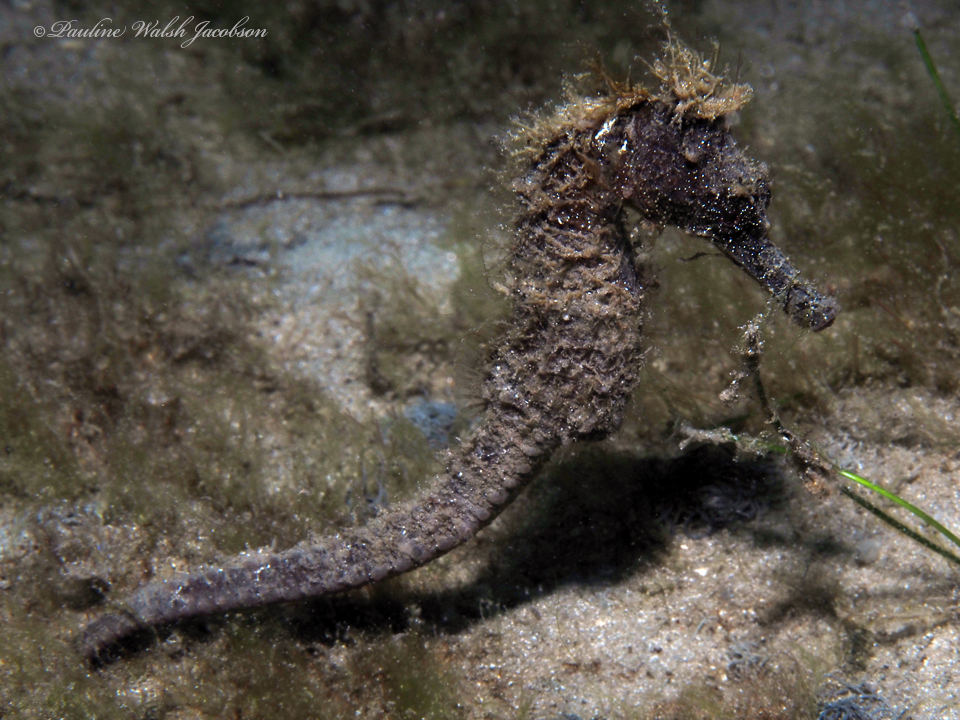


Photos show the species, not always the places on this page.
Length
Up to about 17.5 cm (6.9 in) maximum length; newborns are about 8 mm (0.3 in) tall
Weight
Not given in the sources I read. It is a very light fish, and I did not find a weight range
Next to a person
About the length of an adult hand
What it eats
Zooplankton and small mobile crustaceans such as shrimps and crabs, taken in through its long snout.
Around people
Tiny, look only
How it lives
The longsnout seahorse clings with its prehensile tail to mangrove roots, seagrass, sea rods, sponges and other things that stand up from the seabed. It has no tail fin. As in all seahorses, the male carries the eggs, and one source gives a pregnancy of about two weeks before live young are born. Males are often orange and females yellow, with dark or pale spots.
Where it goes
Seahorses move very little. They hold to one patch of reef, seagrass or mangrove and are usually found at depths from the surface down to about 55 to 65 m (180 to 213 ft), depending on the source.
We only draw a journey on the map when scientists have tracked it or clearly documented it. For this animal we have not found one yet.
Populations
It lives in the western Atlantic from Bermuda to Brazil, including the Caribbean. IUCN lists it as Near Threatened (2017), with an unknown population trend. Main threats named are collection for aquariums and for traditional medicine. It is also listed in CITES Appendix II. I did not find population counts for the Caribbean Netherlands or Saint-Barthélemy.
Meet it respectfully
Look from a calm distance and keep your fins away from the roots, seagrass and sea rods where seahorses hold on. Never touch one, take it off its perch, or move it for a photo. Never try to feed it or lure it. Do not use these animals as souvenirs or buy dried or live seahorses. I did not read local rules for the places listed, so follow your guide.
Fun fact
Tap the bulb to light it up.
The longsnout seahorse has a long snout that makes up about 41 to 49 percent of the length of its head.
The male carries the eggs and gives birth to live young, which are only about 8 mm tall when born.
Males are often orange and females yellow, and both can have brown or white spots.
Longsnout seahorse in the Ocean Atlas
Places we have researched where this animal is recorded. It is never guaranteed, and some places are for watching from the boat only.
Travel with usComing soonTrusted referralExploringOn pause, story onlyEthics pass
Country colour: pink where we travel, blue where we are exploring or refer, grey for story only.
 The Bahamas
 Belize
 Bermuda
 Brazil
 Caribbean Netherlands
 Cayman Islands
 Colombia
 Cuba
 Curaçao
 Dominica
 Grenada
 Guadeloupe
 Haiti
 Honduras
 Jamaica
 Martinique
 Mexico
 Panama
 Puerto Rico
 Saint Barthélemy
 Saint Lucia
 Saint Vincent and the Grenadines
 Suriname
 United States
 US Virgin Islands
Sources for this page
- Smithsonian Tropical Research Institute, Shorefishes of the Greater Caribbean
- Wikipedia, Slender seahorse (summarising IUCN, 2017)
- University of the West Indies, Hippocampus reidi fact sheet
- iNaturalist, Longsnout seahorse
Facts checked 5 October 2026. Photos: Unsplash licence, or Creative Commons as shown on each photo.
Work in ocean travel?
We are always happy to hear from exceptional local operators, accommodation, conservation organisations and destination experts. If your work fits responsible, small-group ocean travel, we would love to learn more.
Partner with Ocean Calling5-day freediving course in Bali
CHF 1,180